SMILE Scheme Implementation Gaps in Rehabilitation of Beggars
Source:The Hindu ↗
Why It Matters
Understanding the gap between policy design and implementation for marginalized groups is critical for UPSC GS2. The SMILE scheme serves as a direct case study on the challenges of rehabilitating the urban and rural poor, highlighting structural bottlenecks in local governance and resource utilization.
Summary
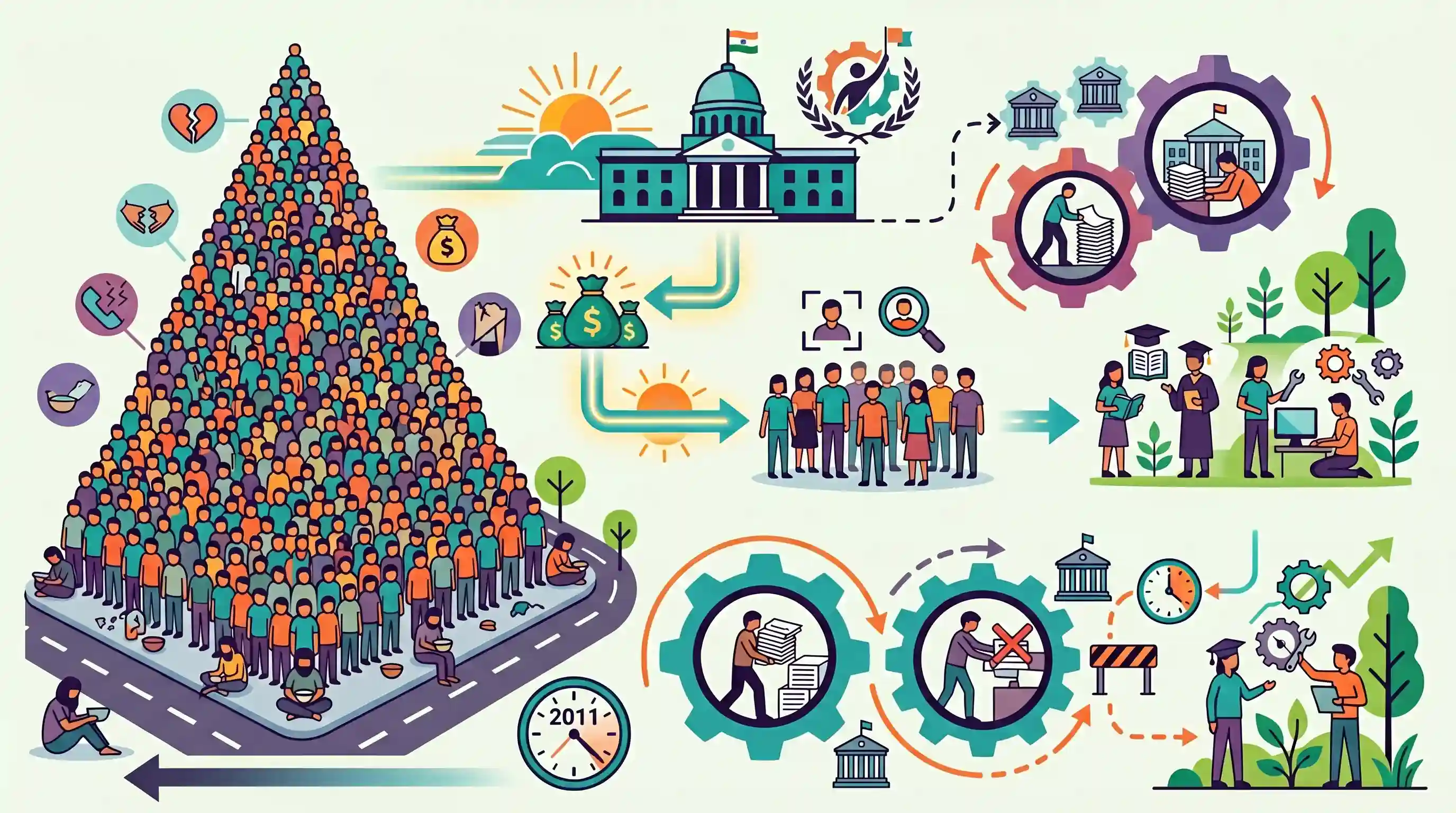
Two years after the launch of the Support for Marginalised Individuals for Livelihood and Enterprise (SMILE) scheme by the Union Social Justice Ministry, fewer than 10,000 people engaged in begging have been identified, and only 970 have been rehabilitated. The scheme, which targets comprehensive rehabilitation including education and skill development, faces a massive scale mismatch given the 2011 Census recorded over 3.72 lakh beggars in India. The slow pace of implementation and fund utilization highlights the ongoing challenges of executing welfare schemes for highly vulnerable sections at the local municipal level.
Key Points
- The SMILE scheme, launched in 2022 to rehabilitate people engaged in begging and empower transgender persons, has successfully rehabilitated only 970 individuals out of 9,958 identified over two years.
- The 2011 Census recorded 3.72 lakh beggars, highlighting a stark contrast between the scheme's current outreach and the actual size of the vulnerable population.
- Implementation involves a two-phase rollout starting with 30 cities of historical and religious significance, subsequently adding 50 more, relying on local government bodies for on-ground execution.
- Despite a budget of ₹100 crore over three years, only ₹14.71 crore had been spent as of December 31, 2024, raising questions about execution bottlenecks and state capacity.
Important Terms
SMILE scheme

A Central Sector Scheme providing comprehensive welfare to transgender persons and individuals engaged in begging, focusing on rehabilitation, medical care, education, and skill development.
UPSC context
GS Paper II (Social Justice/Welfare Schemes); tests understanding of targeted interventions for vulnerable and marginalized sections.
Union Social Justice Ministry
The nodal Union ministry responsible for welfare, social justice, and empowerment of disadvantaged and marginalized sections, including SCs, OBCs, and persons with disabilities.
UPSC context
GS Paper II (Governance); crucial for identifying institutional frameworks responsible for social defense and rehabilitation policies.
urban local bodies
Institutions of local self-government in urban areas, including Municipal Corporations and Municipalities, mandated by the 74th Constitutional Amendment Act for grassroots governance.
UPSC context
GS Paper II (Polity/Local Governance); tests knowledge of the role of local government in executing central welfare schemes.
Census 2011
The 15th Indian Census which provides the official baseline data for beggars (approx. 4.13 lakh), used to measure the scale of social issues.
UPSC context
GS Paper I (Social Issues/Population); tests ability to use demographic data to analyze the efficacy of welfare programs.
Central Sector Scheme
A type of government scheme funded 100% by the Union government and implemented by the central machinery or specific agencies.
UPSC context
GS Paper II (Governance/Welfare Schemes); tests understanding of fiscal federalism and funding patterns in Indian governance.
municipal corporations
The highest form of urban local body for cities with populations over one million, responsible for providing essential services and implementing social welfare projects.
UPSC context
GS Paper II (Polity); relates to the functionality of the 74th Amendment in addressing urban poverty and social issues.
Prelims Trap
"SMILE is a Centrally Sponsored Scheme exclusively meant for rehabilitating people engaged in begging."
It is a Central Sector Scheme (100% Union funded) and covers two distinct vulnerable groups: transgender persons and individuals engaged in begging.
Static Concepts Connected
What is the legal and constitutional status of begging in India?
- No Central Law: India has no central law penalising begging; states historically relied on the Bombay Prevention of Begging Act, 1959 to criminalize the act.
- Judicial Intervention: The Delhi High Court (Harsh Mander case, 2018) decriminalised begging, ruling that punishing poverty and destitution violates Article 21 (Right to Life).
- Constitutional Mandate: Article 41 (DPSP) directs the State to provide public assistance in cases of unemployment, old age, sickness, and "undeserved want."
How does the 74th Amendment connect to vulnerable section welfare?
- 12th Schedule: The 12th Schedule lists 18 functional items for municipalities, explicitly including 'safeguarding the interests of weaker sections of society' and urban poverty alleviation.
- Implementation Bottleneck: Top-down central sector schemes rely on local bodies for execution, but often fail because municipalities chronically lack the 3Fs: Funds, Functions, and Functionaries.
Cross-Topic Patterns
Fund Underutilization & State Capacity
Low expenditure (₹14.7cr of ₹100cr) mirrors broader governance challenges, where scheme failure stems not from budget constraints but weak administrative capacity at municipal levels.
Decriminalization without Rehabilitation
Judicial striking down of anti-beggary laws upholds Article 21, but a lack of effective grassroots rehabilitation creates a socio-legal vacuum for destitute populations.

Expect a Prelims trap on SMILE being a 'Centrally Sponsored' scheme, or a GS-2 question on ULB capacity executing urban poverty schemes.
Linked PYQs · 3
Linked PYQs · 3
- 2019MainsGS2
Performance of welfare schemes that are implemented for vulnerable sections is not so effective due to absence of their awareness and active involvement at all stages of policy process. Discuss.
- 2023MainsGS2
“Development and welfare schemes for the vulnerable, by its nature, are discriminatory in approach.” Do you agree? Give reasons for your answer.
- 2022MainsGS2
Besides the welfare schemes, India needs deft management of inflation and unemployment to serve the poor and the underprivileged sections of the society. Discuss.
