Gas leak at Visakhapatnam pharma unit hospitalises two workers
Source:The Hindu ↗
Why It Matters
Highlights the ongoing challenges of industrial safety and chemical disaster management in manufacturing hubs. Relevant for GS-3 Disaster Management as an example of localized industrial hazards and the need for proactive regulatory oversight.
Summary
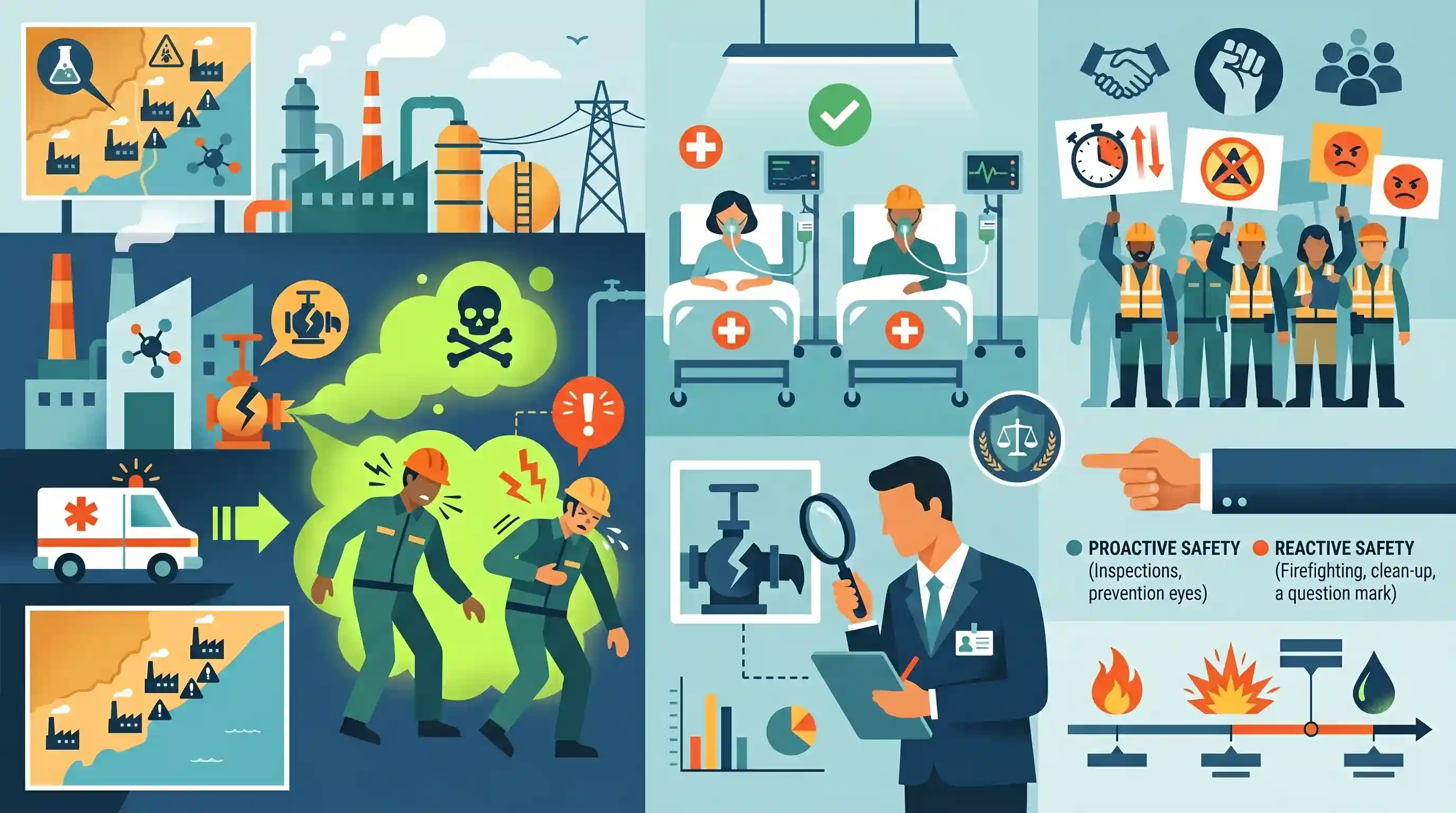
Two workers were hospitalized following a suspected hydrogen sulphide gas leak at a pharmaceutical unit in Jawaharlal Nehru Pharma City (JNPC), Visakhapatnam. The incident, attributed to a pump malfunction, has sparked criticism from workers' unions regarding the government's reactive approach to industrial safety and the frequency of such accidents in the region. The workers are currently stable, and an official investigation is underway.
Key Points
- Two workers from Odisha were hospitalized after inhaling suspected hydrogen sulphide gas at Rakshit Drugs Pvt. Ltd. in Parawada.
- The gas leak was reportedly caused by a pump malfunction during a production process.
- The Deputy Chief Inspector of Factories stated the workers are stable and an investigation into the incident is ongoing.
- The Pharma City Staff and Workers Union criticized the state government for failing to proactively prevent industrial accidents following a recent string of similar incidents.
Important Terms
Hydrogen Sulphide (H2S)

A colorless, highly toxic, and flammable gas with a rotten egg odor. It inhibits cellular respiration, posing a severe occupational hazard in sewers, refineries, and pharmaceutical manufacturing units.
UPSC context
GS Paper 3: Science and Disaster Management. Important for chemical hazard identification and industrial safety protocols.
Jawaharlal Nehru Pharma City (JNPC)
India’s first sector-specific industrial township and Special Economic Zone (SEZ) for pharmaceuticals, located in Visakhapatnam. It provides integrated infrastructure and waste management for bulk drug manufacturing units.
UPSC context
GS Paper 3: Economy and Infrastructure. Highlights the role of industrial clusters and SEZs in India’s manufacturing growth.
NDMA Guidelines for Chemical Disasters
A policy framework by the National Disaster Management Authority emphasizing prevention, preparedness, and response to industrial accidents involving hazardous chemicals, governed by the Disaster Management Act, 2005.
UPSC context
GS Paper 3: Disaster Management. Tests understanding of institutional mechanisms and statutory mandates for managing man-made hazards.
Occupational Safety, Health and Working Conditions (OSH) Code
One of India’s four labor codes that consolidates laws regarding health and safety standards. It regulates the working environment and welfare of laborers across various industrial sectors.
UPSC context
GS Paper 2: Governance. Relates to labor reforms, worker rights, and the government’s regulatory role in industrial safety.
Rakshit Drugs Pvt. Ltd.
A pharmaceutical manufacturing firm in Visakhapatnam specializing in Active Pharmaceutical Ingredients (APIs), frequently cited in industrial safety probes following gas leaks and occupational accidents.
UPSC context
GS Paper 3: Case Study. Exemplifies corporate liability and the implementation of the 'polluter pays' principle in chemical accidents.
Pharma City Staff and Workers Union
A collective bargaining group representing employees at the JNPC. It advocates for worker safety, implementation of hazard protocols, and accountability of management during industrial mishaps.
UPSC context
GS Paper 2: Pressure Groups. Demonstrates the role of unions in influencing safety policy and protecting fundamental labor rights.
Prelims Trap
"The PLI Act, 1991 mandates immediate compensation for factory workers injured in chemical disasters."
The PLI Act provides 'no-fault' compensation specifically to affected third parties (the public) and environment, not to factory workers. Workers are covered under separate legislation like the Workmen's Compensation Act.
Static Concepts Connected
What are the key environmental and physiological characteristics of Hydrogen Sulphide (H2S)?
- Physical traits: It is a colourless, flammable, and highly poisonous gas easily recognized by its characteristic foul odour of rotten eggs.
- Sulphur cycle: It represents the gaseous phase of the sedimentary sulphur cycle and oxidizes in the atmosphere into sulphur dioxide (SO2), contributing to acid rain.
- Health impact: Occupational exposure to high concentrations is rapidly fatal because the gas directly inhibits cellular respiration.
How does Indian law govern corporate liability for industrial chemical disasters?
- Absolute Liability: Established post-Oleum gas leak (MC Mehta case), industries engaged in hazardous activities are absolutely liable for harm without exceptions, an evolution from strict liability.
- NGT Adjudication: The National Green Tribunal (NGT) adjudicates major industrial chemical leaks under the Environment (Protection) Act, 1986.
- PLI Act 1991: Mandates industries handling hazardous substances to maintain insurance for immediate 'no-fault' financial relief to affected third parties.
Cross-Topic Patterns
Pharma hubs + Coastal Vulnerability
Recurrent chemical accidents in Visakhapatnam's coastal industrial zones link industrial safety directly to marine ecology degradation, a theme increasingly tested in GS3 Environment.
OSH Code + Industrial Safety
Recurrent factory accidents highlight the tension between state deregulation for 'Ease of Doing Business' and the implementation of the new Occupational Safety, Health and Working Conditions (OSH) Code.

Expect a prelims statement mixing H2S physical properties (acid rain precursor) with the absolute liability principle.
Linked PYQs · 3
Linked PYQs · 3
- 2020MainsGS3
Discuss the recent measures initiated in disaster management by the Government of India departing from the earlier reactive approach.
- 2019MainsGS3
Disaster preparedness is the first step in any disaster management process. Explain how hazard zonation mapping will help disaster mitigation in the case of landslides.
- 2024PrelimsGS1
According to the Environmental Protection Agency (EPA), which one of the following is the largest source of sulphur dioxide emissions?
