Tropical Storms Trigger Severe Flooding and Landslides in Japan
Source:The Hindu ↗
Why It Matters
Highlights the vulnerability of island nations to compounding natural hazards (cyclones combining with seasonal monsoons) and underscores the importance of robust disaster preparedness, early warning systems, and resilient infrastructure in mitigating the impacts of climate-induced disasters.
Summary
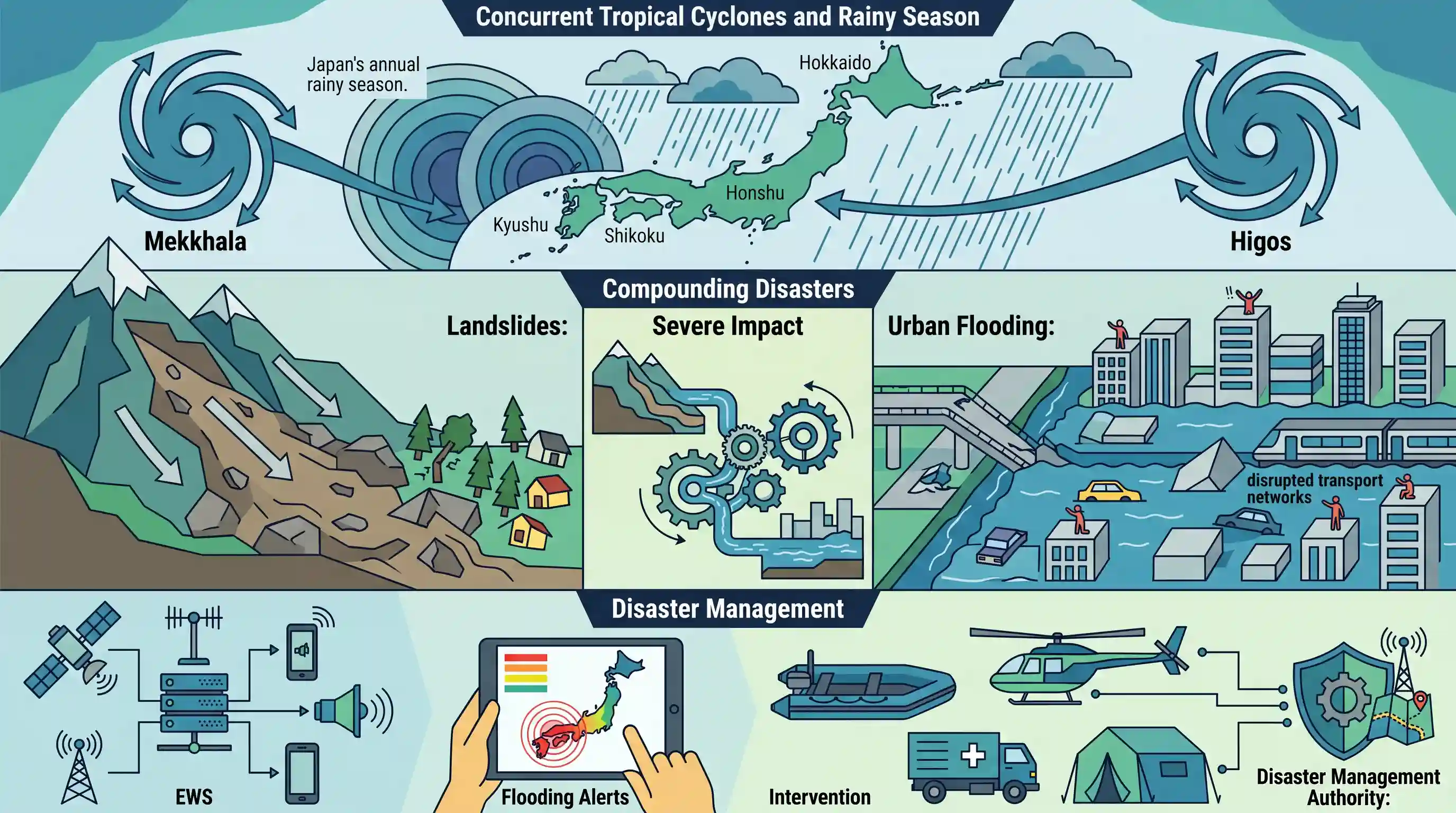
Japan was battered by two concurrent tropical storms, Mekkhala and Higos, which caused severe flooding and landslides across the country. The intense rainfall, coinciding with Japan's annual rainy season, swelled rivers, destroyed homes, and disrupted transport networks across western regions. The events prompted widespread flooding alerts and intervention by disaster management authorities, highlighting the compounding impact of seasonal weather and severe storm systems.
Key Points
- Two tropical storms, Mekkhala and Higos, struck Japan during its annual rainy season, bringing torrential rainfall.
- The storms triggered severe flooding and landslides, resulting in casualties and the destruction of homes, notably in Yamaguchi Prefecture.
- Major rivers like the Kamo River swelled, prompting authorities to issue flooding alerts across Kyoto, Osaka, and other western regions.
- The heavy rain disrupted transportation networks, halting train operations and flights in the affected areas.
Important Terms
Fire and Disaster Management Agency (FDMA)

An external bureau of Japan's Ministry of Internal Affairs and Communications responsible for national disaster response, firefighting oversight, and rescue coordination.
UPSC context
GS III (Disaster Management): Relevant for comparative studies on institutional disaster frameworks and community-level resilience strategies.
Fujiwhara Effect
A meteorological phenomenon where two nearby tropical cyclones interact, causing them to orbit a common center, diverge, or merge into one storm.
UPSC context
GS I (Geography): Tests understanding of cyclone dynamics, atmospheric pressure interactions, and complexities in predicting storm pathways.
Japan Meteorological Agency (JMA)
Japan's primary government agency for weather forecasting, earthquake/tsunami monitoring, and issuing official disaster warnings to the public.
UPSC context
GS III (Disaster Management): Illustrates the importance of specialized scientific bodies in multi-hazard early warning systems (EWS).
J-Alert
Japan's satellite-based nationwide emergency warning system that instantly transmits disaster alerts to local authorities and citizens via radio and loudspeakers.
UPSC context
GS III (Science and Technology): A global benchmark for ICT-based disaster preparedness and rapid emergency communication networks.
Kyodo News Agency
A leading nonprofit cooperative news organization in Japan that provides comprehensive news coverage to domestic and international media outlets.
UPSC context
Prelims (General Awareness): Frequently appears in questions regarding major international news agencies and global media organizations.
Prelims Trap
"The Fujiwhara effect always leads to the merging of two cyclones into a super-cyclone."
The Fujiwhara effect primarily causes two nearby cyclones to orbit a common center. While they can merge, they often simply deflect each other's tracks or one dissipates.
Static Concepts Connected
What is the Fujiwhara Effect in tropical cyclones?
- Definition: An interaction where two cyclonic vortices (usually within 1,400 km of each other) begin to orbit around a common center of mass.
- Outcomes: It can result in track deflection, mutual absorption (merging into one storm), or one storm dominating and dissipating the other.
- Forecasting Challenge: This binary interaction severely complicates meteorological modeling, making the exact track and intensity of the storms difficult to predict.
How are tropical cyclones named in the western North Pacific?
- ESCAP/WMO Committee: Names are drawn from a sequential list contributed by 14 member nations of the ESCAP/WMO Typhoon Committee (including Thailand, USA, Japan, etc.).
- RSMC Tokyo: The Regional Specialized Meteorological Centre (RSMC) Tokyo is responsible for assigning these names once a system reaches tropical storm strength.
- Sequential Usage: Unlike the Atlantic basin which resets annually and uses alphabetical order, this basin uses the contributed names sequentially and continuously.
Cross-Topic Patterns
Compounding climate extremes
The intersection of sequential tropical cyclones with stationary seasonal systems demonstrates how anomalous sea surface temperatures create compounding multi-hazard events, a rising theme in Disaster Management.
Pore water pressure and slope failure
The linkage between extreme rainfall and slope failure via increased pore water pressure is frequently tested in Geography Mains alongside India's own Himalayan and Western Ghats vulnerabilities.

Expect a Prelims question pairing the 'Fujiwhara Effect' with the specific ESCAP/WMO cyclone naming conventions across different ocean basins.
Linked PYQs · 4
Linked PYQs · 4
- 2024MainsGS1
What is sea surface temperature rise? How does it affect the formation of tropical cyclones?
- 2021MainsGS3
Describe the various causes and the effects of landslides. Mention the important components of the National Landslide Risk Management Strategy.
- 2024MainsGS3
Flooding in urban areas is an emerging climate-induced disaster. Discuss the causes of this disaster. Mention the features of two such major floods in the last two decades in India. Describe the policies and frameworks in India that aim at tackling such floods.
- 2019MainsGS3
Disaster preparedness is the first step in any disaster management process. Explain how hazard zonation mapping will help disaster mitigation in the case of landslides.
