NMCG signs agreements for new sewage plants in UP
Source:theprint ↗
Why It Matters
The article details key infrastructure development for river conservation in Uttar Pradesh under the NMCG. It touches on geographical aspects (Varuna River meeting the Ganga) and economic models (Hybrid Annuity Model PPP), which are highly relevant for UPPSC Prelims questions on state-specific environment and infrastructure initiatives.
Summary
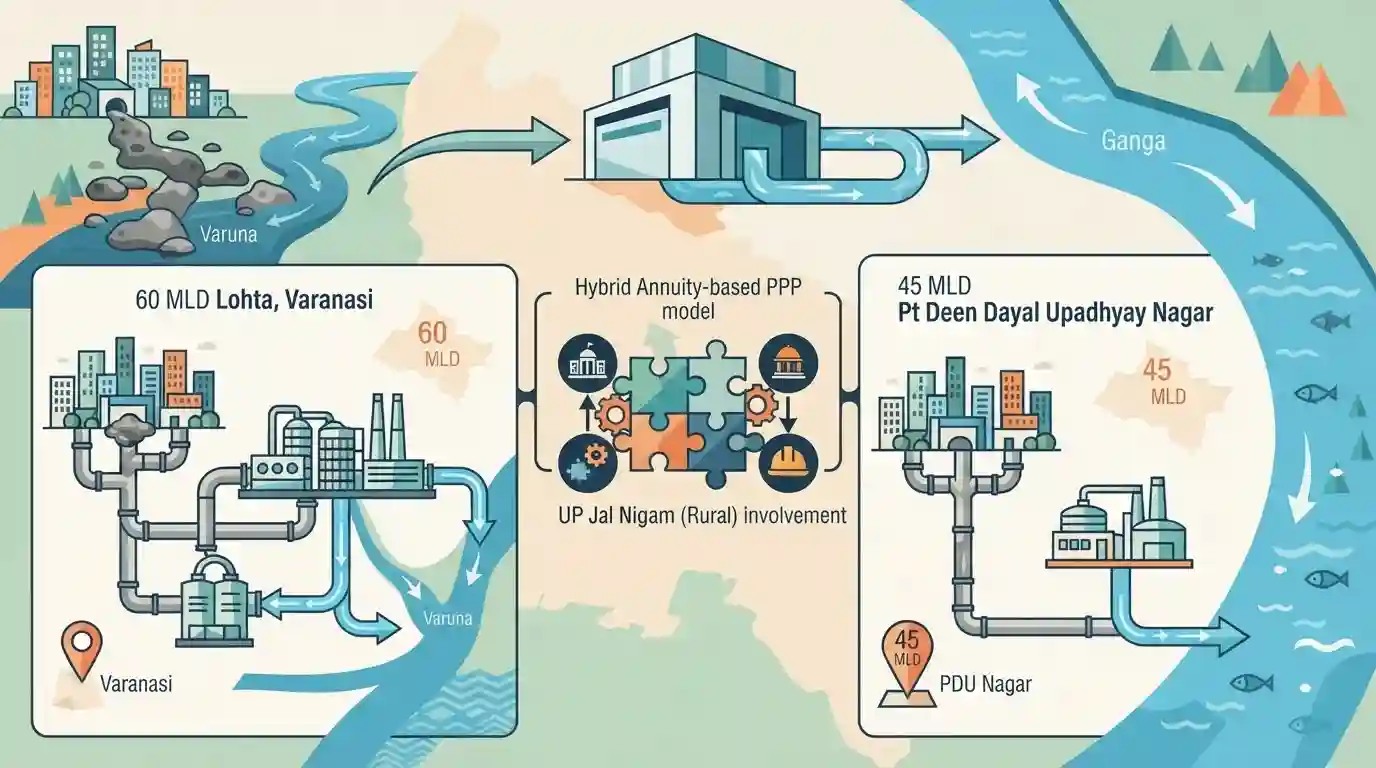
The National Mission for Clean Ganga (NMCG) has signed concession agreements for two new Sewage Treatment Plants (STPs) in Uttar Pradesh to enhance wastewater management. A 60 MLD plant in Lohta, Varanasi, will intercept sewage currently entering the Varuna River, a tributary of the Ganga. Another 45 MLD plant will be established in Pt Deen Dayal Upadhyay Nagar. Executed under the Hybrid Annuity-based PPP model by UP Jal Nigam (Rural), these projects aim to reduce pollution and advance the 'Nirmal Ganga' mission.
Key Points
- The National Mission for Clean Ganga (NMCG) has signed agreements for two new Sewage Treatment Plant (STP) projects in Uttar Pradesh.
- The projects include a 60 MLD STP at Lohta in Varanasi and a 45 MLD STP at Pt Deen Dayal Upadhyay Nagar.
- The Lohta project will treat sewage flowing into the Varuna River (a tributary that joins the Ganga near Adi Keshav Ghat) via the Durga Drain.
- Both projects are being executed under the Hybrid Annuity-based Public-Private Partnership (PPP) model.
- The initiatives are part of efforts to achieve the 'Nirmal Ganga' objective by reducing pollution loads and rejuvenating river ecosystems.
Important Terms
Nirmal Ganga

The pollution abatement component of the Namami Gange Programme, focused on treating municipal sewage, tackling industrial effluents, and establishing solid and liquid waste management infrastructure to prevent river pollution.
UPSC context
Vital for GS Paper 3 (Environment) and GS Paper 5 (UP Special), evaluating knowledge of river conservation frameworks.
Hybrid Annuity Model (HAM)
A public-private partnership model where the government funds 40% of project costs during construction, while the private developer finances 60%, later recovered through performance-linked, periodic government annuity payments.
UPSC context
Core concept in GS Paper 3 (Economy/Investment Models) and GS Paper 5, testing knowledge of sustainable infrastructure financing.
National Mission for Clean Ganga (NMCG)
The operational arm of the National Ganga Council, responsible for implementing the Namami Gange Programme by funding and executing river rejuvenation, pollution abatement, and ecological restoration projects across the basin.
UPSC context
Essential for GS Paper 3 (Environment), testing institutional mechanisms governing water resource management and river conservation.
Uttar Pradesh Jal Nigam (Rural)
A specialized state agency managing rural water supply and sanitation infrastructure in Uttar Pradesh, executing key initiatives like the Jal Jeevan Mission and establishing sewage treatment plants for river conservation.
UPSC context
Highly relevant for GS Paper 5 (UP Specific Awareness), assessing candidates' understanding of state-level developmental and infrastructure agencies.
Prelims Trap
"The Varuna river originates in Varanasi and is managed by NMCG, a statutory body."
The Varuna originates in Prayagraj (Phulpur), not Varanasi. Additionally, NMCG is a registered society under the Societies Registration Act, 1860, not a statutory body.
Static Concepts Connected
What is the geographical course and significance of the Varuna River in UP?
- Origin: Originates in Phulpur, Prayagraj district, flowing eastwards before entering Varanasi.
- Confluence: Merges into the Ganga River near Sarai Mohana and Adi Keshav Ghat in Varanasi district.
- Cultural Significance: Together with the Assi River, it gives Varanasi its name, serving as the city's traditional northern boundary.
How does the Hybrid Annuity Model (HAM) function in public-private partnerships?
- Payment Structure: The government pays 40% of the project cost upfront during construction; the remaining 60% is paid as an annuity over the concession period.
- Risk Allocation: The government assumes the revenue/collection risk, while the private developer bears the construction and maintenance risks.
Cross-Topic Patterns
HAM expanding beyond highways
Historically used for road networks, UP is increasingly adopting the Hybrid Annuity Model (HAM) for civic infrastructure like STPs to distribute financial risk and ensure long-term maintenance.
Reviving minor tributaries for Ganga
The Nirmal Ganga mission highlights that cleaning the main stem requires intercepting sewage in smaller tributaries like the Varuna and Assi, linking urban waste management directly to riverine ecology.

Expect a multi-statement question on UP's local tributaries (like Varuna) covering their origins and confluence points with the Ganga.
Linked PYQs · 1
Linked PYQs · 1
- 2022UPPSC_PRELIMSGS1
The main purpose of 'Ganga Action Plan' project, launched in 1985, was
