Murshidabad Minority Issues: MPs Discuss Electoral Rolls and Prayers
Source:The Hindu ↗
কেন এটি গুরুত্বপূর্ণ
The incident brings to focus constitutional guarantees regarding the freedom of religion (Article 25) and the administrative mechanisms of the Election Commission (electoral roll revisions), which are critical components of democratic governance and fundamental rights.
সারসংক্ষেপ
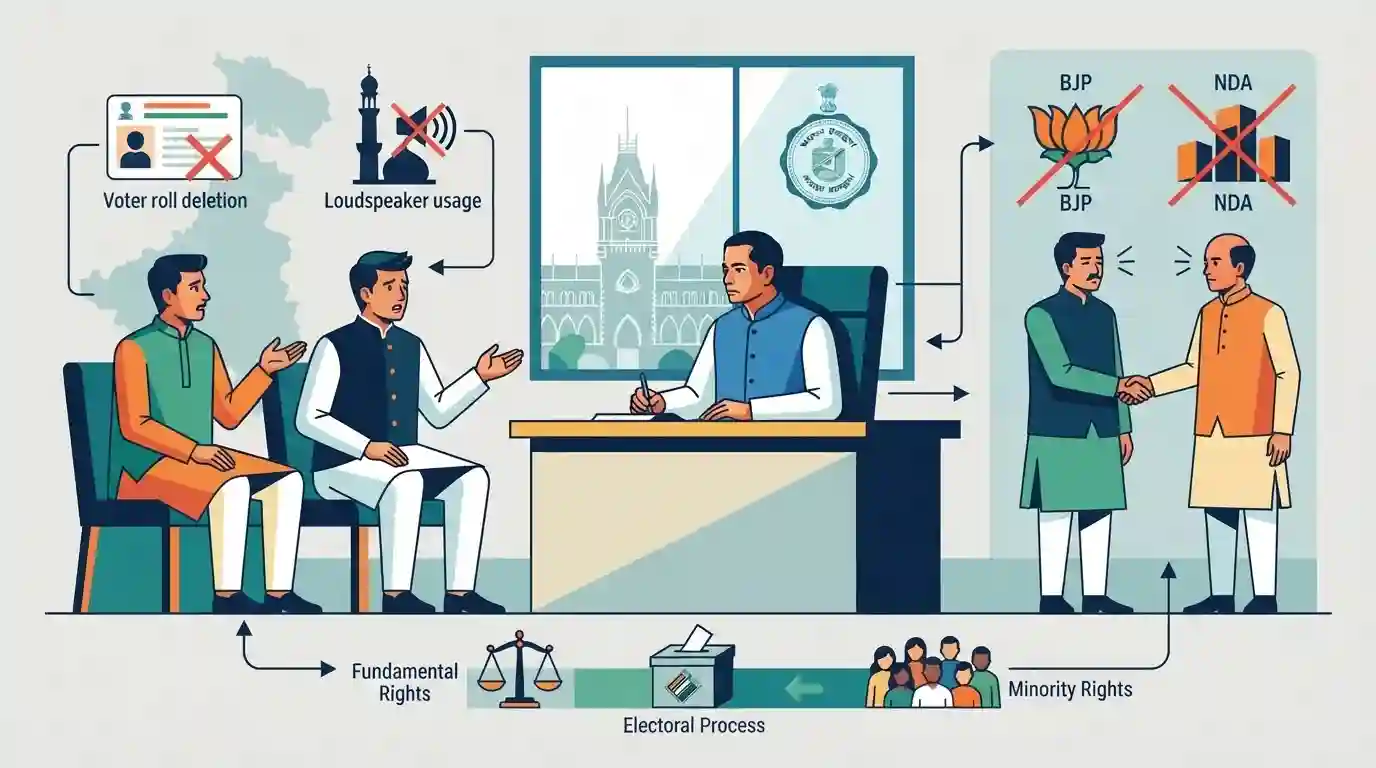
Two Members of Parliament from Murshidabad representing the Nationalist Citizens Party of India (NCPI) met West Bengal Chief Minister Suvendu Adhikari to raise concerns over the alleged targeting of the Muslim community. The MPs flagged issues including the deletion of Muslim voters during the Special Intensive Revision (SIR) of electoral rolls and the imposition of restrictions on loudspeaker usage in mosques. While pressing for administrative redressal, they explicitly dismissed speculations about aligning with the BJP or the NDA.
মূল বিষয়
- Two MPs belonging to the Nationalist Citizens Party of India (NCPI) met West Bengal Chief Minister Suvendu Adhikari at Nabanna to discuss administrative issues concerning the minority community.
- The MPs alleged that Muslims are being specifically targeted, with their names deleted during the Election Commission’s Special Intensive Revision (SIR) of electoral rolls.
- They also raised objections against the administration's restrictions on the use of loudspeakers during Azan at mosques in Murshidabad.
- Both MPs clarified that their meeting was strictly for administrative grievance redressal and ruled out joining the BJP or NDA.
গুরুত্বপূর্ণ শব্দ
Special Intensive Revision (SIR)

A large-scale electoral roll purification exercise conducted by the Election Commission of India involving house-to-house enumeration to eliminate deceased, duplicate, migrated, or non-citizen voters while updating eligible voters.
UPSC context
GS Paper II: Electoral Reforms. Tests understanding of election management, Article 324, and Representation of the People Act 1950.
Nationalist Citizens Party of India (NCPI)
A regional political party in eastern India that gained national prominence in 2026 following the merger of twenty rebel All India Trinamool Congress MPs, becoming a key political entity in West Bengal.
UPSC context
GS Paper II: Polity and Representation. Tests understanding of regional political parties, coalition dynamics, and the Tenth Schedule.
Election Commission of India
An autonomous constitutional authority responsible for administering Union and State election processes in India, including the preparation of electoral rolls under Article 324 of the Constitution.
UPSC context
GS Paper II: Constitutional Bodies. Tests understanding of powers, functions, and constitutional mandate of the ECI.
Trinamool Congress (TMC)
A major regional political party active primarily in West Bengal, which served as the ruling party in the state for three terms before losing power in the 2026 assembly elections.
UPSC context
GS Paper II: Federalism and Party System. Tests knowledge of regional political dynamics and state election outcomes.
Bharatiya Janata Party (BJP)
One of India's major national political parties, which formed its first-ever government in West Bengal under Chief Minister Suvendu Adhikari following its electoral victory in 2026.
UPSC context
GS Paper II: Indian Polity. Tests understanding of party ideologies, national political shifts, and state executive dynamics.
National Democratic Alliance (NDA)
A centre-right coalition of political parties in India, led by the Bharatiya Janata Party, which forms the government at the Centre and across various states.
UPSC context
GS Paper II: Coalition Politics. Tests concepts of multi-party alliances, federal governance, and legislative stability.
প্রিলিমস ফাঁদ
The use of loudspeakers for religious purposes is protected as an Essential Religious Practice under Article 25.
The Supreme Court (e.g., in Church of God case) held that no religion prescribes that prayers must be performed via amplifiers. Hence, it is not an essential practice and can be restricted.
সংযুক্ত স্থির ধারণা
Is the Right to Vote a Fundamental, Constitutional, or Statutory Right?
- Constitutional basis: Article 326 of the Constitution establishes adult suffrage, classifying the right to vote primarily as a Constitutional Right.
- Judicial stance: The Supreme Court has repeatedly affirmed that while it is a vital constitutional right, it is not a Fundamental Right and can be regulated by law.
- Statutory regulation: The exercise of this right is practically governed and restricted by the Representation of the People Act, 1951 (e.g., excluding prisoners).
What is the Essential Religious Practices Test and how does it apply to noise?
- Doctrine origin: Originating in the Shirur Mutt case (1954), it determines which practices are key to a religion and thus immune from state interference under Article 25.
- Article 21 supremacy: The SC ruled that freedom from noise pollution is a facet of the Right to Life (Article 21), which cannot be defeated by religious claims.
- Reasonable restrictions: Article 25 is explicitly subject to 'public order, morality, and health', allowing the state to regulate decibel limits and timing.
আন্তঃবিষয় প্যাটার্ন
Article 21 vs. Article 25 conflict
Examines how the Right to Life (specifically environmental rights like freedom from noise pollution under Article 21) overrides collective religious claims under Article 25.
Electoral integrity and minority representation
Links demographic change, federal machinery, and the Election Commission's Special Intensive Revision (SIR) procedures to issues of minority voter disenfranchisement and representation.

SC rulings on Article 21 (noise-free environment) overriding Article 25 claims are prime fodder for multi-statement Polity questions.
সংযুক্ত PYQ · 4
সংযুক্ত PYQ · 4
- 2019WBCS_PRELIMSGS1
Right to vote and to be elected in India is a
- 2021WBCS_PRELIMSGS1
Article 21 of the Indian Constitution ensues
- 2014WBCS_PRELIMSGS1
The Election Commission of India celebrates the National Voters Day on
- 2021WBCS_PRELIMSGS1
Under which amendment of the Indian Constitution the voting age reduced to 18 from 21?
