Security forces eliminate Maoists in Odisha anti-insurgency operation
Source:The Hindu ↗
Why It Matters
Left Wing Extremism (LWE) is a persistent internal security threat. This event showcases the tactical coordination between Central Armed Police Forces (CRPF) and state specialised units (SOG) in counter-insurgency operations, and reflects the government's targeted deadline to eliminate Naxalism by 2026—a recurrent theme in UPSC GS3.
Summary
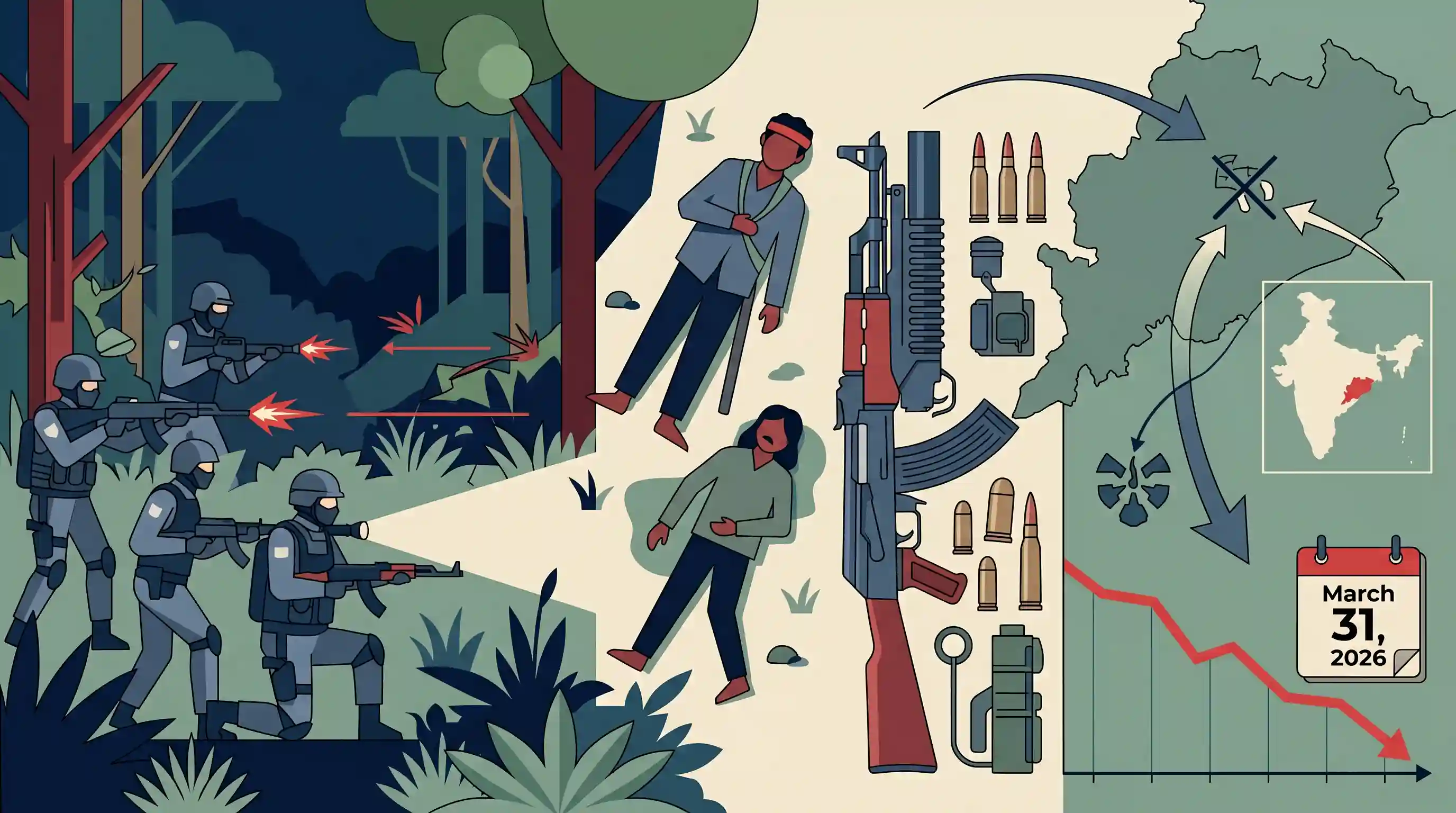
Two Left Wing Extremists (Maoists) were killed in a joint encounter involving the Special Operations Group, CRPF, and District Voluntary Force in Odisha's Kandhamal district. The security forces seized an AK-47 rifle equipped with a UBGL and other heavy ammunition. This successful operation reinforces the ongoing coordinated crackdown on insurgents, aligning with the broader national and state objective to completely eradicate Naxalism by March 31, 2026.
Key Points
- Two armed Maoist cadres were killed in an exchange of fire with joint security forces in the Nandabali Protected Reserve Forest of Kandhamal district.
- The joint anti-Maoist operation involved teams from the state's Special Operations Group (SOG), the District Voluntary Force, and the central CRPF.
- Large quantities of arms and ammunition, including an AK-47 rifle fitted with an Under Barrel Grenade Launcher (UBGL), were recovered.
- Odisha Police reaffirmed their commitment to the national objective of completely eliminating Naxalism by March 31, 2026.
Important Terms
Left Wing Extremism (LWE)

An armed insurgency, also known as Naxalism, driven by Maoist ideology that seeks to overthrow the state through guerrilla warfare and mass mobilization.
UPSC context
GS Paper III: Internal Security; essential for topics on development linkages and non-state actor threats.
Special Operations Group (SOG)
An elite anti-insurgency tactical unit of the Odisha Police specialized in jungle warfare, high-risk operations, and neutralizing Maoist threats in remote terrains.
UPSC context
GS Paper III: Security Forces and Agencies; tests knowledge of state-specific specialized units.
District Voluntary Force (DVF)
A specialized district-level constabulary of the Odisha Police that leverages local personnel, intelligence, and terrain knowledge for grassroots anti-Maoist operations.
UPSC context
GS Paper III: Internal Security; relevant for community-based policing and counter-insurgency strategies.
Central Reserve Police Force (CRPF)
India's largest Central Armed Police Force under the Ministry of Home Affairs, acting as the lead agency for internal security and counter-insurgency.
UPSC context
GS Paper III: Security Forces and their Mandate; fundamental to internal security questions.
Under Barrel Grenade Launcher (UBGL)
A weapon attachment that fires grenades; its recovery from insurgents signifies a high level of military sophistication and a threat to security personnel.
UPSC context
GS Paper III: Challenges to Internal Security; indicates the technical evolution of insurgent groups.
March 31, 2026 Deadline
The strategic policy target set by the Union Home Minister to completely eradicate Naxalism from India through multi-pronged security and development measures.
UPSC context
GS Paper III: Internal Security Policy; tests awareness of current government targets and strategies.
Prelims Trap
"The CRPF has primary jurisdiction and operational command over counter-insurgency operations in LWE-affected states."
Public order and police are strictly State subjects. CAPFs like CRPF do not have independent jurisdiction; they are deployed to 'aid and assist' state civil authorities.
Static Concepts Connected
What is the constitutional framework for deploying central forces in states?
- State Subject: 'Public Order' and 'Police' are enumerated under the State List (Schedule VII). Consequently, states hold the primary responsibility for internal security.
- Article 355 mandates: The Union deploys Central Armed Police Forces (CAPFs) under Article 355 to protect states against internal disturbance, functioning strictly in aid of civil power.
What are the key non-kinetic Central initiatives to combat Left Wing Extremism?
- SRE Scheme: The Security Related Expenditure (SRE) scheme reimburses state governments for operational costs, training, and ex-gratia payments to victims of LWE violence.
- Special Central Assistance: Provides flexible, untied funds to LWE-affected districts to bridge critical infrastructure gaps and public utility deficits quickly.
- Connectivity Plans: The Road Requirement Plan (RRP) systematically builds all-weather roads in remote LWE territories to facilitate security mobility and local economic access.
Cross-Topic Patterns
LWE mapping & Schedule V areas
LWE strongholds heavily overlap with Schedule V areas. Development and governance schemes (PESA, Forest Rights Act) act as critical non-kinetic tools to counter insurgent recruitment.
State-led counter-insurgency forces
Odisha's SOG/DVF mirrors Andhra's Greyhounds. UPSC themes often contrast the effectiveness of state-raised, locally-recruited jungle-warfare units against centralized CAPF deployment.

LWE elimination targets (March 2026) make CAPF vs State Police mandates and SAMADHAN doctrine funding highly probable for 2026 Prelims.
Linked PYQs · 3
Linked PYQs · 3
- 2025MainsGS3
The Government of India recently stated that Left Wing Extremism (LWE) will be eliminated by 2026. What do you understand by LWE and how are the people affected by it? What measures have been taken by the government to eliminate LWE?
- 2022MainsGS3
Naxalism is a social, economic and developmental issue manifesting as a violent internal security threat. In this context, discuss the emerging issues and suggest a multilayered strategy to tackle the menace of Naxalism.
- 2018MainsGS3
Left Wing Extremism (LWE) is showing a downward trend, but still affects many parts of the country. Briefly explain the Government of India's approach to counter the challenges posed by LWE.
