Ranthambore Tiger Reserve Fringe Area Leopard Rescue Operation
Source:telangana-today ↗
Why It Matters
Ranthambore Tiger Reserve is one of the most prominent wildlife sanctuaries in Rajasthan. Rising incidences of big cat sightings near human settlements highlight the pressing challenges of human-wildlife conflict, habitat encroachment, and the necessity for robust wildlife rescue strategies in the state.
Summary
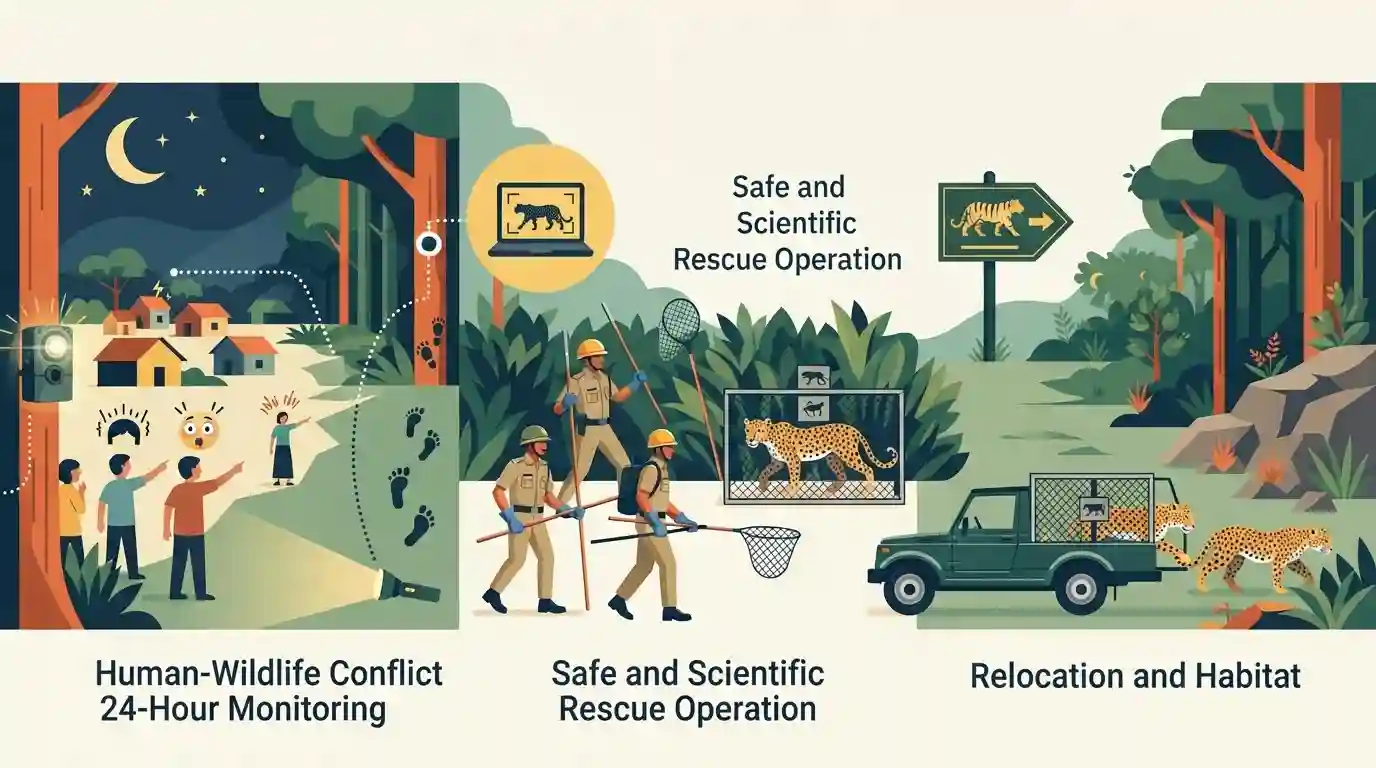
The Rajasthan forest department successfully rescued two leopards near the Phalodi Todra area, located on the fringes of the Ranthambore Tiger Reserve in Sawai Madhopur district. After repeated sightings caused panic among local residents, forest officials employed 24-hour monitoring with camera traps and field tracking to execute a safe and scientific rescue operation without any untoward incidents.
Key Points
- Two leopards were safely rescued by the Rajasthan forest department near the Ranthambore Tiger Reserve in Sawai Madhopur district.
- The rescue operation took place in the Phalodi Todra area after repeated sightings of the big cats triggered panic among local residents.
- Forest officials employed scientific methods, including 24-hour monitoring, camera traps, and field tracking to successfully capture the animals without incident.
Important Terms
Ranthambore Tiger Reserve

A major national park and tiger reserve in Rajasthan's Sawai Madhopur district, located at the junction of the Aravalli and Vindhya ranges. Known for Bengal tigers, it features dry deciduous forests and the historic Ranthambore Fort.
UPSC context
Important for GS-3 (Environment) regarding tiger conservation (Project Tiger), habitat connectivity, and mitigating human-wildlife conflict in arid landscapes.
Human-Wildlife Conflict
Any interaction between humans and wildlife that negatively impacts human livelihoods, property, or safety, as well as wildlife populations. It is primarily driven by habitat loss, fragmentation, and rapid land-use changes.
UPSC context
Highly relevant for GS-3 (Environment) covering conservation challenges, sustainable development, and socio-ecological mitigation strategies.
Camera Trap
A remotely activated, non-invasive digital camera equipped with motion or infrared sensors. It automatically captures images or videos of wild animals, aiding researchers in population estimation, anti-poaching efforts, and behavioral monitoring.
UPSC context
Crucial for GS-3 (Science & Tech / Environment) relating to the application of modern technologies in wildlife conservation and biodiversity monitoring.
Rajasthan Forest Department
The state government body responsible for managing and protecting Rajasthan’s forest resources and wildlife. It enforces conservation laws, maintains protected areas like Ranthambore, and executes safe wildlife rescue operations.
UPSC context
Pertains to GS-2 (Governance) and GS-3 (Environment) regarding the role of state agencies in executing national environmental policies and wildlife protection.
Prelims Trap
"Ranthambore Tiger Reserve lies exclusively within the Aravalli hill ranges."
Ranthambore is actually situated at the unique confluence of the Aravalli and Vindhya hill ranges, making its topography a blend of both systems.
Static Concepts Connected
What geographical and ecological features uniquely define Ranthambore Tiger Reserve?
- Hill Ranges: Located at the unique geographical junction of the Aravalli and Vindhya hill ranges.
- River Boundaries: Bounded by the Banas River in the north and the Chambal River in the south.
- Forest Vegetation: Predominantly tropical dry deciduous, with 'Dhak' (Flame of the Forest) being the dominant, highly drought-resistant tree species.
What are the designated Tiger Reserves of Rajasthan?
- Established Reserves: Ranthambore, Sariska, Mukundra Hills, and Ramgarh Vishdhari form the older designated reserves in the state.
- Dholpur-Karauli TR: Approved by the NTCA as Rajasthan's 5th tiger reserve, acting as a crucial spill-over habitat for Ranthambore.
Cross-Topic Patterns
Spillover populations & carrying capacity
Leopard and tiger rescues near Ranthambore highlight the GS-3 theme of carrying capacity. Habitat fragmentation forces spillover populations into human-dominated fringe areas, escalating human-wildlife conflict.
Riverine ecosystems and Protected Areas
The Chambal River links Ranthambore, Mukundra Hills, and the National Chambal Sanctuary. UPSC frequently tests the overlap of protected areas with major river basins and distinct topography.

Mapping question matching Ranthambore to rivers (Banas, Chambal) or hill ranges (Aravalli-Vindhya confluence) is highly probable in 2026.
Linked PYQs · 3
Linked PYQs · 3
- 2023RPSC_PRELIMSGS1
The National Tiger Conservation Authority has conferred the status of the fifth tiger sanctuary in Rajasthan, to which of the following sanctuaries?
- 2023RPSC_PRELIMSGS1
Which of the following pairings is incorrect? Wildlife Sanctuary – District
- 2025RPSC_PRELIMSGS1
Choose the incorrect statement with respect to the Rajasthan Forestry and Biodiversity Project (Phase-2).
