Ethnic conflict dynamics and internal security challenges in Manipur
Source:The Hindu ↗
Why It Matters
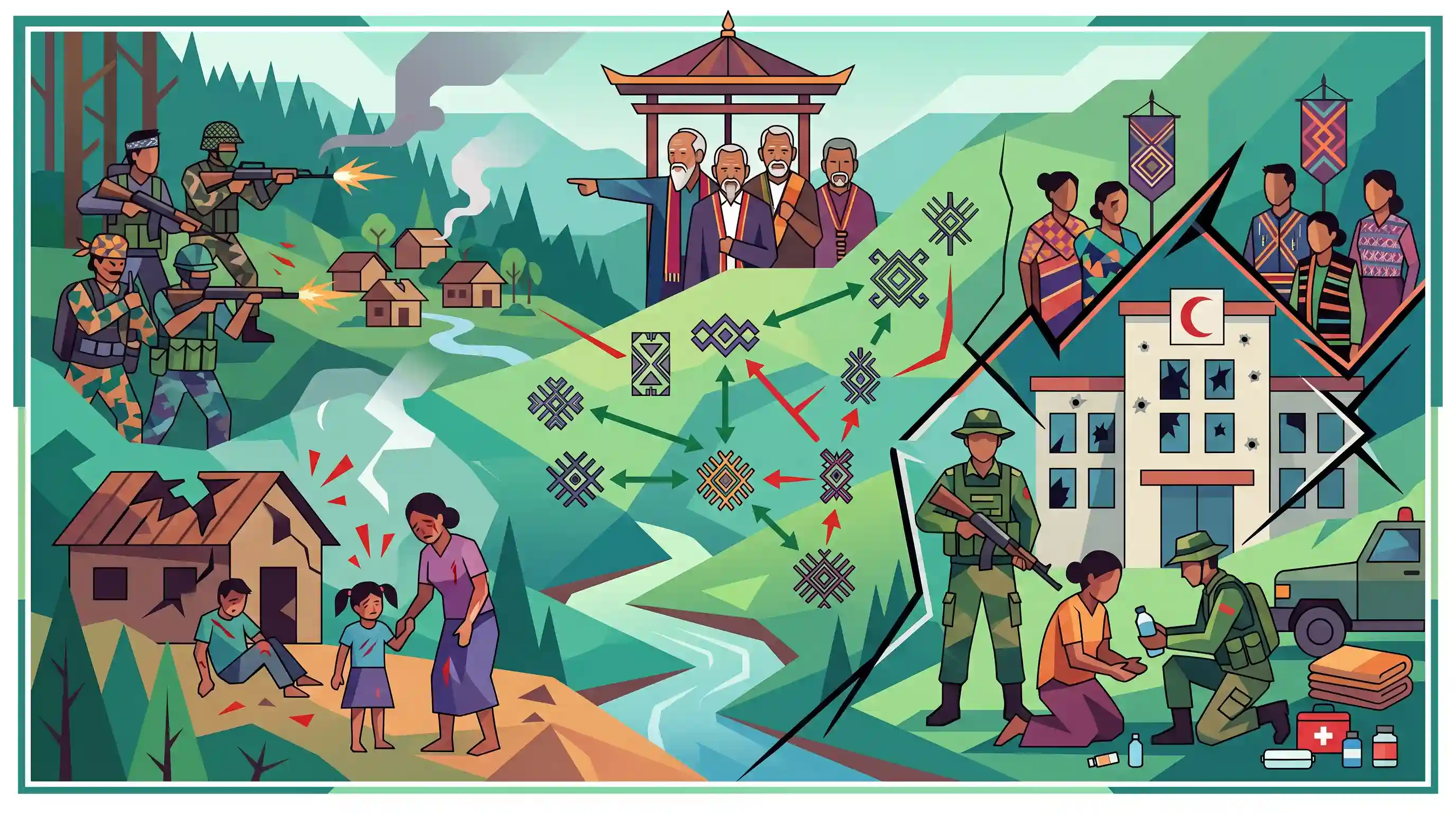
The incident illustrates how protracted ethnic unrest drags in multiple non-state armed actors (Naga and Kuki groups), creating complex internal security challenges. It also demonstrates how public infrastructure (like hospitals) becomes securitized and polarized, and showcases the vital civic-humanitarian role played by security forces like the Assam Rifles in conflict areas.
Summary
A firing incident by armed groups in Manipur's Kangpokpi district injured two civilians, including an 8-year-old girl. Kuki Inpi Manipur (KIM) has accused the NSCN(IM) and ZUF (Kamson) of executing the attack. The incident highlights the complex multi-ethnic dimensions of Northeast insurgency, the dual security-humanitarian role of the Assam Rifles, and the deep polarization affecting public infrastructure like hospitals in conflict zones.
Key Points
- An 8-year-old girl and a 56-year-old woman were injured in a firing incident by armed groups at Thingkhongjang village in Manipur's Kangpokpi district, showcasing the persistent high risk to unarmed civilians in the region.
- The Kuki Inpi Manipur (KIM), the apex body of the Kuki tribe, alleged that the National Socialist Council of Nagaland (Isak-Muivah) [NSCN (IM)] and the Zeliangrong United Front [ZUF (Kamson)] were behind the attack, revealing a complex web of multi-ethnic armed groups active beyond just the Kuki-Meitei divide.
- The Assam Rifles played a crucial first-responder and civic role by administering emergency first aid at their camp to the injured before they were transferred to the Regional Institute of Medical Sciences (RIMS) in Imphal.
- Deep polarization has turned public facilities like RIMS into flashpoints, as shown by heightened security on campus and a past incident in June where protesters attempted to storm the hospital over the treatment of injured Kuki youths.
- Civil society statements emphasize that the state and Central governments' prolonged failure to secure civilian lives gravely erodes public confidence in democratic state institutions and the rule of law.
Important Terms
Assam Rifles

India's oldest paramilitary force (established 1835), responsible for border security along the Indo-Myanmar border and counter-insurgency in Northeast India under dual control of the Home and Defence ministries.
UPSC context
GS Paper III (Internal Security); tests understanding of border management and the role of security forces in the Northeast.
NSCN (IM)
The Isak-Muivah faction of the National Socialist Council of Nagaland; a major insurgent group seeking a unified Naga homeland ("Nagalim") and engaged in ceasefire negotiations with New Delhi.
UPSC context
GS Paper III (Internal Security); tests understanding of regional insurgency, peace negotiations, and ethnic challenges to territorial integrity.
Kuki Inpi Manipur (KIM)
The apex civil society organization representing the Kuki tribes in Manipur, advocating for tribal rights, community security, and political justice during regional ethnic conflicts.
UPSC context
GS Paper III (Internal Security); tests knowledge of ethnic conflicts, tribal administration, and civil society's role in resolution.
Zeliangrong United Front (ZUF)
A militant group representing the Zeliangrong Naga community in Assam, Manipur, and Nagaland, advocating for a secure, unified homeland under the framework of the Indian Constitution.
UPSC context
GS Paper III (Internal Security); tests awareness of minor tribal insurgent groups, factional dynamics, and regional autonomy movements.
Regional Institute of Medical Sciences (RIMS)
An autonomous public medical institute and teaching hospital established in 1972 in Imphal, Manipur, catering to the tertiary healthcare and medical education needs of Northeast India.
UPSC context
GS Paper II (Social Justice/Health); tests knowledge of healthcare infrastructure and human resource development in remote border regions.
Prelims Trap
The Assam Rifles operates under the administrative control of the Ministry of Defence and operational control of the Ministry of Home Affairs.
Aspirants frequently confuse the dual-control split of Assam Rifles. While administrative control rests with the Ministry of Home Affairs, operational control belongs to the Ministry of Defence (Indian Army).
Static Concepts Connected
What is the dual control structure of the Assam Rifles?
- Administrative control: Managed by the Ministry of Home Affairs (MHA), which handles salaries, infrastructure, recruitment, and postings.
- Operational control: Directed by the Ministry of Defence (MoD) through the Indian Army, which deploys officers on deputation and directs operational tasks.
- Historical origin: Established in 1835 as the Cachar Levy to protect tea estates; it is India's oldest paramilitary force.
How do Suspension of Operations (SoO) and Cessation of Operations (CoO) function?
- SoO mechanism: Tripartite agreements between Centre, State, and groups to halt hostilities, confine cadres to camps, and monitor weapons.
- CoO objectives: Pacts like the 2022 ZUF agreement where groups agree to abjure violence and join democratic peace dialogues.
- Security challenge: Absence of rigorous joint monitoring allows cadres to keep arms outside camps, refueling active ethnic conflicts.
Cross-Topic Patterns
Border fencing vs ethnic kinship
Transnational ethnic ties (Kuki-Chin, Naga) complicate India's Free Movement Regime suspension and border fencing, transforming local conflicts into bilateral security challenges with Myanmar.
CSOs as parallel governance actors
In Northeast India, traditional tribal apex bodies (like KIM) often wield greater localized governance and peace-negotiation influence than formal municipal or state institutions.

Dual-control split of Assam Rifles and historic peace accords (SoO/Framework) are highly likely to feature in 2026 GS-3.
Linked PYQs · 2
Linked PYQs · 2
- 2017MainsGS3
The North-East region of India has been infested with insurgency for a very long time. Analyze the major reasons for the survival of armed insurgency in this region.
- 2025MainsGS3
What are the major challenges to internal security and peace process in the North-Eastern States? Map the various peace accords and agreements initiated by the government in the past decade.
