Two Himachal IAS officers moved to Central Staffing Scheme roles
Source:uniindia ↗
Why It Matters
Understanding the Central Staffing Scheme (CSS) and the mechanism of deputing All India Services officers from state cadres to the Centre is crucial for the Civil Services polity and governance syllabus. It highlights the administrative interdependence between the Centre and the States.
Summary
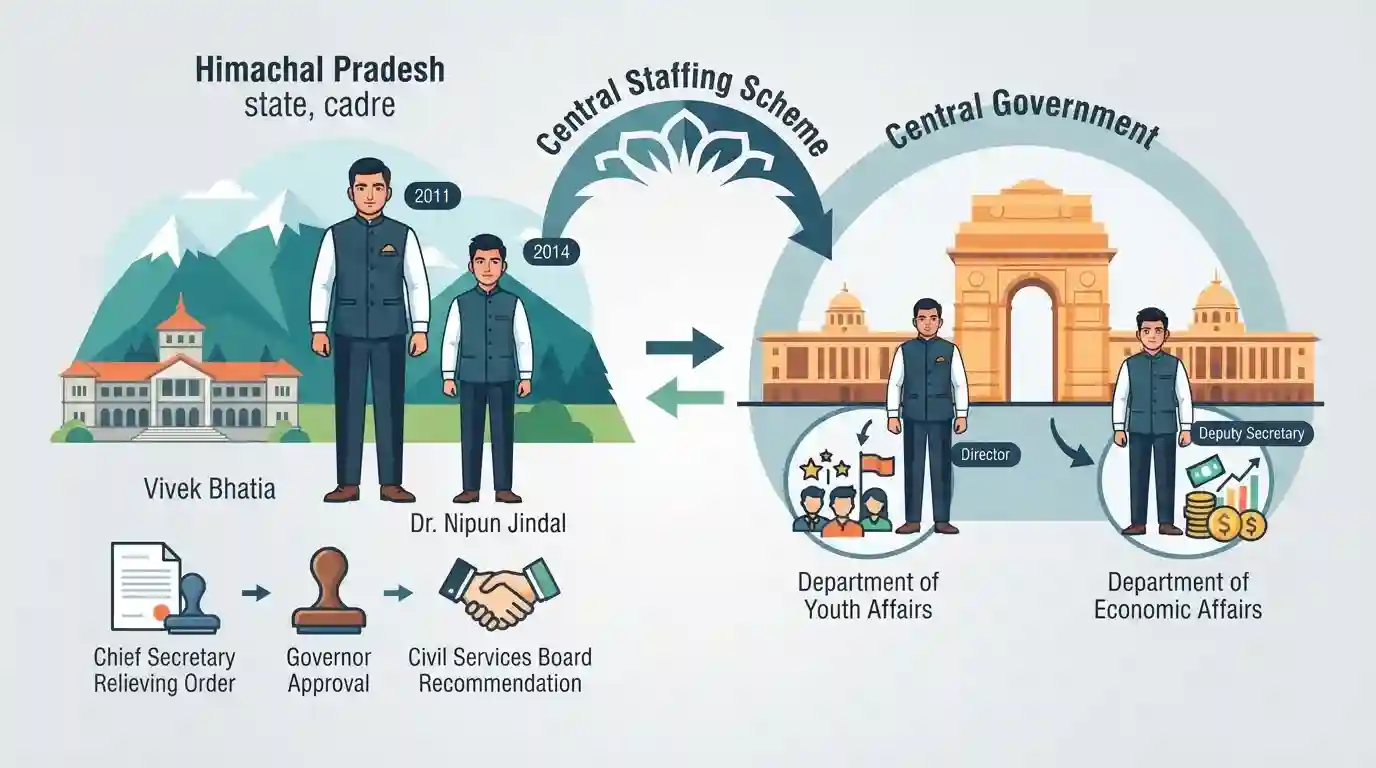
Two IAS officers from the Himachal Pradesh cadre, Vivek Bhatia (2011 batch) and Dr. Nipun Jindal (2014 batch), have been deputed to the Central Government under the Central Staffing Scheme. Bhatia will serve as Director in the Department of Youth Affairs, while Jindal has been appointed as Deputy Secretary in the Department of Economic Affairs. Their deputation and relieving orders were formally issued by the Chief Secretary of Himachal Pradesh following the Governor's approval and recommendations from the Civil Services Board.
Key Points
- Two IAS officers from the Himachal Pradesh cadre have been deputed to the Centre under the Central Staffing Scheme.
- Vivek Bhatia (2011 batch) has been appointed as Director in the Department of Youth Affairs, Government of India.
- Dr. Nipun Jindal (2014 batch) has been appointed as Deputy Secretary in the Department of Economic Affairs, Government of India.
- The orders were issued by the Governor of Himachal Pradesh based on recommendations from the Civil Services Board, with Chief Secretary Prabodh Saxena formally issuing the relieving notifications.
Important Terms
Central Staffing Scheme

The administrative framework (administered by DoPT) under which All India Services and Group A Central Service officers are appointed on deputation to senior management posts in the Union Government for fixed tenures.
UPSC context
Crucial for GS-II (Governance) as it operationalizes Centre-State administrative relations and exposes state-cadre officers to national policy-making.
Civil Services Board
A statutory/executive body established at both central and state levels (following the 2013 Supreme Court TSR Subramanian verdict) to advise the executive on civil servant transfers and postings, ensuring minimum assured tenures.
UPSC context
Important for GS-II (Role of Civil Services) as a mechanism to insulate bureaucrats from arbitrary political interference and frequent transfers.
Department of Economic Affairs
The nodal agency under the Ministry of Finance responsible for formulating and monitoring India's macroeconomic policies. Its primary responsibility includes preparing and presenting the Union Budget to Parliament.
UPSC context
Highly relevant for GS-III (Indian Economy) and GS-II. UPSC frequently tests its role in preparing the Union Budget and managing capital markets.
Department of Youth Affairs
A department under the Ministry of Youth Affairs and Sports that acts as a facilitator to develop the personality of youth (ages 15-29) and involve them in nation-building activities, coordinating with education and health ministries.
UPSC context
Relates to GS-II (Social Justice), specifically highlighting demographic dividend policies, the National Youth Policy, and grassroots empowerment schemes.
Prelims Trap
"In a central deputation dispute between the Centre and a State, the State government's decision prevails."
Under Rule 6(1) of the IAS (Cadre) Rules, 1954, if there is a disagreement regarding deputation, the Central Government's decision prevails, not the State's.
Static Concepts Connected
What is the constitutional framework structuring the All India Services?
- Article 312: Empowers Parliament to create new All India Services if the Rajya Sabha passes a resolution by a two-thirds majority.
- Dual Control: While officers serve the state (immediate control), ultimate disciplinary control and rule-making authority rest with the Central Government.
- Central Deputation Reserve: Requires every state cadre to maintain a reserve (up to 40% of senior posts) to ensure officers are available for Central deputation.
What did the T.S.R. Subramanian vs Union of India (2013) judgment mandate?
- Civil Services Board: Mandated the establishment of statutory boards to advise on transfers, postings, and deputations of civil servants.
- Fixed Tenures: Required a minimum guaranteed tenure for officers to insulate them from arbitrary political transfers.
- Written Orders: Directed officers to record all oral instructions from political executives in writing to ensure accountability.
Cross-Topic Patterns
Federal friction over AIS deputation
Proposed amendments to bypass state consent for central deputations reflect broader challenges in administrative federalism and chronic State cadre shortages (Central Deputation Reserve).
Judicial intervention in Governance
Mentions of the Civil Services Board directly link to the 2013 T.S.R. Subramanian judgment, a staple for Mains GS-2 answers on establishing bureaucratic autonomy.

Expect a 2026 Prelims question on IAS Cadre Rules specifically testing the overriding power of the Centre in deputation disputes.
