Palghar District Seismic Activity And Disaster Management Response
Source:newindianexpress ↗
Why It Matters
Understanding the seismic zones of Maharashtra, particularly prone regions like Palghar which frequently experience earthquake swarms, is crucial for MPSC Geography and Disaster Management syllabi.
Summary
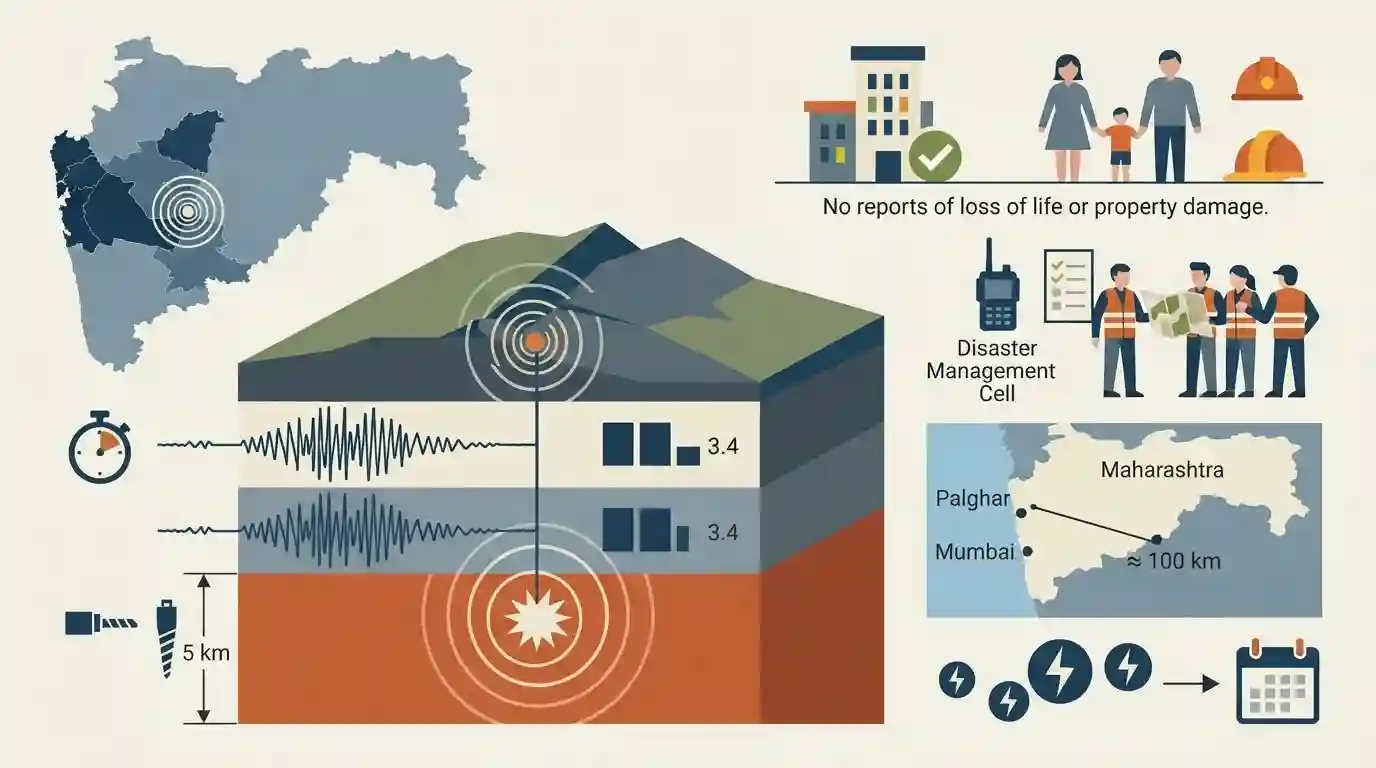
Two earthquakes, both measuring 3.4 on the Richter scale, occurred in Maharashtra's Palghar district within minutes of each other. The epicenters were located in Jawhar taluka at a depth of 5 km. According to the District Disaster Management Cell and the National Center for Seismology, no loss of life or damage to property was reported. Palghar is located approximately 100 km from Mumbai and has a history of experiencing seismic swarms.
Key Points
- Two minor earthquakes of magnitude 3.4 struck Maharashtra's Palghar district in quick succession.
- The epicenter of both earthquakes was recorded in the Jawhar taluka, at a shallow depth of 5 km.
- The National Center for Seismology recorded the quakes, and the District Disaster Management Cell confirmed no casualties or property damage.
- Palghar, a district adjoining Mumbai, frequently reports minor seismic activities and earthquake swarms.
Important Terms
National Center for Seismology (NCS)

The nodal agency under the Ministry of Earth Sciences responsible for 24x7 monitoring of earthquake activity in India, managing the national seismological network, and conducting seismic hazard research.
UPSC context
Tests GS-3 (Disaster Management) and GS-1 (Geography). Crucial for understanding India's institutional framework for earthquake monitoring and early warning systems.
District Disaster Management Authority (DDMA)
A district-level statutory body created under the Disaster Management Act, 2005. It is responsible for planning, coordinating, and executing local disaster preparedness, response, and mitigation strategies.
UPSC context
Essential for GS-3 (Disaster Management). Tests knowledge of India's decentralized, three-tier institutional architecture for emergency response and local governance.
Seismic Swarm
A localized cluster of numerous low-magnitude earthquakes occurring over an extended period without a dominant mainshock. In stable intraplate regions like Palghar, they are often triggered by fluid migration.
UPSC context
Relevant for GS-1 (Physical Geography). Tests understanding of intraplate seismic phenomena, natural hazards, and geology distinct from typical fault-line earthquakes.
Richter Scale
A base-10 logarithmic scale used to measure an earthquake's magnitude. It calculates the energy released by measuring the amplitude of the largest seismic waves recorded by a seismograph.
UPSC context
Relevant for GS-1 (Geography) and GS-3 (Disaster Management). Tests foundational knowledge of how seismic natural hazards are quantitatively measured.
Epicenter
The point on the Earth's surface directly above an earthquake's focus (hypocenter). It represents the location where seismic waves first reach the surface, typically causing the strongest shaking.
UPSC context
Important for GS-1 (Physical Geography). Tests foundational understanding of geomorphology, seismic activity, and the mechanics of natural hazards.
Prelims Trap
India's seismic hazard map is currently divided into five active zones, from Zone I to Zone V.
India currently has only four seismic zones (II, III, IV, V). Zone I was merged with Zone II long ago.
Static Concepts Connected
What distinguishes an earthquake swarm from a typical earthquake sequence?
- No Mainshock: A swarm is a sequence of small-to-moderate quakes with no distinctly identifiable mainshock.
- Typical Sequence: Standard earthquakes have a prominent mainshock followed by progressively smaller aftershocks.
- Common Triggers: Swarms are often associated with volcanic activity, geothermal fluid movement, or reservoir-induced stress.
What is the structure of the District Disaster Management Authority (DDMA)?
- Chairperson: The District Magistrate, District Collector, or Deputy Commissioner acts as the ex-officio Chairperson.
- Co-Chairperson: An elected local authority representative, but in autonomous districts, the Chief Executive Member takes this role.
- Statutory Basis: Established under Section 25 of the Disaster Management Act, 2005.
Cross-Topic Patterns
Hydro-seismicity & Deccan shield
Swarms in Maharashtra's Palghar bridge physical geography with reservoir-induced seismicity and the unique structural geology of the Deccan basalt plateaus.
DM Act & Tribal Governance
The DDMA structure embeds tribal autonomy provisions, making the Chief Executive Member of the Autonomous District Council the Co-Chairperson, linking disaster governance with constitutional mandates.

Contrasting earthquake swarms with mainshocks, paired with India's 4-tier BIS seismic zoning (II-V), is highly probable in 2026 prelims.
Linked PYQs · 2
Linked PYQs · 2
- 2025MPSC_PRELIMSGS1
_______ Monsoon winds blow in Maharashtra from June to September.
- 2026MPSC_PRELIMSGS1
Match the following forest circles with their share in percentage to total forest area of Maharashtra. | (Forest circles of Maharashtra) | (Percentage to total forest area Economic survey of Maharashtra (2024)) | |---|---| | (a) Gadchiroli | (1) 12.5 | | (b) Nagpur | (2) 20.8 | | (c) Dhule | (3) 9.5 | | (d) Thane | (4) 10.4 | Code: (a) (b) (c) (d)
