Delhi Urban Flooding: Civic Negligence and Power Infrastructure
Source:The Hindu ↗
Why It Matters
The incident highlights the growing challenge of urban disaster management in India. It serves as a practical case study for GS-3 (Disaster Management) and GS-1 (Urbanization), demonstrating how inadequate civic infrastructure and poor maintenance can turn natural extreme weather events into deadly human-made disasters.
Summary
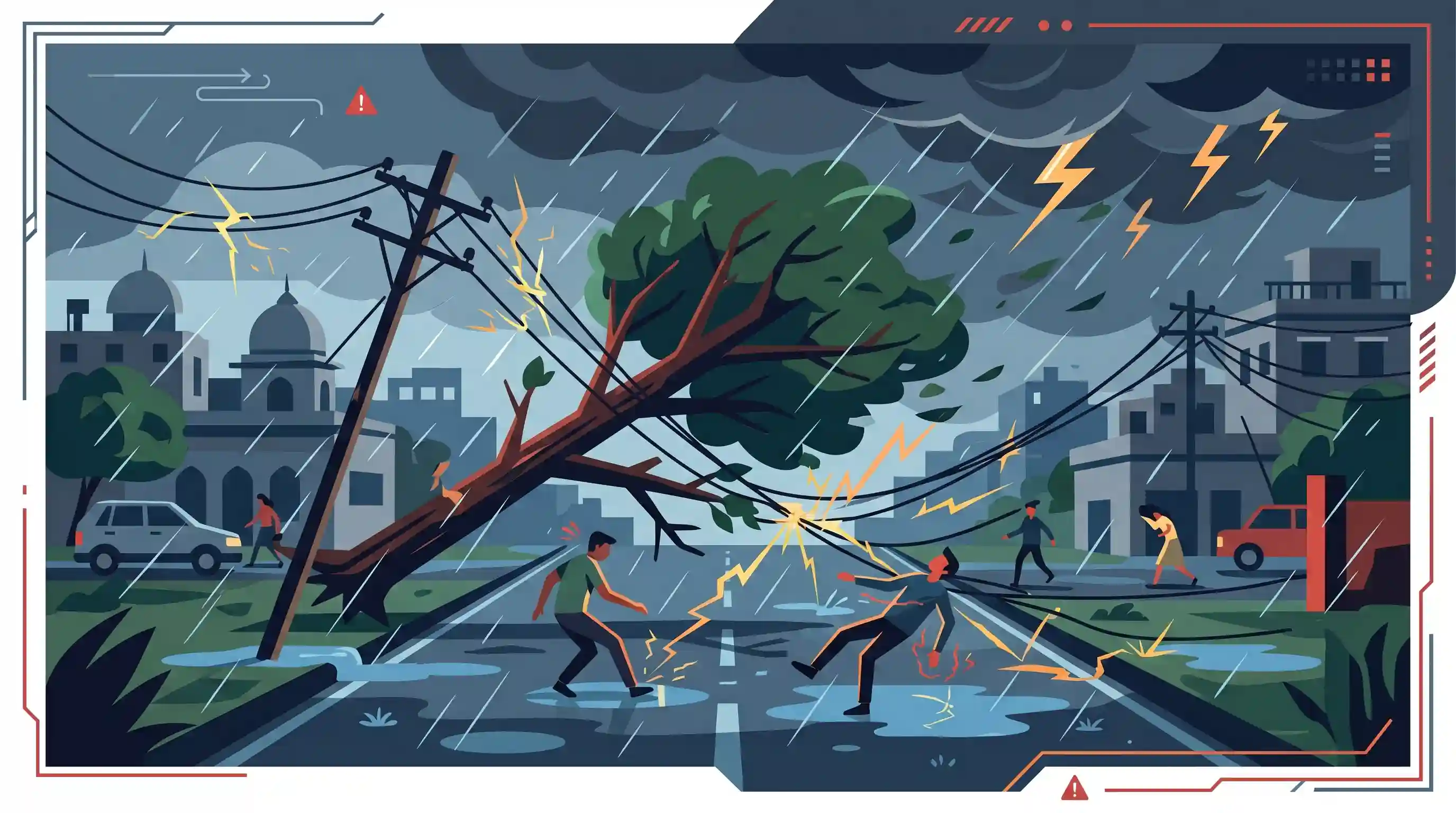
Two individuals were electrocuted to death in Delhi's RK Puram after a storm brought down a tree onto an overhead power line, electrifying the damp ground. The incident followed heavy rainfall and strong winds, for which the India Meteorological Department (IMD) had issued a 'yellow alert'. This tragedy highlights critical vulnerabilities in urban infrastructure and the severe risks posed by poor civic maintenance and extreme weather events.
Key Points
- Two fatalities occurred due to electrocution in Delhi's RK Puram area when a tree fell on an overhead power line, making the damp ground live.
- The incident was triggered by severe weather conditions, including strong winds and heavy rainfall, illustrating the vulnerability of urban infrastructure to extreme weather events.
- The India Meteorological Department (IMD) had issued a 'yellow alert', forecasting thunderstorms and robust winds for the region.
- The tragedy underscores persistent gaps in urban civic management, particularly regarding the maintenance of overhead power lines and tree pruning ahead of the monsoon/storm season.
Important Terms
India Meteorological Department (IMD)

Principal government agency under the Ministry of Earth Sciences responsible for weather forecasting, meteorological observations, and seismology. It tracks monsoons and issues critical alerts for cyclones and extreme weather events.
UPSC context
GS Paper 1 (Geography) & 3 (Disaster Management); tests knowledge of institutional frameworks for weather monitoring and disaster preparedness.
Yellow Alert
A cautionary weather warning in IMD's four-stage color-coded system advising the public to "be aware." It signals potentially worsening conditions that may disrupt daily activities, requiring local authorities to monitor the situation.
UPSC context
GS Paper 3 (Disaster Management); tests understanding of early warning systems and protocols for mitigating weather-related risks.
Disaster Management Act, 2005
Primary legal framework for disaster response in India, establishing the NDMA and SDMAs. It shifted the national approach from reactive relief to proactive preparedness, mitigation, and institutionalized disaster risk reduction.
UPSC context
GS Paper 3 (Disaster Management); a core topic regarding India's administrative and legal response to natural and man-made calamities.
Urban Resilience
The capacity of an urban area's infrastructure and population to withstand, recover from, and adapt to climate-related shocks. It emphasizes robust planning and maintenance to minimize the impact of extreme weather.
UPSC context
GS Paper 1 (Urbanization) & 3 (Infrastructure); tests the ability to suggest sustainable solutions for urban decay and climate change impacts.
Urban Infrastructure Vulnerability
The susceptibility of city systems—such as power grids and drainage—to failure during stress. This is often exacerbated by poor maintenance, unplanned growth, and inadequate civic oversight during extreme weather events.
UPSC context
GS Paper 3 (Disaster Management & Infrastructure); focuses on the risks associated with rapid urbanization and poor municipal governance.
Prelims Trap
"An IMD Yellow Alert mandates immediate action and suspension of civic activities."
Yellow simply means "Be aware/Stay updated". Orange means "Be prepared", and Red means "Take action". Aspirants often confuse Yellow with strict emergency protocols requiring action.
Static Concepts Connected
What is the IMD's colour-coded warning system for extreme weather events?
- Green (No warning): No advisory is issued. Weather is expected to be normal with no immediate threat.
- Yellow (Be aware): Keep a watch on the weather and stay updated. It indicates potential for worsening weather conditions.
- Orange (Be prepared): Advises authorities and the public to be prepared for power outages, localized flooding, and transport disruptions.
- Red (Take action): Highest level of warning. Authorities must take immediate action to protect life and property from severe weather.
What do NDMA Guidelines recommend for mitigating electrical hazards in urban flooding?
- Underground Cabling: A phased transition from overhead power lines to underground cables in cities to eliminate electrocution risks during storms.
- Hazard Zonation: Integrating vulnerable overhead electrical infrastructure and historic waterlogging hotspots into city-level Hazard Zonation Mapping.
- Pre-monsoon Audits: Strict safety protocols, including periodic inspections and safe distancing/pruning of trees near overhead lines before the monsoons.
Cross-Topic Patterns
Urban Disaster Management + 74th Amendment
The failure to maintain civic infrastructure like tree pruning highlights the capacity constraints of Urban Local Bodies (ULBs) in managing functions listed under the 12th Schedule (Article 243W).
Climate Extremes + Infrastructure Deficit
Rising frequency of high-intensity, short-duration rainfall makes legacy infrastructure lethal, reinforcing why the transition to underground cabling is a critical climate adaptation strategy for cities.

Expect a 2026 Prelims multi-statement question pairing IMD's colour-coded alerts with NDMA's Urban Flooding guidelines on urban utilities.
Linked PYQs · 2
Linked PYQs · 2
- 2024MainsGS3
Flooding in urban areas is an emerging climate-induced disaster. Discuss the causes of this disaster. Mention the features of two such major floods in the last two decades in India. Describe the policies and frameworks in India that aim at tackling such floods.
- 2020MainsGS1
Account for the huge flooding of million cities in India including the smart ones like Hyderabad and Pune. Suggest lasting remedial measures.
