Democratic Backsliding and Institutional Checks and Balances
Source:The Hindu ↗
Why It Matters
Understanding the vulnerabilities of democratic systems to authoritarianism and populism is highly relevant for GS Paper 2 (Polity and Governance). It provides critical insights for evaluating the strength of checks and balances in the Constitution and for writing nuanced answers on comparative politics (India and the US).
Summary
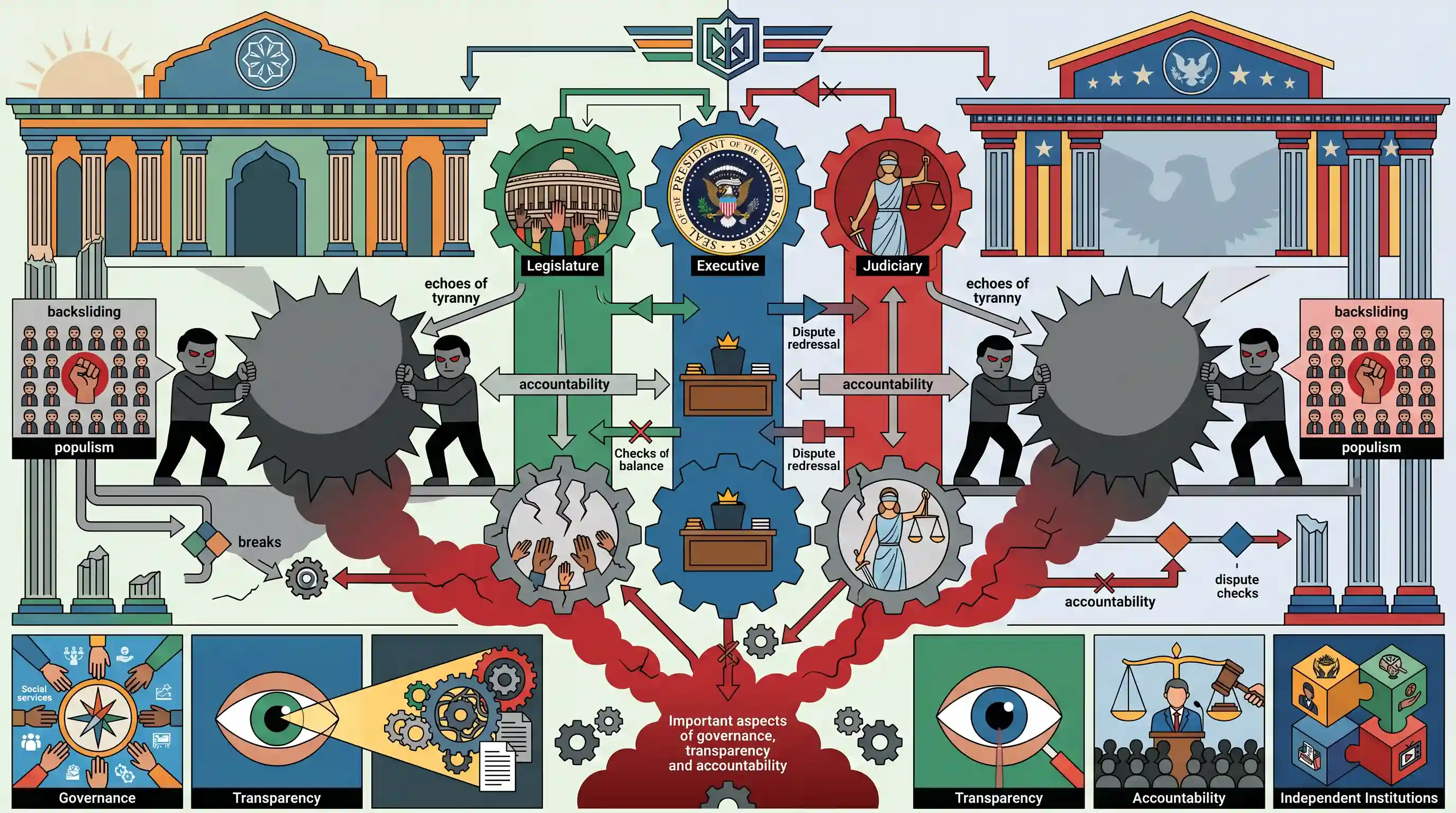
The article critically reflects on the democratic health of two major global democracies—most likely contextualized as India and the United States—and warns against the subtle but growing signs of authoritarianism, described as 'echoes of tyranny.' It examines how populism, executive overreach, and the erosion of institutional checks and balances pose existential threats to foundational democratic principles. The piece underlines the critical need to safeguard constitutional ethos, defend the independence of democratic institutions, and resist majoritarian impulses that risk degrading the democratic fabric from within.
Key Points
- Analyzes the current challenges and vulnerabilities facing large democracies, typically drawing a comparative perspective between India and the United States.
- Identifies 'echoes of tyranny' such as democratic backsliding, the rise of populism, and creeping executive overreach.
- Emphasizes the vital role of independent democratic institutions and a robust system of checks and balances to prevent authoritarian centralization of power.
- Cautions against the dangers of majoritarianism and the systematic polarization of civil society, which erode the foundations of a constitutional republic.
- Advocates for continuous civic vigilance, the defense of fundamental rights, and the upholding of constitutional morality as essential safeguards for democracy.
Important Terms
Constitutionalism

The doctrine that government authority is determined and limited by a body of fundamental law, ensuring that the rule of law prevails over arbitrary political power.
UPSC context
GS Paper 2; fundamental to understanding how institutional constraints prevent democratic backsliding into authoritarianism.
Separation of Powers
The division of government responsibilities into three distinct branches—Legislature, Executive, and Judiciary—to prevent the concentration of power and ensure mutual oversight.
UPSC context
GS Paper 2; core syllabus topic for comparing global governance structures and analyzing institutional friction.
Executive Overreach
A political trend where the executive branch exceeds its constitutional boundaries, often by bypassing the legislature or undermining judicial independence to consolidate authority.
UPSC context
GS Paper 2; vital for evaluating contemporary challenges to the balance of power and democratic stability.
Judicial Review
The power of the judiciary to scrutinize and invalidate legislative or executive actions that violate constitutional provisions, ensuring the supremacy of the fundamental law.
UPSC context
GS Paper 2; a primary mechanism for safeguarding fundamental rights and maintaining executive accountability.
Emergency Provisions
Constitutional clauses (Articles 352–360) allowing for the suspension of normal governance during crises, which can be exploited to centralize power and suppress dissent.
UPSC context
GS Paper 2; tested through historical case studies (1975 Emergency) regarding constitutional vulnerabilities and institutional resilience.
Constitution of India
The supreme law of India, establishing the political framework and rights. It is characterized as a "living document" that combines rigidity with flexibility.
UPSC context
GS Paper 2; the foundational text for all questions on Indian polity, governance, and institutional relationships.
US Constitution
The foundational law of the United States (1789), featuring a presidential system, strict separation of powers, and a rigid amendment process.
UPSC context
GS Paper 2; essential for the "Comparison of the Indian constitutional scheme with that of other countries" syllabus topic.
Majoritarianism
A political ideology where the majority's will is prioritized, often at the risk of undermining minority rights and institutional checks within a democracy.
UPSC context
GS Paper 1 & 2; tests understanding of social-political challenges and threats to the inclusive fabric of a constitution.
Prelims Trap
Constitutional morality is explicitly defined in the Indian Constitution to limit executive overreach.
Constitutional morality is nowhere explicitly defined in the Constitution. It is a judicial doctrine derived from the Preamble and fundamental rights, popularized in recent judgments.
Static Concepts Connected
How does the Separation of Powers differ between India and the United States?
- US Rigid Separation: Built on Montesquieu's model, the US strictly separates personnel and functions. The President and their cabinet are not members of the legislature.
- Indian Functional Overlap: India follows the Westminster model where the executive is drawn directly from, and remains collectively responsible to, the legislature (Article 75).
- Judicial Review Balance: While the US relies heavily on structural separation, India heavily utilizes judicial review (and the Basic Structure doctrine) to strike down majoritarian legislative overreach.
What is 'Constitutionalism' and how does it restrict Majoritarianism?
- Limited Government: Constitutionalism ensures government power is not absolute. It places substantive limits on state actions to prevent tyranny, even if backed by a numerical majority.
- Constitutional Morality: It prioritizes constitutional values (liberty, equality, justice) over popular societal morality, acting as an institutional shield for minority rights against majoritarian impulses.
Cross-Topic Patterns
Ordinance Raj and Legislative Bypass
Frequent use of Articles 123/213 bypasses parliamentary debate. This executive overreach structurally erodes legislative accountability and is often cited as a symptom of state-led democratic backsliding.
Anti-Defection Law and Institutional Decay
The partisan role of the Speaker under the Tenth Schedule highlights how majoritarian governments can exploit institutional vulnerabilities to dismantle internal legislative checks and balances.

A GS2 question contrasting India's "functional overlap" with the US "strict separation of powers" is highly likely in the 2026 Mains.
Linked PYQs · 2
Linked PYQs · 2
- 2018MainsGS2
India and USA are two large democracies. Examine the basic tenets on which the two political systems are based.
- 2019MainsGS2
Do you think that Constitution of India does not accept principle of strict separation of powers rather it is based on the principle of 'checks and balance'? Explain.
