Judicial Procedure Delays: Release of Protest Detainees in Bihar
Source:The Hindu ↗
Why It Matters
This issue brings into focus the practical application of 'procedure established by law' in India, demonstrating how executive decisions (like withdrawing cases) must pass through proper judicial channels, often leading to delays that affect personal liberty and fundamental rights.
Summary
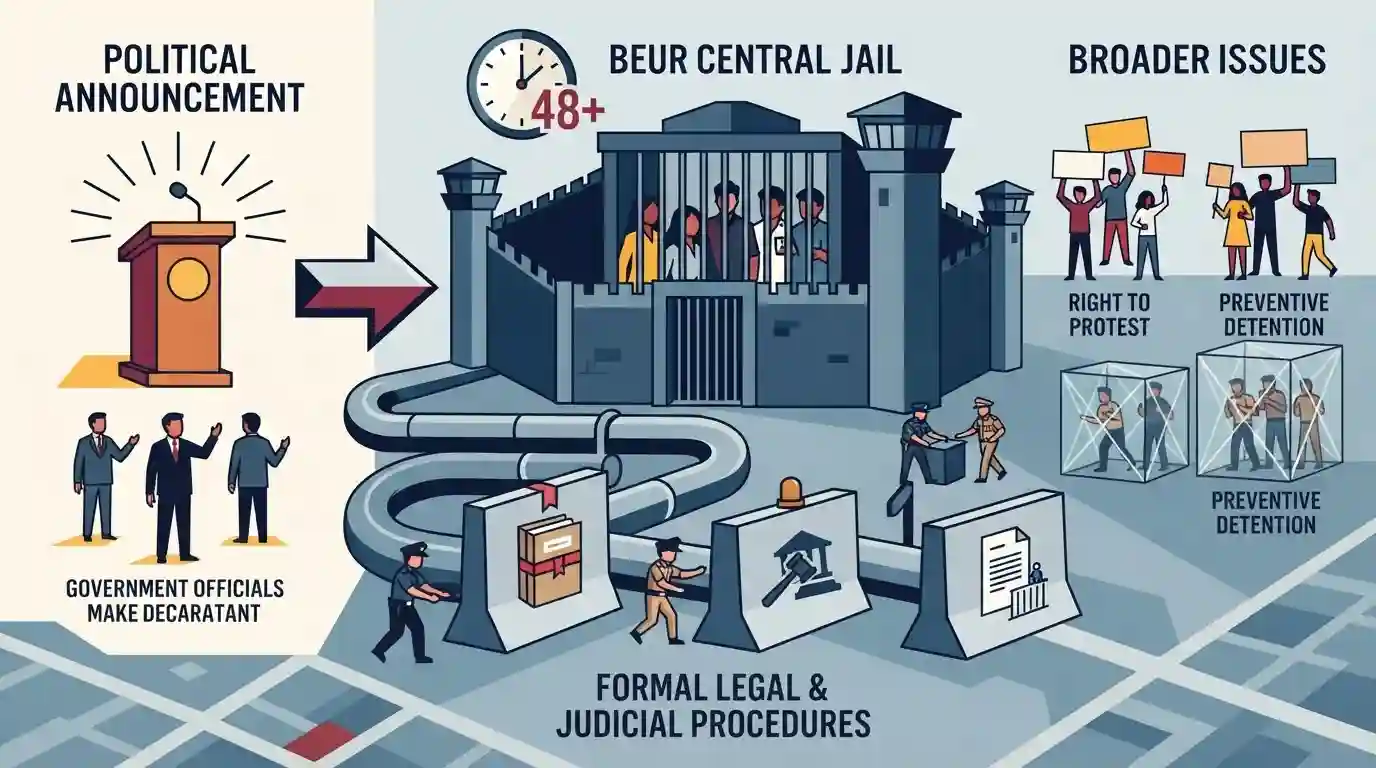
More than 48 hours after the Bihar government announced the withdrawal of cases against students and leaders protesting the NEET paper leak, many remain incarcerated in Patna's Beur Central Jail. While the political announcement was made to pacify the situation, the actual release is delayed by formal legal and judicial procedures required to process bail or withdraw prosecution cases. The situation highlights systemic friction between political directives and judicial procedure, as well as broader issues of civil liberties, the right to protest, and preventive detention.
Key Points
- Following protests against the NEET paper leak, several student activists and leaders were detained and lodged in Patna's Beur Central Jail.
- Despite an announcement by the Bihar government to withdraw all cases against the protesters, the detainees have not been released even after 48 hours.
- The delay highlights the procedural constraints in the criminal justice system, where executive announcements must be followed by formal judicial procedures like bail or withdrawal of prosecution in court.
- The incident underscores the tension between the fundamental right to protest and law and order enforcement by state authorities.
Important Terms
All India Students’ Association (AISA)

A prominent left-wing student organization in India founded in 1990. It frequently mobilizes on issues like campus democracy and educational reforms, recently organizing protests demanding accountability over NEET exam irregularities.
UPSC context
GS Paper 2 (Pressure Groups). Tests understanding of student movements, civil society organizations, and their democratic roles.
Beur Central Jail
The primary and largest prison facility in Bihar, located in Patna. It regularly houses political prisoners and undertrials, frequently drawing focus to systemic issues like prison conditions and delayed legal procedures.
UPSC context
GS Paper 2 (Governance). Relevant for questions concerning the criminal justice system, prison reforms, and undertrial rights.
Bihar Government
The state-level executive authority in Bihar. While it holds the power to issue political directives, such as announcing case withdrawals, it must navigate formal judicial mechanisms to legally enact them.
UPSC context
GS Paper 2 (State Executive). Evaluates understanding of the separation of powers between the political executive and the judiciary.
Patna Police
The primary law enforcement agency for the Patna district. It manages public order during large demonstrations and executes arrests, highlighting the operational balance between maintaining security and protecting civil liberties.
UPSC context
GS Paper 2 (Governance). Tests the role of local law enforcement in handling civil unrest and managing public protests.
Prelims Trap
The State Executive can unilaterally withdraw criminal prosecutions by issuing an official notification.
Withdrawal requires the Public Prosecutor to formally apply under Section 360 of BNSS, and it is strictly subject to the consent of the Court.
Static Concepts Connected
What is the legal procedure for the State to withdraw a criminal prosecution?
- Statutory provision: Under Section 360 of BNSS (formerly Sec 321 CrPC), the Public Prosecutor may withdraw prosecution only with the prior consent of the Court.
- Victim's right: The newly enacted BNSS mandates that the Court must give the victim an opportunity to be heard before permitting any withdrawal of prosecution.
- Independent discretion: The Supreme Court holds that a Public Prosecutor must apply an independent mind and not act as a mere rubber stamp for the government.
How is the 'Right to Protest' constitutionally protected and restricted in India?
- Derivative fundamental right: It is not explicitly stated in the Constitution but is derived from Article 19(1)(a) (speech and expression) and 19(1)(b) (peaceful assembly).
- Reasonable restrictions: It can be restricted under Article 19(2) and (3) on grounds of India's sovereignty, integrity, and public order.
- No indefinite occupation: In the Shaheen Bagh case, the SC ruled that public spaces and routes cannot be occupied indefinitely, balancing dissent with citizens' right to movement.
Cross-Topic Patterns
BNSS & victim-centric criminal justice
The shift from CrPC Sec 321 to BNSS Sec 360 introduces mandatory victim hearings, reflecting a broader syllabus trend emphasizing victim rights over traditional state-vs-accused paradigms.
Remission vs. Prosecution Withdrawal
Similar to recent judicial pushback on state remission powers (e.g., Bilkis Bano), the withdrawal of prosecution underscores the judiciary's role as a vital check against arbitrary executive clemency.

Expect a Prelims statement comparing the executive's constitutional power of remission (Art 161) with statutory withdrawal of prosecution.
Linked PYQs · 3
Linked PYQs · 3
- 2025BPSC_PRELIMSGS1
The constitution of India provides for reasonable restrictions on Fundamental Rights but reasonableness must keep in mind that: 1. The restrictions must be necessary for the protection of the rights of others. 2. The restrictions must be proportionate to the end sought. 3. The restrictions must be reasonable in the light of the circumstances. 4. The restrictions must be in the public interest.
- 2022BPSC_PRELIMSGS1
Judicial process in India is based on
- 2025BPSC_PRELIMSGS1
Which one of the following subjects fall within the jurisdiction of both High Court and Supreme Court?
