BRICS Finance Meet in Jaipur Focuses on Global Financial Stability
Source:etv-bharat ↗
Why It Matters
RPSC RAS Prelims routinely tests candidates on the venues of major international summits (e.g., BRICS, G20) hosted in Rajasthan. Additionally, questions regarding multilateral institutions like the New Development Bank (NDB) and their agendas form a core part of the international relations and economy syllabus.
Summary
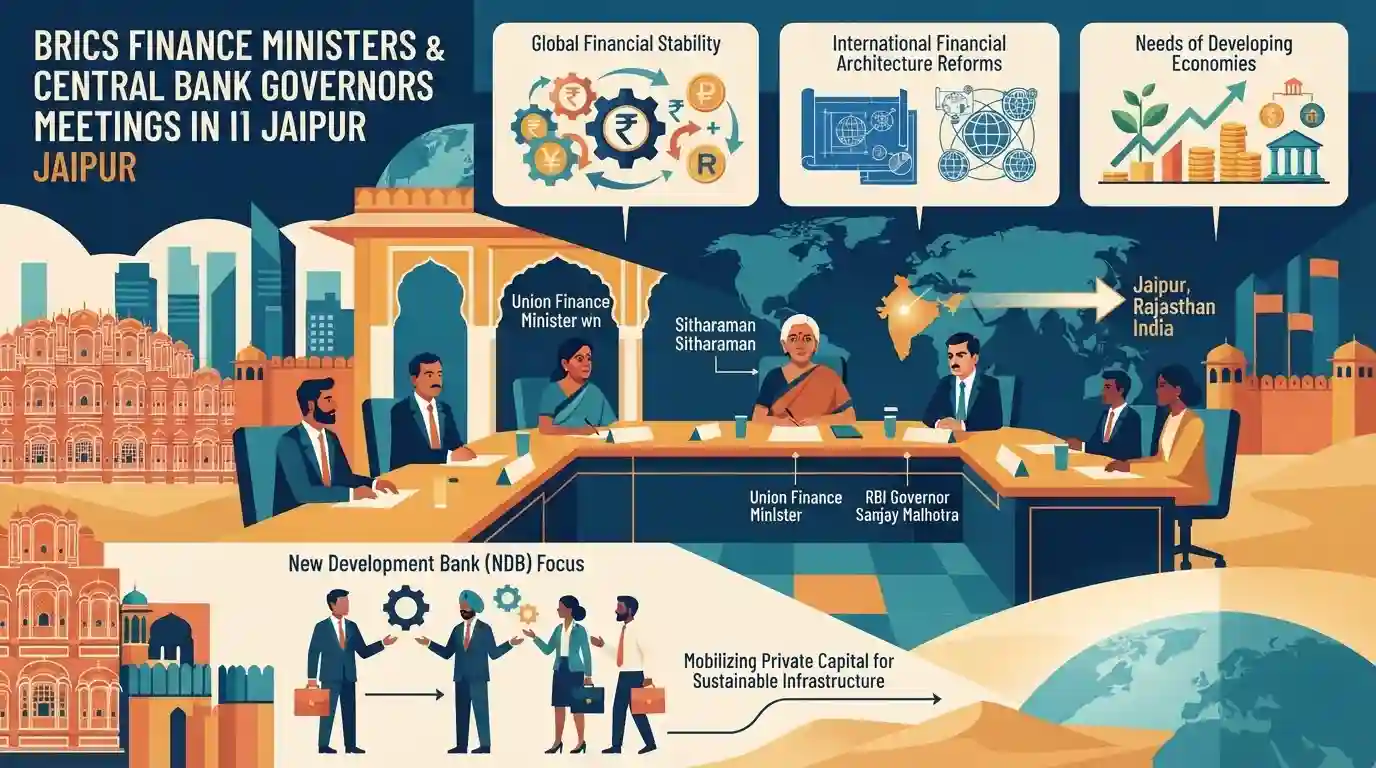
A significant two-day BRICS Finance Ministers and Central Bank Governors (FMCBG) meeting has commenced in Jaipur under India's 2026 BRICS Presidency. The event brings together key financial figures, including Union Finance Minister Nirmala Sitharaman and RBI Governor Sanjay Malhotra, to deliberate on global financial stability, international financial architecture reforms, and the needs of developing economies. A major focus area of the summit is evaluating the New Development Bank's (NDB) role in mobilizing private capital. This event marks another high-profile international summit hosted in Rajasthan, highlighting the state's growing prominence as an international venue.
Key Points
- Jaipur is hosting the two-day BRICS Finance Ministers and Central Bank Governors (FMCBG) meeting under India's 2026 BRICS Presidency.
- The meeting focuses on global economic challenges, financial stability, and reforming the international financial architecture to better suit developing economies.
- Union Finance Minister Nirmala Sitharaman and RBI Governor Sanjay Malhotra are leading the discussions.
- A key seminar during the event highlights the role of the New Development Bank (NDB) in mobilizing private capital.
Important Terms
BRICS

An intergovernmental organization comprising major emerging economies—Brazil, Russia, India, China, and South Africa—along with expanded members, designed to enhance geopolitical cooperation and represent the Global South.
UPSC context
Crucial for GS Paper 2 (International Relations), testing knowledge of global groupings, multipolar world order, and South-South cooperation.
New Development Bank (NDB)
A multilateral development bank established by BRICS nations to mobilize resources for infrastructure and sustainable development projects in emerging economies, functioning as a Global South alternative to the World Bank.
UPSC context
Essential for GS Paper 2 (Global Groupings) and GS Paper 3 (Economy), focusing on international financial architecture and alternative banking.
Reserve Bank of India (RBI)
India's central bank and apex regulatory authority responsible for formulating monetary policy, issuing currency, managing foreign exchange reserves, and maintaining domestic financial stability under the RBI Act, 1934.
UPSC context
Core to GS Paper 3 (Indian Economy), frequently tested in Prelims and Mains regarding inflation targeting, monetary policy, and banking regulations.
Ministry of Finance
A key Indian government ministry managing the national economy, fiscal policy, taxation, financial legislation, and the preparation of the Union Budget to ensure macroeconomic stability.
UPSC context
Critical for GS Paper 2 (Governance) and GS Paper 3 (Economy); tested via budget allocation, economic reforms, and fiscal policy initiatives.
Prelims Trap
The New Development Bank (NDB) was formally established during the 4th BRICS Summit held in New Delhi.
India proposed the idea of the NDB at the 2012 New Delhi Summit, but it was formally established by the Fortaleza Declaration at the 2014 Summit in Brazil.
Static Concepts Connected
How does the New Development Bank (NDB) differ from the AIIB in governance?
- Voting structure: NDB assigns equal voting shares to founding members without veto power. AIIB allocates voting power based on the member's economic size.
- Headquarters: Both institutions are in China, but NDB is based in Shanghai while the AIIB is headquartered in Beijing.
- Origin declarations: NDB was established by the 2014 Fortaleza Declaration (BRICS), whereas AIIB was launched as a broader multilateral initiative led by China.
What does "International Financial Architecture reform" mean for the Global South?
- IMF Quota realignment: Reallocating IMF quotas to reflect the current economic weight of developing nations, moving away from historic Western dominance.
- MDB evolution: Expanding Multilateral Development Bank mandates to include climate finance and private capital mobilization, as advocated by the N.K. Singh-Summers panel.
- Debt mechanisms: Creating faster, more equitable sovereign debt resolution frameworks for vulnerable nations outside the traditional Paris Club structures.
Cross-Topic Patterns
BRICS Expansion vs. NDB Membership
Aspirants must note that joining BRICS (e.g., Iran, Ethiopia) is politically distinct from joining the NDB, which admits non-BRICS states like Bangladesh and Uruguay under separate financial protocols.
G20 Continuity in BRICS Agenda
India is using its 2026 BRICS Presidency to advance the MDB reform agenda (mobilizing private capital) successfully seeded during its 2023 G20 Presidency, demonstrating continuity in Global South leadership.

Expect a 2026 comparative Prelims question contrasting NDB's equal voting rights with the quota-based systems of the IMF and AIIB.
Linked PYQs · 2
Linked PYQs · 2
- 2025RPSC_PRELIMSGS1
Where was the India-Norway Round Table Conference held on December 8, 2024?
- 2016RPSC_PRELIMSGS1
Which external agency is providing financial assistance for the Rajasthan Renewable Energy Transmission Investment Program?
