Rajasthan Court Sentences Two Congress MLAs in 2014 Protest Case
Source:The Hindu ↗
Why It Matters
The article serves as a concrete case study on the application of Section 8(3) of the RPA, 1951. It helps aspirants distinguish between convictions that trigger immediate disqualification (2+ years) and those that do not, a recurring concept in both UPSC Prelims and Mains.
Summary
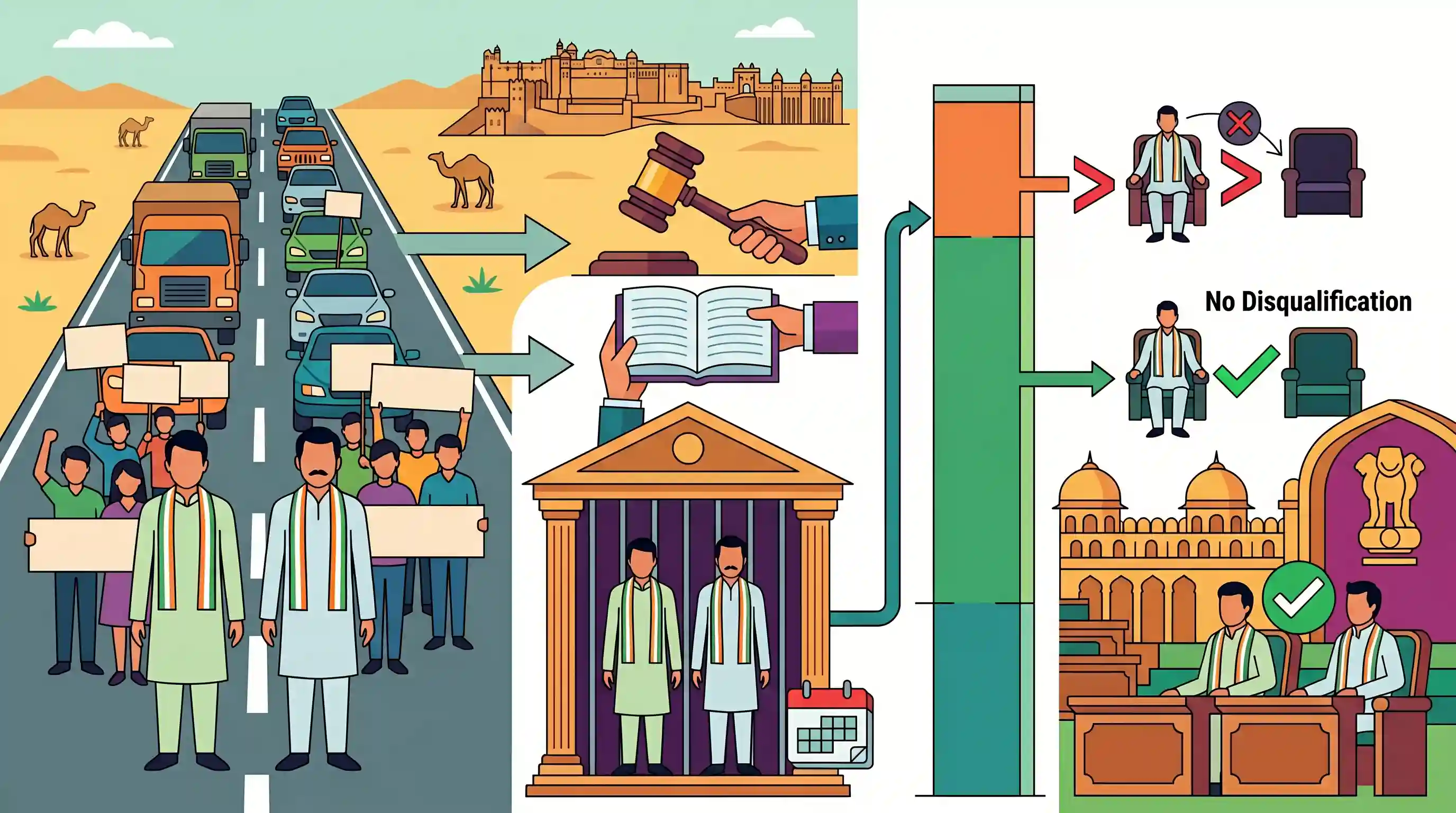
A Rajasthan court sentenced two sitting Congress MLAs to one year in prison for blocking a state highway during a 2014 student protest. Because the jail term is under the two-year threshold stipulated by Section 8(3) of the Representation of the People Act, 1951, the legislators will not be disqualified from the State Assembly. The judgment underscores the legal boundary between lawful political expression and unlawful public obstruction, while highlighting the statutory mechanics of elected representative disqualification.
Key Points
- Two Congress MLAs in Rajasthan, Mukesh Bhakar and Manish Yadav, were sentenced to one year in jail for blocking a highway during a 2014 protest.
- The MLAs were convicted under IPC sections related to unlawful assembly, wrongful restraint, and causing public obstruction.
- They will not be disqualified from the Assembly because Section 8(3) of the Representation of the People Act (RPA), 1951 requires a sentence of at least two years for disqualification.
- The ruling illustrates the statutory thresholds separating minor protest convictions from disqualifying criminal offenses for elected representatives.
Important Terms
Representation of the People Act, 1951 (RPA)

A landmark 1951 statute governing the conduct of elections, registration of parties, and qualifications or disqualifications of Members of Parliament and State Legislatures.
UPSC context
GS Paper II: Salient features of the RPA; essential for understanding electoral reforms and legislative integrity.
Section 8(3), RPA 1951
A provision stating that a person convicted of any offence and sentenced to at least two years' imprisonment shall be disqualified from the date of conviction.
UPSC context
GS Paper II: Disqualification of representatives; tests knowledge of legal thresholds for holding public office.
Lily Thomas vs Union of India (2013)
A landmark 2013 Supreme Court judgment that struck down Section 8(4) of the RPA, mandating the immediate disqualification of convicted legislators sentenced to 2+ years.
UPSC context
GS Paper II: Judiciary/Landmark Cases; critical for questions on decriminalizing politics and immediate disqualification rules.
Indian Penal Code (IPC)
The official criminal code of India defining various offences and their punishments, such as rioting (Section 147) and public obstruction (Section 283).
UPSC context
GS Paper II: Statutory bodies and laws; relevant for understanding the legal basis of criminal convictions.
Legislative Assembly (Vidhan Sabha)
The lower house of a state legislature in India, responsible for making laws and overseeing the state executive.
UPSC context
GS Paper II: State Legislatures; structure and functioning of sub-national democratic institutions.
Disqualification of Representatives
The legal process by which a member of a legislature is removed from office for failing to meet statutory or constitutional requirements.
UPSC context
GS Paper II: Parliament and State Legislatures; covers grounds like criminal conviction, defection, and office of profit.
Prelims Trap
An MP or MLA is disqualified from office only if they are sentenced to imprisonment for two years or more.
False. While Section 8(3) requires a two-year sentence, Sections 8(1) and 8(2) list specific offenses (like bribery or untouchability) where ANY sentence, including a mere fine, triggers disqualification.
Static Concepts Connected
What are the criminal disqualification rules under the Representation of the People Act, 1951?
- Specific Offenses: Convictions for specific crimes like bribery, untouchability, or promoting enmity trigger immediate disqualification, even if the punishment is only a fine.
- General Offenses: Under Section 8(3), conviction for any general crime must result in a minimum of two years of imprisonment to trigger automatic disqualification.
- Total Duration: Disqualification begins on the date of conviction and extends for a further period of six years after the legislator's release from prison.
How can a disqualified MP or MLA have their disqualification legally halted or removed?
- Stay on Conviction: An appellate court must specifically stay the conviction itself, not just the sentence. A mere suspension of sentence does not reverse the disqualification.
- ECI Intervention: Under Section 11 of the RPA, 1951, the Election Commission has discretionary power to record written reasons and remove or reduce the period of disqualification.
Cross-Topic Patterns
Right to Protest vs. Public Order
Highway blockades clash with Article 19(1)(a) and (b) limitations. The Supreme Court (e.g., Amit Sahni vs Commissioner of Police) has repeatedly ruled that the right to protest cannot justify blocking public pathways indefinitely.
RPA 1951 + ECI Discretionary Powers
The Election Commission's Section 11 power to reduce or remove disqualifications acts as a statutory safety valve. This frequently connects the criminalization of politics with the ECI's quasi-judicial authority.

Expect a Prelims question contrasting RPA Section 8(1) specific offenses (any sentence) against Section 8(3) general crimes (2-year min).
Linked PYQs · 3
Linked PYQs · 3
- 2019MainsGS2
On what grounds a people's representative can be disqualified under the Representation of Peoples Act, 1951? Also mention the remedies available to such person against his disqualification.
- 2020MainsGS2
There is a need for simplification of procedure for disqualification of persons found guilty of corrupt practices under the Representation of Peoples Act". Comment.
- 2020PrelimsGS1
Consider the following statements: 1. According to the Constitution of India, a person who is eligible to vote can be made a minister in a State for six months even if he/she is not a member of the Legislature of that State. 2. According to the Representation of People Act, 1951, a person convicted of a criminal offence and sentenced to imprisonment for five years is permanently disqualified from contesting an election even after his release from prison. Which of the statements given above is/are correct?
