Dust Storm in Barmer Causes Casualties and Property Damage
Source:newindianexpress ↗
Why It Matters
The event underscores the recurring threat of extreme weather phenomena like dust storms (Andhi) in the Thar Desert region of Rajasthan, illustrating the need for disaster resilient infrastructure, understanding convective atmospheric processes, and assessing rural structural vulnerability to seasonal storms.
Summary
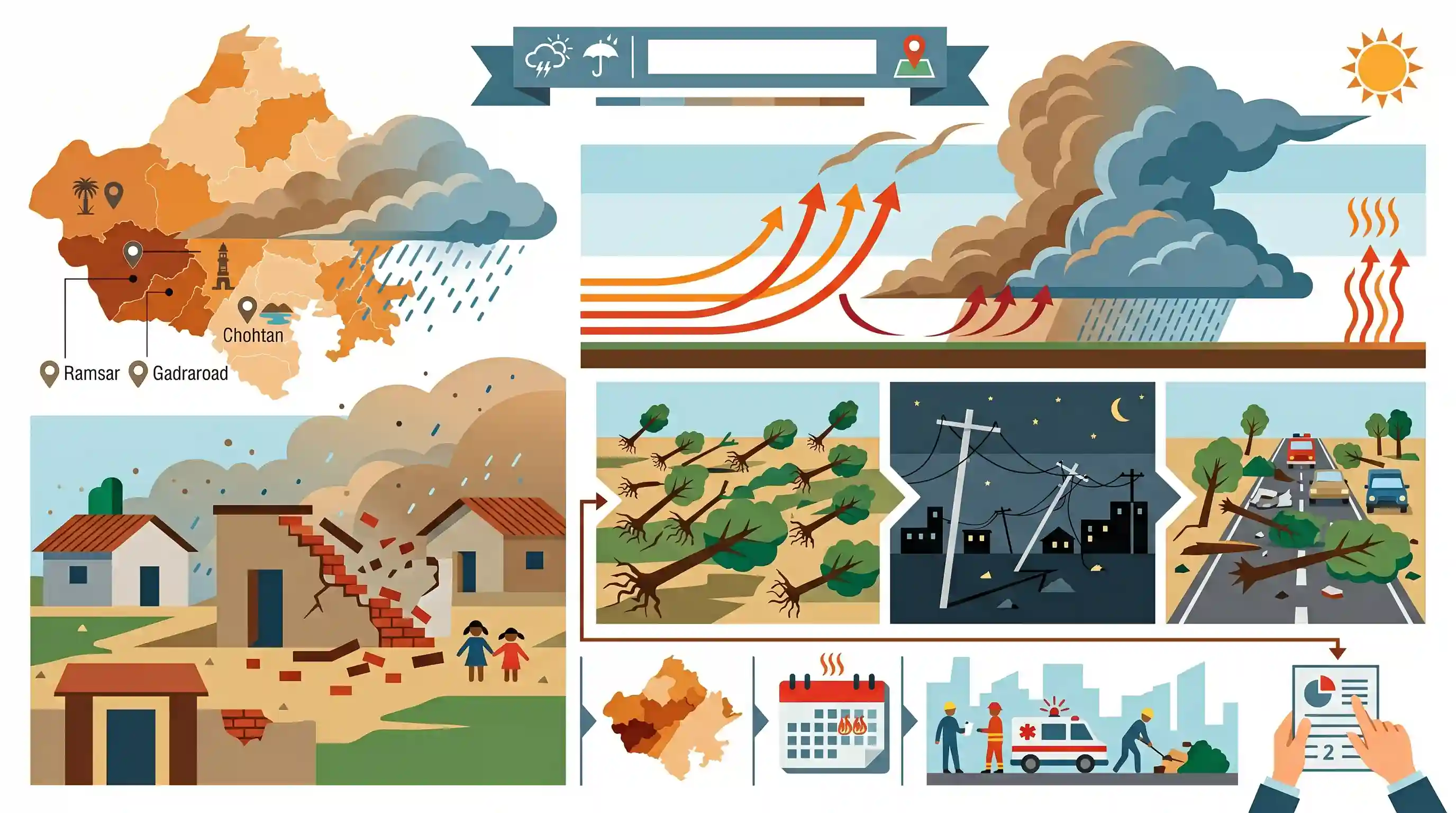
On June 1, 2026, a severe dust storm accompanied by rain struck the rural pockets of Rajasthan's Barmer district, causing the deaths of two children due to wall collapses in Sabri Nagar village. The storm uprooted trees and electricity poles across Chohtan, Ramsar, Gadraroad, and adjacent border villages, resulting in severe power disruptions and blocked roads. This highlights the region's vulnerability to extreme localized weather events, specifically convective dust storms ('Andhis') common during the peak summer months of May and June.
Key Points
- A powerful dust storm (locally known as Andhi) accompanied by rain struck rural parts of Barmer district, Rajasthan, on June 1, 2026, causing widespread damage.
- Two young children, aged eight and four, lost their lives in Sabri Nagar village under Bola gram panchayat due to the collapse of walls of a tin-shed room and a kutcha house.
- The severe storm had a widespread impact across areas including Chohtan, Ramsar, Gadraroad, and several other border villages of Barmer.
- Widespread power outages, uprooted trees, and blocked roads were reported across the rural pockets of the district.
- From an RPSC RAS Prelims perspective, dust storms in May and June in Rajasthan are a seasonal geographical phenomenon driven by the creation of intense localized convective currents.
Prelims Trap
Jaisalmer has the highest frequency of dust storms in Rajasthan due to its extreme aridity.
Sri Ganganagar records the highest average annual dust storm frequency (17-27 days), while Jaisalmer actually records one of the lowest (under 2 days) despite its deep desert location.
Static Concepts Connected
What are the major pre-monsoon convective weather systems in India?
- Andhi: Blinding dust storms in Northwest India, particularly Rajasthan, driven by intense solar insolation and convective instability during May-June.
- Kalbaisakhi / Nor'westers: Violent convective storms in West Bengal and Assam, accompanied by heavy rain and lightning, beneficial for tea, jute, and rice cultivation.
- Mango & Blossom Showers: Pre-monsoon rains in Karnataka and Kerala; Mango Showers assist early ripening, while Blossom Showers trigger coffee flowering.
What are the key features of the Luni River and the Godwar Basin?
- Luni River: An ephemeral river originating in the Pushkar valley of the Aravallis, flowing west-southwest into the Rann of Kutch.
- Salinity transition: Luni's water is fresh/sweet up to Balotra in Barmer, turning highly saline downstream as it flows over salt-rich desert soils.
- Godwar Basin: The physiographic unit representing the Luni-Jawai basin, forming a semi-arid transitional plain between the Aravalli hills and the desert.
Cross-Topic Patterns
Pre-monsoon convective extremes and crop loss
Convective events like Kalbaisakhi and Andhi disrupt critical sowing phases. Aligning crop insurance under PM Fasal Bima Yojana with localized weather index-based monitoring is crucial.
Desertification and dust-storm dynamics
Changes in Aravalli forest cover alter the wind-shielding capacity of the semi-arid zone, allowing high-speed dust storms to penetrate further east toward the Indo-Gangetic plains.

Match-the-following questions pairing local pre-monsoon winds (Andhi, Kalbaisakhi, Blossom Showers) with state/crop impact remain a high probability.
Linked PYQs · 1
Linked PYQs · 1
- 2018RPSC_PRELIMSGS1
The dust storms occurring in Rajasthan during May-June months are responsible for: (a) Origin of convective currents at some places (b) Aravalli hills are parallel to the southwest winds. (c) Origin of very intense easterly winds
