Gandhi Sagar Set as Second Home for Project Cheetah Relocation
Source:The Hindu ↗
Why It Matters
The translocation of megafauna is a highly tested area in UPSC Prelims and Mains (e.g., the 2017 question on relocating Asiatic lions to Kuno). Aspirants must track new protected areas emerging as second habitats (like Gandhi Sagar and Banni Grasslands), understand the ecological requirements of keystone species, and grasp the broader implications of Project Cheetah for grassland ecosystem restoration and biodiversity conservation under GS3.
Summary
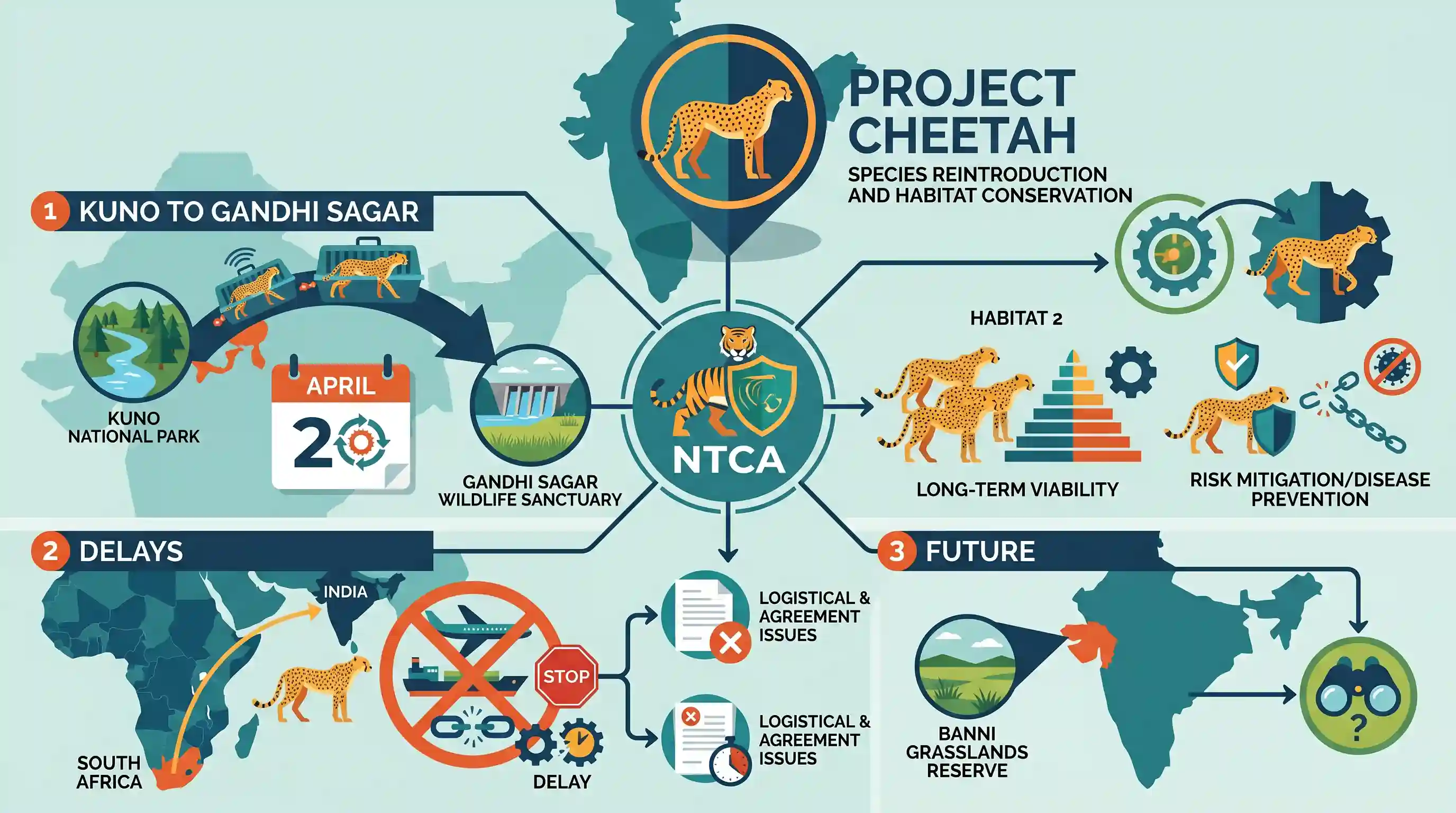
Two cheetahs will be translocated from Kuno National Park to the Gandhi Sagar Wildlife Sanctuary in Madhya Pradesh on April 20 as part of India's ongoing Project Cheetah. This move establishes Gandhi Sagar as the second habitat for cheetahs in the country, a crucial step to ensure the long-term viability of the population and mitigate risks such as disease outbreaks. The National Tiger Conservation Authority (NTCA) is overseeing the process. Additionally, the government is exploring the Banni Grasslands Reserve in Gujarat as a future habitat, though the planned importation of more cheetahs from South Africa has faced delays.
Key Points
- Two cheetahs are scheduled to be translocated from Kuno National Park to the Gandhi Sagar Wildlife Sanctuary on April 20.
- Gandhi Sagar Wildlife Sanctuary will serve as the second home for cheetahs in India, aimed at establishing geographically separated populations to reduce localized extinction risks.
- Future expansions of Project Cheetah are being considered, including the Banni Grasslands Reserve in Gujarat.
- The expected arrival of a second batch of cheetahs from South Africa has been delayed.
- The National Tiger Conservation Authority (NTCA) is steering the translocation and overall cheetah reintroduction efforts.
Important Terms
Project Cheetah

World’s first intercontinental large wild carnivore translocation project aimed at reintroducing cheetahs in India (extinct since 1952). It focuses on restoring grassland ecosystems and establishing a viable meta-population.
UPSC context
GS Paper III (Environment). Tests species reintroduction, biodiversity conservation, and the role of flagship species in ecosystem restoration.
National Tiger Conservation Authority (NTCA)
A statutory body under the MoEFCC, established under the Wildlife (Protection) Act, 1972. It provides administrative and policy oversight for Project Tiger and the Cheetah Reintroduction Project.
UPSC context
GS Papers II & III. Tests knowledge of statutory bodies and institutional frameworks for wildlife management in India.
Gandhi Sagar Wildlife Sanctuary
A protected area in Madhya Pradesh designated as India’s second cheetah habitat. This diversification aims to prevent overcrowding at Kuno National Park and mitigate risks like disease outbreaks.
UPSC context
GS Paper III (Environment). Relevant for map-based questions and strategies for habitat diversification in species conservation.
Banni Grasslands Reserve
Located in Gujarat’s Kutch district, it is Asia's largest grassland. It is a proposed site for cheetah introduction and a vital ecosystem for the semi-nomadic Maldhari community.
UPSC context
GS Papers I (Geography) & III (Environment). Tests knowledge of unique ecosystems and community-led conservation efforts.
Wildlife Institute of India (WII)
An autonomous institution under the MoEFCC that provides scientific expertise, habitat assessments, and technical monitoring for major wildlife conservation initiatives like Project Cheetah.
UPSC context
GS Paper III (Environment). Tests understanding of research-driven conservation and scientific support for environmental policy.
Ministry of Environment, Forest and Climate Change (MoEFCC)
The nodal ministry for planning, promoting, and overseeing environmental and forestry policies in India. It coordinates national and international commitments regarding biodiversity and climate change.
UPSC context
GS Paper II (Governance). Relevant for understanding the administrative structure and nodal agencies for environmental legislation.
Prelims Trap
"Project Cheetah aims to restore India's historical ecosystems by reintroducing the Asiatic Cheetah."
India is relocating African cheetahs. The Asiatic cheetah (historically found in India) only survives in Iran, which refused to share its critically endangered population for this project.
Static Concepts Connected
What is the statutory mandate of the National Tiger Conservation Authority (NTCA)?
- Statutory Origin: Established in 2006 via an amendment to the Wildlife (Protection) Act, 1972.
- Parent Ministry: Operates under the Ministry of Environment, Forest and Climate Change.
- Expanded Scope: Beyond tigers, it officially oversees Project Cheetah and coordinates complex inter-state and inter-continental wildlife relocations.
What are the distinct geographical features of Gandhi Sagar and Banni?
- Gandhi Sagar WLS: Located in northwestern Madhya Pradesh, this dry deciduous sanctuary is uniquely bifurcated by the Chambal River.
- Banni Grasslands: Situated near the Rann of Kutch in Gujarat, it is Asia's largest tropical grassland, characterized by high salinity and the Maldhari pastoralist community.
Cross-Topic Patterns
Protected Area river mapping
UPSC frequently asks to match wildlife sanctuaries with rivers flowing through them. Gandhi Sagar's direct intersection with the Chambal River makes it a prime target for this classic question template.
Metapopulation management strategy
Creating a "second home" limits species vulnerability to localized extinction from disease or disasters, mirroring the ecological logic behind the long-pending Asiatic Lion relocation from Gir to Kuno.

Expect a multi-statement question mapping emerging cheetah sites (Gandhi Sagar, Banni) with geographic features like the Chambal River.
Linked PYQs · 2
Linked PYQs · 2
- 2017PrelimsGS1
Recently there was a proposal to translocate some of the lions from their natural habitat in Gujarat to which one of the following sites?
- 2022PrelimsGS1
With reference to Indian laws about wildlife protection, consider the following statements : 1. Wild animals are the sole property of the government. 2. When a wild animal is declared protected, such animal is entitled for equal protection whether it is found in protected areas or outside. 3. Apprehension of a protected wild animal becoming a danger to human life is sufficient ground for its capture or killing. Which of the statements given above is/are correct?
