Great Indian Bustard Rewilding and Rajasthan Conservation
Source:The Hindu ↗
কেন এটি গুরুত্বপূর্ণ
The Great Indian Bustard is one of the most critically endangered bird species in the world, and its captive-breeding and release program represents a flagship test case for species recovery and wildlife management in India.
সারসংক্ষেপ
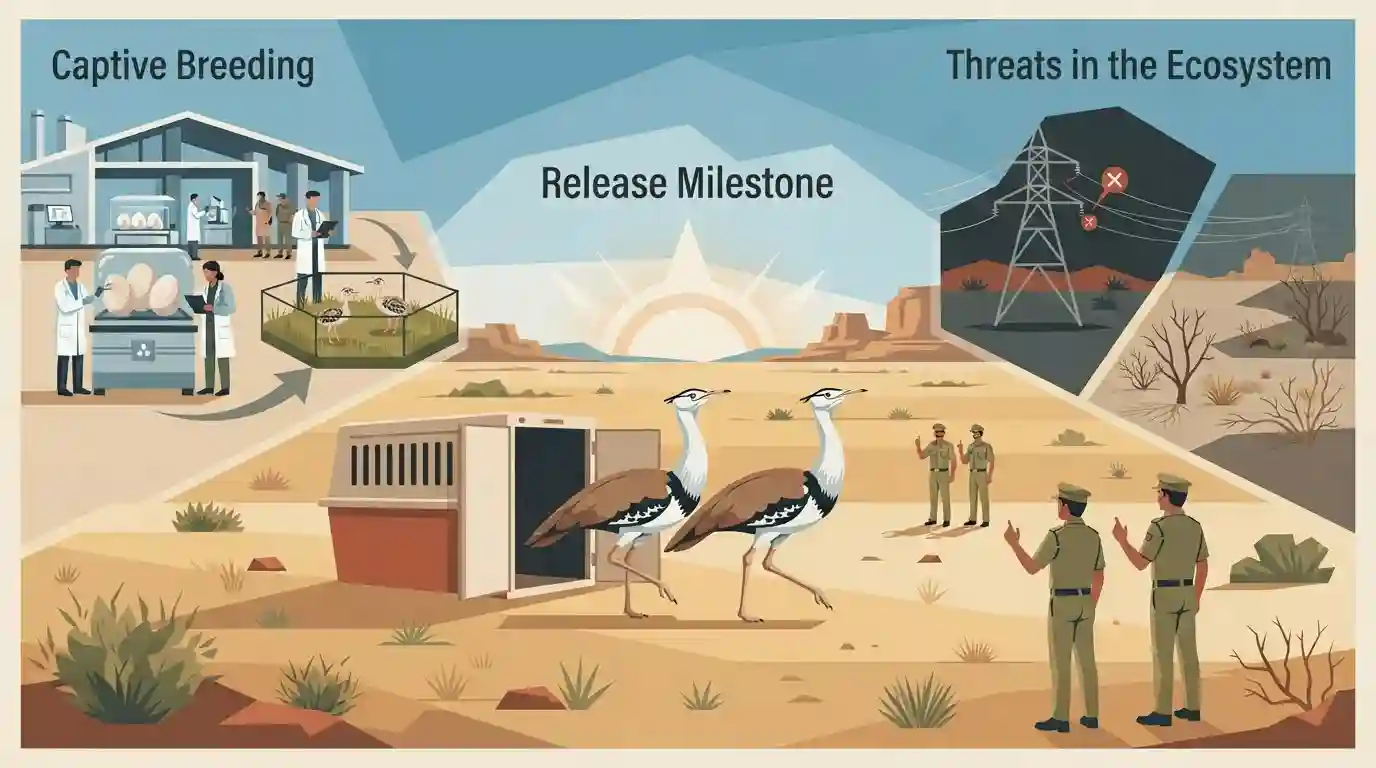
Two captive-bred Great Indian Bustards (GIBs), critically endangered birds native to arid grasslands, have been successfully released into the wild in Rajasthan. This marks an important milestone in India's conservation and captive-breeding efforts led by state forest authorities and research institutions to save the species from the brink of extinction, amidst persistent threats like power transmission lines and habitat degradation.
মূল বিষয়
- Two captive-bred Great Indian Bustards (GIBs) were successfully released into the wild in Rajasthan as part of species conservation efforts.
- The release marks a significant milestone for the captive breeding programme of the critically endangered Great Indian Bustard, one of India's heaviest flying birds.
- The initiative involves collaboration between the Rajasthan Forest Department, the Wildlife Institute of India (WII), and other conservation bodies.
- Major threats to the GIB include habitat loss, collisions with high-voltage power transmission lines, and stray dogs.
গুরুত্বপূর্ণ শব্দ
Species Recovery Programme

A targeted conservation initiative under India's centrally sponsored wildlife schemes aimed at rebuilding populations of critically endangered native species through captive breeding, habitat restoration, and reintroduction into the wild.
UPSC context
UPSC CSE Prelims and Mains (GS Paper III - Environment): Tests knowledge of government-backed strategies for endangered species management and biodiversity conservation.
Wildlife (Protection) Act, 1972
India's principal legislation for the protection of wild animals, birds, and plants. It places species like the Great Indian Bustard under Schedule I, granting them the highest level of legal protection against hunting and habitat destruction.
UPSC context
UPSC CSE Prelims and Mains (GS Paper III - Environment): Essential for questions on environmental laws, statutory protections, and wildlife sanctuaries.
Wildlife Institute of India (WII)
An autonomous institution under the Ministry of Environment, Forest and Climate Change providing technical expertise, research, and scientific leadership for wildlife management, biodiversity assessment, and species reintroduction programs in India.
UPSC context
UPSC CSE Prelims: Frequently asked regarding research bodies, conservation science, and institutional roles in environmental governance.
প্রিলিমস ফাঁদ
The Great Indian Bustard is exclusively found in the Desert National Park of Rajasthan with no historical range outside the state.
Aspirants often assume GIB is endemic only to Rajasthan or that captive breeding has successfully recovered wild populations across all historical ranges. Its stronghold is specifically Desert National Park.
সংযুক্ত স্থির ধারণা
What are the key legal protections and IUCN statuses of India's critically endangered bustard species?
- Legal Protection: Schedule I status under Wildlife (Protection) Act, 1972, granting it the highest level of legal protection in India.
- IUCN Status: Listed as Critically Endangered on the IUCN Red List due to rapid population declines driven by habitat loss.
- Primary Habitat: Desert National Park in Rajasthan serves as its primary natural habitat and stronghold in India.
- Recovery Programme: Identified as one of the priority species under the Species Recovery Programme of the Ministry of Environment.
আন্তঃবিষয় প্যাটার্ন
Renewable energy corridors vs. endangered fauna protection
GIB mortality from high-voltage cables triggered landmark Supreme Court directives on undergrounding power lines, balancing renewable energy transmission with wildlife conservation.
Species Recovery Programme and ex-situ conservation
Captive-breeding programs for GIB reflect the shift from passive protection to intensive ex-situ and in-situ intervention under the Species Recovery Programme.

GIB habitat threats (power lines, Desert National Park) + IUCN status + Wildlife Protection Act Schedule I placement.
সংযুক্ত PYQ · 1
সংযুক্ত PYQ · 1
- 2020PrelimsGS1
With reference to India's Desert National Park, which of the following statements are correct? 1. It is spread over two districts. 2. There is no human habitation inside the Park. 3. It is one of the natural habitats of Great Indian Bustard. Select the correct answer using the code given below:
