Great Indian Bustard Release In Rajasthan Conservation Program
Source:The Hindu ↗
Why It Matters
Directly pertains to Rajasthan's state bird, the Great Indian Bustard, and state-level wildlife conservation breeding initiatives, making it highly relevant for RPSC RAS questions on regional environment, biodiversity, and protected species.
Summary
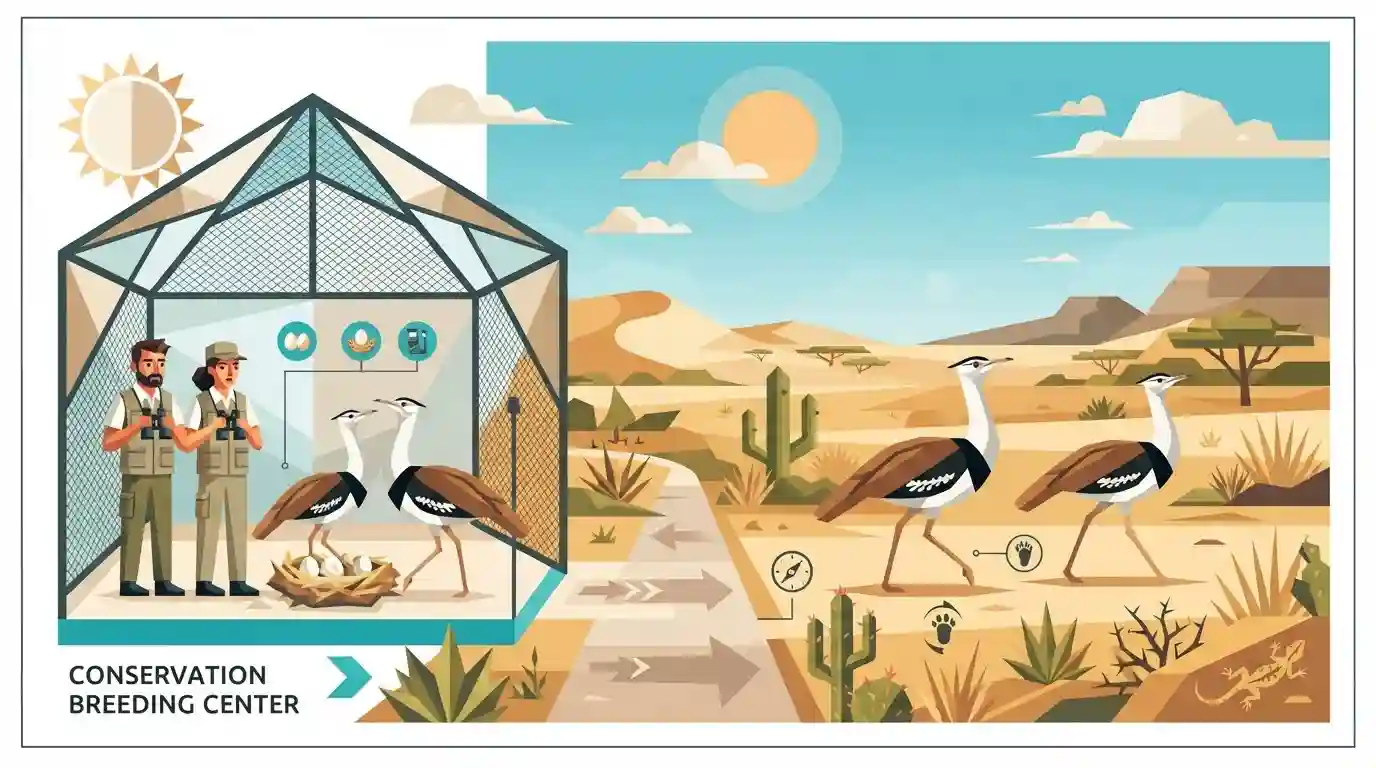
Two captive-bred Great Indian Bustards (Godawan)—Rajasthan's state bird—have been released into the wild as part of targeted conservation breeding initiatives to save the critically endangered species from extinction.
Key Points
- Two captive-bred Great Indian Bustards (GIBs), locally known as Godawan, were successfully released into the wild in Rajasthan under ongoing conservation efforts.
- The Great Indian Bustard is critically endangered, and Rajasthan is its primary stronghold, particularly in habitats like the Desert National Park.
- Captive-breeding programs serve as a crucial intervention to supplement declining wild populations of this flagship grassland species.
- Key threats to the species include overhead power transmission lines, habitat degradation, and low reproductive rates.
Important Terms
State Forest Department

The state government body responsible for the management, protection, and administration of forests, wildlife sanctuaries, and state-level conservation initiatives in Rajasthan.
UPSC context
Important for RPSC (Rajasthan Administration and Geography) covering state institutional mechanisms for wildlife protection, forestry, and biodiversity management.
Wildlife Institute of India
An autonomous national institution under the Ministry of Environment, Forest and Climate Change (MoEFCC) dedicated to wildlife research, capacity building, and supporting endangered species recovery programs across India.
UPSC context
Important for RPSC/UPSC General Studies (Environment & Ecology) assessing central scientific bodies involved in species reintroduction and conservation breeding.
Prelims Trap
captive-bred Great Indian Bustards have fully restored the wild population of Rajasthan's state bird.
Aspirants often assume GIB is extinct in the wild or that captive breeding has fully recovered the population; only two initial captive-bred birds have been released so far under ongoing efforts.
Static Concepts Connected
What are the key ecological characteristics and conservation status of the Great Indian Bustard?
- State Symbol: Rajasthan state bird locally known as Godawan, designated as the flagship grassland species of the Thar desert region.
- IUCN Status: Listed as Critically Endangered under the IUCN Red List, facing extreme risk of global extinction.
- Legal Protection: Included in Schedule I of the Wildlife Protection Act, 1972, offering the highest degree of legal protection.
- Global Treaties: Protected under Appendix I of the Convention on Migratory Species (CMS) and CITES.
Cross-Topic Patterns
GIB Conservation vs Renewable Energy Transmission
The collision with high-voltage power lines is a leading cause of GIB mortality, linking wildlife conservation with renewable energy infrastructure development in the Thar Desert.

GIB conservation, status, habitat (Desert National Park), and primary threats (power lines) are high-yield for RPSC RAS prelims/mains.
Linked PYQs · 3
Linked PYQs · 3
- 2023RPSC_PRELIMSGS1
The National Tiger Conservation Authority has conferred the status of the fifth tiger sanctuary in Rajasthan, to which of the following sanctuaries?
- 2023RPSC_PRELIMSGS1
Which of the following pairings is incorrect? Wildlife Sanctuary – District
- 2025RPSC_PRELIMSGS1
Choose the incorrect statement with respect to the Rajasthan Forestry and Biodiversity Project (Phase-2).
