Captive Bred Great Indian Bustard Release In Rajasthan
Source:The Hindu ↗
Why It Matters
The Great Indian Bustard is a critically endangered endemic bird species whose conservation status, state-bird significance in Rajasthan, and captive breeding initiatives are frequently tested in state-level public service exams.
Summary
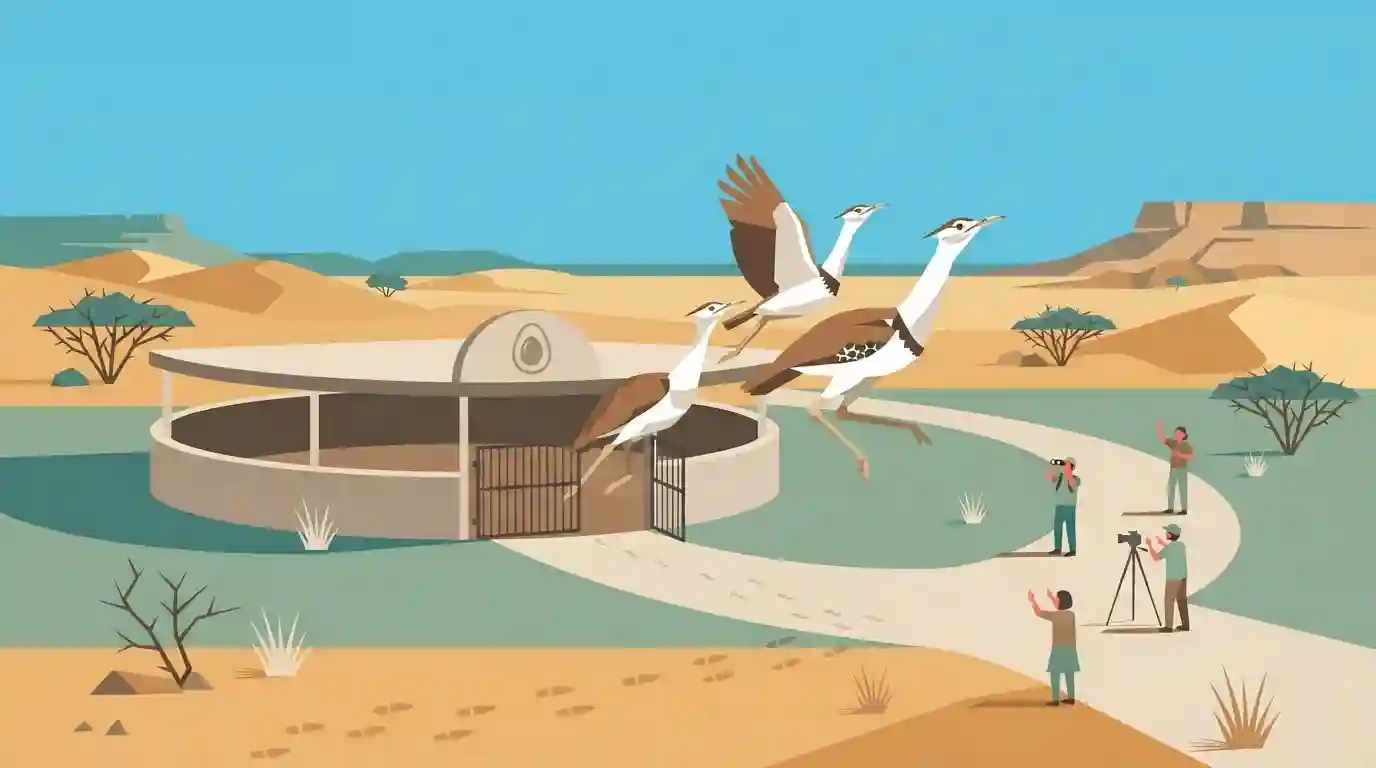
Two captive-bred Great Indian Bustards have been released into the wild in Rajasthan, marking a significant milestone in the conservation of India's critically endangered state bird.
Key Points
- Two captive-bred Great Indian Bustards (GIBs) were successfully released into the wild in Rajasthan as part of species conservation efforts.
- The Great Indian Bustard (Godawan) is critically endangered and is the State Bird of Rajasthan.
- Captive breeding programs play a vital role in reviving populations of highly threatened endemic species facing imminent extinction threats like power line collisions and habitat loss.
Important Terms
Great Indian Bustard

The state bird of Rajasthan, classified as critically endangered by the IUCN and protected under Schedule I of the Wildlife Protection Act, known for significant conservation breeding and rewilding efforts in the Thar Desert.
UPSC context
Crucial for RPSC/UPSC Environment & Ecology (Species in News, Biodiversity Conservation, Rajasthan state symbols).
Rajasthan Forest Department
The state government body responsible for implementing wildlife protection laws, habitat restoration, and conservation projects like Project Great Indian Bustard in Rajasthan's protected areas.
UPSC context
Important for Rajasthan Geography and Environment, state administrative setup, and wildlife management schemes (RPSC Paper III/IV).
Wildlife Institute of India
An autonomous institution under the Ministry of Environment, Forest and Climate Change, Government of India, providing scientific research and technical guidance for wildlife conservation and species reintroduction programs.
UPSC context
Asked in RPSC/UPSC Prelims under national conservation institutions, research bodies, and ecological monitoring.
Prelims Trap
Captive breeding and wild release of Great Indian Bustards is currently underway across all historical states of its range.
Aspirants often assume GIBs are successfully bred and released across multiple states, but the program is primarily centered in Rajasthan (its stronghold).
Static Concepts Connected
What are the key ecological characteristics and legal status of the Great Indian Bustard (GIB)?
- IUCN Status: Critically Endangered status on the IUCN Red List due to rapid population decline.
- State Identity: State Bird of Rajasthan, locally known as 'Godawan', found primarily in the Thar Desert.
- Legal Protection: Listed under Schedule I of the Wildlife (Protection) Act, 1972, giving it highest legal protection.
- Threats: Primary threats include overhead power transmission lines (collisions) and habitat loss from agriculture and renewable energy projects.
Cross-Topic Patterns
Renewable Energy vs. Wildlife Corridor Conflicts
GIB conservation intersects with power transmission projects, raising legal conflicts between India's renewable energy push (solar/wind in Thar) and wildlife protection under the Wildlife Protection Act.
Arid Ecosystem Restoration and Pastoralism
Species recovery programs in Rajasthan require balancing pastoral livelihoods with strict protected area regulations in fragile arid ecosystems like the Thar.

GIB captive breeding + Desert National Park + power line collision threats is a high-yield RPSC biodiversity match.
Linked PYQs · 2
Linked PYQs · 2
- 2025RPSC_PRELIMSGS1
Choose the incorrect statement with respect to the Rajasthan Forestry and Biodiversity Project (Phase-2).
- 2023RPSC_PRELIMSGS1
The National Tiger Conservation Authority has conferred the status of the fifth tiger sanctuary in Rajasthan, to which of the following sanctuaries?
