Great Indian Bustard Species Recovery Release In Rajasthan
Source:The Hindu ↗
Why It Matters
Crucial for RPSC RAS aspirants tracking state-specific environmental updates, endangered species conservation programs, and state symbols of Rajasthan.
Summary
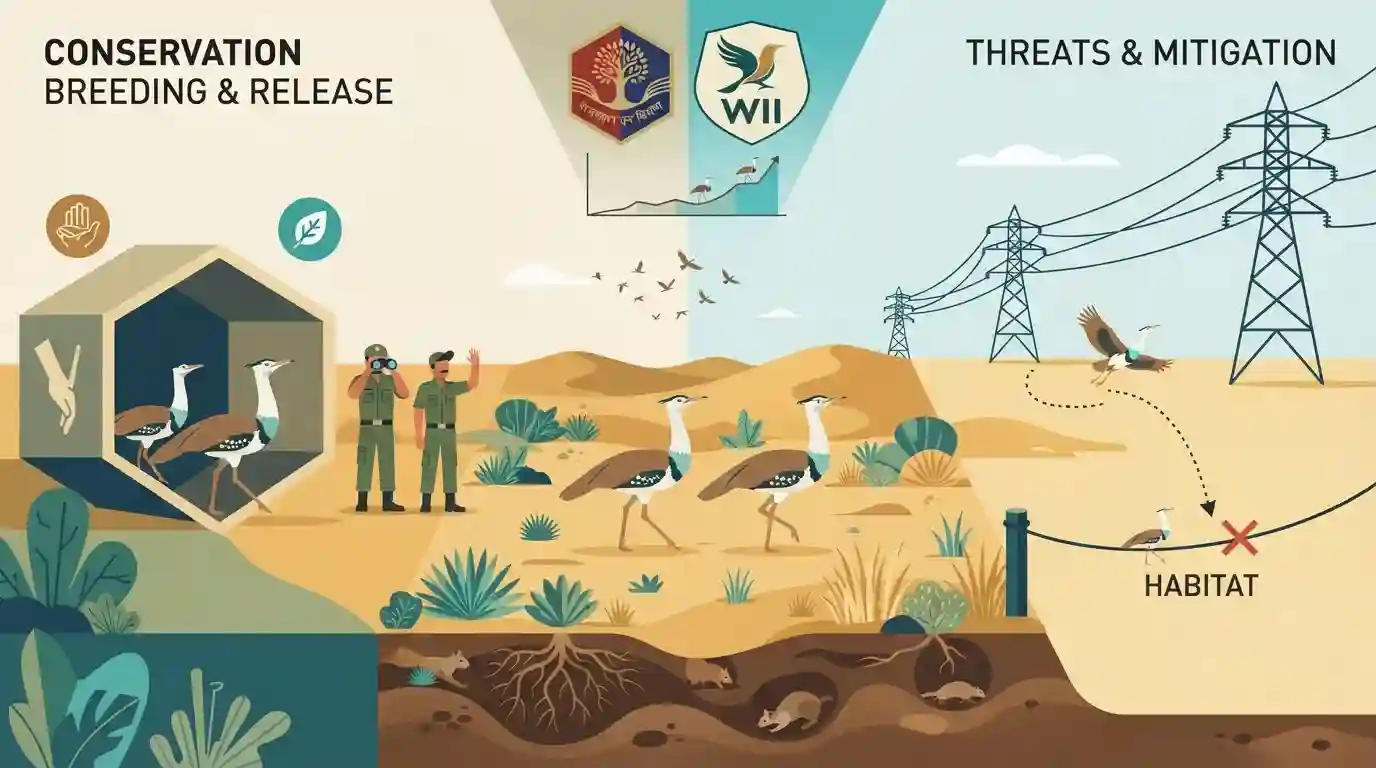
Two captive-bred Great Indian Bustards (GIBs), Rajasthan's critically endangered state bird, have been released into the wild in Rajasthan under targeted conservation and species recovery efforts. This milestone highlights the collaborative captive-breeding programs led by the Rajasthan Forest Department and the Wildlife Institute of India to revive the dwindling population of the species, which faces severe threats from habitat loss and high-tension power lines in the Thar Desert.
Key Points
- Two captive-bred Great Indian Bustards (GIBs) were successfully released into the wild in Rajasthan as part of ongoing species recovery and conservation programs.
- The Great Indian Bustard (Ardeotis nigriceps) is critically endangered and is Rajasthan's state bird, with its primary remaining stronghold in the Thar Desert region.
- Captive breeding initiatives are being undertaken jointly by the Rajasthan Forest Department, Wildlife Institute of India (WII), and the Union Ministry of Environment, Forest and Climate Change to save the species from the brink of extinction.
- Major threats to the species include habitat degradation, free-ranging dogs, and collision with overhead power transmission lines.
Important Terms
Wildlife Institute of India

A premier autonomous institution under the Ministry of Environment, Forest and Climate Change, Government of India, providing technical expertise and research for wildlife management and conservation biology.
UPSC context
RPSC Paper III (Environment & Biodiversity) / Prelims: Tests knowledge of key national scientific bodies assisting state-level wildlife conservation initiatives like Project GIB.
Rajasthan Forest Department
The principal state government agency responsible for protecting, managing, and conserving Rajasthan's forests, wildlife habitats, and state-level species recovery programs such as the Great Indian Bustard rewilding project.
UPSC context
RPSC RAS Prelims & Mains (Rajasthan Geography & Environment): Tests knowledge of state administrative agencies executing endangered species conservation and habitat restoration.
Prelims Trap
exclusive central government captive-breeding program
Aspirants often assume GIB captive breeding is exclusively a central government initiative, ignoring the vital collaborative role of the Rajasthan Forest Department and WII.
Static Concepts Connected
What are the key conservation parameters and statutory protections of the Great Indian Bustard in India?
- Legal Status: Schedule 1 protection under the Wild Life (Protection) Act, 1972, granting the highest level of legal protection against hunting or habitat destruction.
- IUCN Status: Critically Endangered on the IUCN Red List, with fewer than 150 individuals remaining globally, primarily concentrated in Rajasthan's Thar Desert.
- Recovery Programme: Endangered Species Recovery Programme identified by the MoEFCC, featuring specialized captive-breeding facilities at Sam and Ramdevra in Jaisalmer.
Cross-Topic Patterns
GIB Protection vs Renewable Energy Corridors
The Supreme Court mandated undergrounding high-tension power lines in the Thar Desert to protect GIBs, intersecting wildlife conservation with renewable energy transmission mandates.

Expect a matching-list or multi-statement question on GIB conservation partners, IUCN status, and Thar desert threats in RPSC exams.
Linked PYQs · 2
Linked PYQs · 2
- 2023RPSC_PRELIMSGS1
The National Tiger Conservation Authority has conferred the status of the fifth tiger sanctuary in Rajasthan, to which of the following sanctuaries?
- 2021RPSC_PRELIMSGS1
The state flower of Rajasthan is
