Rajasthan Releases Captive Bred Great Indian Bustards
Source:The Hindu ↗
Why It Matters
Crucial for RPSC RAS aspirants tracking environmental conservation initiatives, state symbols, and endangered species management within Rajasthan.
Summary
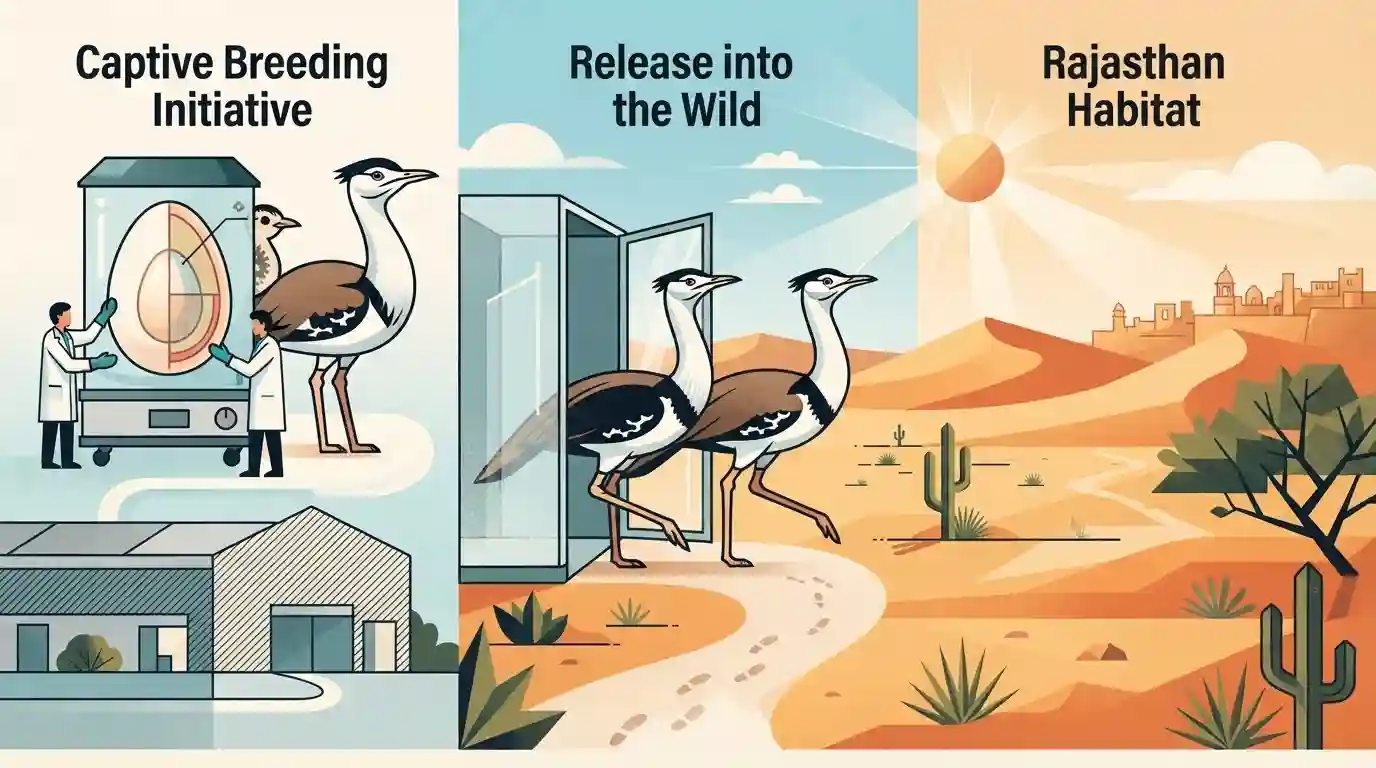
Two captive-bred Great Indian Bustards, one of the world's rarest and India's most critically endangered birds, have been released into the wild in Rajasthan as part of intensive conservation and breeding initiatives.
Key Points
- Two captive-bred Great Indian Bustards (GIBs) were successfully released into the wild in Rajasthan as part of species conservation efforts.
- The Great Indian Bustard is critically endangered and is state bird of Rajasthan, facing severe threats from habitat loss and high-tension power lines.
- Captive breeding programs aim to boost the declining wild population of India's most critically endangered bird.
Important Terms
Rajasthan Forest Department

The state forest administration body of Rajasthan responsible for wildlife protection, forestry management, and implementing endangered species conservation projects such as the Great Indian Bustard rewilding initiative in Jaisalmer.
UPSC context
RPSC RAS Prelims & Mains (Environment & Geography): Tests role of state departments in wildlife conservation and regional biodiversity management.
Wildlife Institute of India
An autonomous institution under the Ministry of Environment, Forest and Climate Change, providing scientific advisory, research, and technical leadership for wildlife management and endangered species recovery programs in India.
UPSC context
RPSC RAS Prelims & Mains (Environment & Ecology): Tests key national scientific institutions involved in wildlife protection, research, and conservation breeding.
Prelims Trap
The captive breeding program for the Great Indian Bustard is run exclusively by the Union Ministry of Environment.
Aspirants often assume GIB captive breeding is solely managed by the central government, overlooking the crucial collaborative role of the Rajasthan Forest Department and WII.
Static Concepts Connected
What are the key protected areas and conservation breeding sites for the Great Indian Bustard in Rajasthan?
- State Status: State Bird: Designated as the state bird of Rajasthan, locally known as 'Godawan'.
- Natural Habitat: Core Habitat: Primarily found in the Desert National Park, Jaisalmer, along with pockets in Kachchh (Gujarat) and Andhra Pradesh.
- Ex-situ Centers: Breeding Centers: Dedicated breeding and conservation facilities are located at Sam and Ramdevra in Jaisalmer district.
- Primary Threat: Major Threat: Collisions with overhead high-tension electric power transmission wires are the leading cause of adult mortality.
Cross-Topic Patterns
Renewable Energy Corridors vs. Wildlife Conservation
GIB power line collisions intersect with renewable energy transmission mandates, posing a governance dilemma between green energy goals and endangered species protection in the Thar Desert.

GIB conservation facilities (Sam/Ramdevra), IUCN status, and powerline mitigation orders will feature in RPSC Environment matching questions.
Linked PYQs · 3
Linked PYQs · 3
- 2023RPSC_PRELIMSGS1
The National Tiger Conservation Authority has conferred the status of the fifth tiger sanctuary in Rajasthan, to which of the following sanctuaries?
- 2025RPSC_PRELIMSGS1
Choose the incorrect statement with respect to the Rajasthan Forestry and Biodiversity Project (Phase-2).
- 2023RPSC_PRELIMSGS1
According to the India State Forest Report 2021, the forest area, in terms of forest cover, is 16,654 sq km, which is ___ percent of Rajasthan's geographical area.
