States Raise Concerns Over Financial Burden of New Rural Scheme
Source:The Hindu ↗
Why It Matters
The transition from MGNREGA to VB-G RAM G highlights crucial dynamics in Centre-State financial relations and cooperative federalism, demonstrating how changes in the funding patterns of Centrally Sponsored Schemes impact state exchequers. It also touches upon rural welfare policy dilemmas, such as balancing agricultural labour supply with the income security and bargaining power of rural workers.
Summary
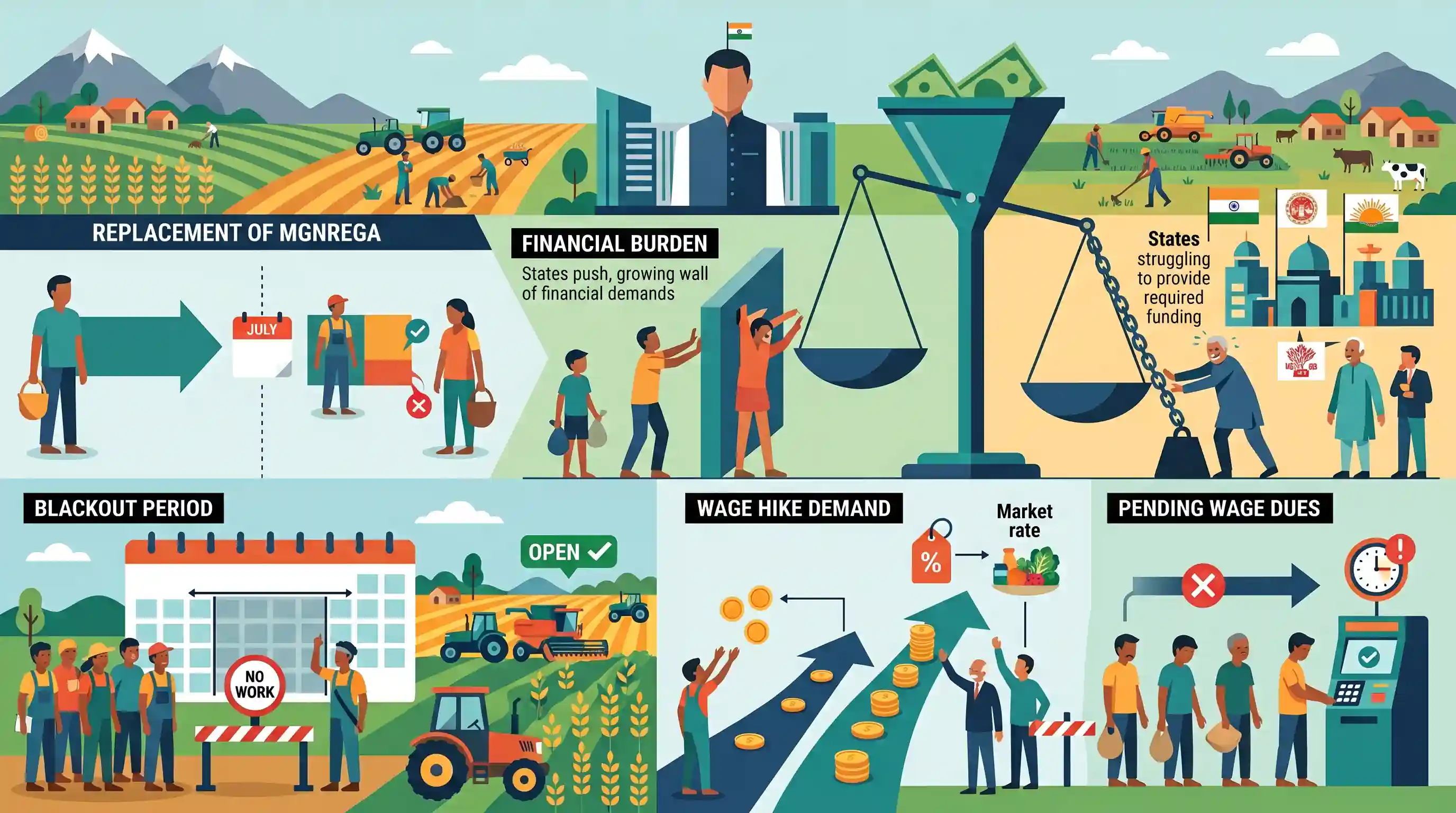
Several states, including BJP-led Bihar and Madhya Pradesh, have raised strong objections to the financial structure of the newly proposed Viksit Bharat-Guarantee for Rozgar and Aajeevika Mission (Gramin) (VB-G RAM G), which will replace MGNREGA on July 1. The primary contention is the shift from a model where the Centre fully funded the wage bill to a 60:40 funding pattern for the total expenditure, imposing a heavy financial burden on states. Furthermore, states have opposed a proposed 60-day 'blackout period' during peak agricultural seasons and demanded wage hikes to better reflect market rates, alongside the swift clearance of pending wage dues.
Key Points
- The VB-G RAM G scheme is set to replace MGNREGA starting July 1, promising 125 days of rural employment.
- The new scheme introduces a 60:40 Centre-State funding ratio for total expenditure, shifting from MGNREGA where the Centre bore 100% of the wage bill.
- States like Bihar, Madhya Pradesh, and Jharkhand opposed the new funding pattern, citing an unmanageable financial burden of thousands of crores.
- Special category states (Himalayan/North-Eastern) maintain a 90:10 ratio, though Uttarakhand requested 100% central wage funding due to difficult terrain.
- Four states objected to a proposed 60-day 'blackout period' during peak agricultural seasons, which critics argue will strip rural workers of bargaining power.
- Five states requested wage revisions to match market rates, while almost all states highlighted the persistent issue of delayed wage payments.
Important Terms
Viksit Bharat-Guarantee for Rozgar and Aajeevika Mission (Gramin) (VB-G RAM G)

A 2025 legislation replacing MGNREGA, increasing guaranteed work to 125 days while introducing a 60:40 Centre-State funding ratio and seasonal 'blackout periods' to ensure agricultural labor availability.
UPSC context
GS II: Welfare schemes, Social Justice. Critical for understanding shifts from rights-based to allocation-linked social security models.
Mahatma Gandhi National Rural Employment Guarantee Act (MGNREGA)
The 2005 landmark legislation providing a legal right to 100 days of unskilled manual work. It featured 100% Central funding for wages and a demand-driven financial model.
UPSC context
GS II & III: Governance and Economy. Evaluates the evolution of India's largest rural safety net.
NREGA Sangharsh Morcha
A national network of activists and worker organizations advocating for the rights of rural laborers; currently leading protests against the repeal of MGNREGA.
UPSC context
GS II: Civil Society and Pressure Groups. Tests understanding of non-state actors in policy advocacy.
Cooperative Federalism
A constitutional concept where Centre and States collaborate to solve national problems; used by the Centre to justify cost-sharing, but contested by States citing fiscal stress.
UPSC context
GS II: Federal Structure. Key for analyzing Centre-State financial relations and Centrally Sponsored Schemes.
Viksit Gram Panchayat Plans
The integrated planning framework under VB-G RAM G that aligns village-level infrastructure projects with national spatial tools like PM Gati Shakti and GIS-based mapping.
UPSC context
GS II: Panchayati Raj. Focuses on the decentralization of planning and integration with national infrastructure goals.
National Campaign for People's Right to Information (NCPRI)
A broad-based network advocating for transparency and accountability; its members used RTI to uncover state-level objections to the new rural employment framework.
UPSC context
GS II: Accountability and Transparency. Highlights the role of institutionalized RTI in monitoring policy changes.
Prelims Trap
Under VB-G RAM G, the Centre continues to bear 100% of the unskilled wage cost.
Aspirants often conflate MGNREGA's legacy 100% central wage funding with the new VB-G RAM G scheme, which shifts to a 60:40 overall expenditure ratio.
Static Concepts Connected
What are the standard funding patterns for Centrally Sponsored Schemes (CSS)?
- Core of the Core: Schemes of paramount national importance (e.g., MGNREGA previously) historically retained higher or 100% central funding for core components like wages.
- Core Schemes: For most schemes, general category states have a 60:40 (Centre:State) ratio, while North-Eastern and Himalayan states share a 90:10 ratio.
- Finance Commission Impact: Following the 14th FC's increase in tax devolution to states (42%), the Centre rationalized CSS funding to demand higher state contribution.
Which Constitutional provisions relate to rural employment guarantee schemes?
- Article 41 (DPSP): Directs the State to secure the right to work, education, and public assistance in cases of unemployment or old age.
- Article 43 (DPSP): Mandates the State to secure a living wage, decent standard of life, and full enjoyment of leisure for all workers.
- Statutory Rights: Schemes like MGNREGA and VB-G RAM G provide statutory, justiciable backing to these otherwise non-justiciable directive principles.
Cross-Topic Patterns
Fiscal Federalism & CSS Burden
The shift to a 60:40 ratio forces states to co-fund wages, stressing state exchequers and highlighting ongoing friction in fiscal federalism post-14th Finance Commission.
Farm Labor vs Welfare Intersections
The novel 'blackout period' connects rural welfare policy to agricultural economics, addressing farmer complaints about labor shortages during peak sowing and harvesting seasons.

Expect a 2026 Prelims question comparing MGNREGA vs VB-G RAM G, specifically targeting the 60:40 wage funding shift and blackout periods.
Linked PYQs · 3
Linked PYQs · 3
- 2025MainsGS2
Examine the evolving pattern of Centre-State financial relations in the context of planned development in India. How far have the recent reforms impacted the fiscal federalism in India?
- 2024MainsGS2
What changes has the Union Government recently introduced in the domain of Centre-State relations ? Suggest measures to be adopted to build the trust between the Centre and the States and for strengthening federalism.
- 2019PrelimsGS1
The Service Area Approach was implemented under the purview of
