Interstellar scintillation and local cosmic plasma density mapping
Source:The Hindu ↗
Why It Matters
Understanding space phenomena like interstellar scintillation and plasma structures is crucial for UPSC aspirants as it aligns with the 'Awareness in Space' syllabus. Such discoveries demonstrate the practical application of observational astronomy and basic physics principles, forming the basis for Prelims questions on space concepts (e.g., pulsars, plasma) and Mains questions on space missions and technological advancements.
Summary
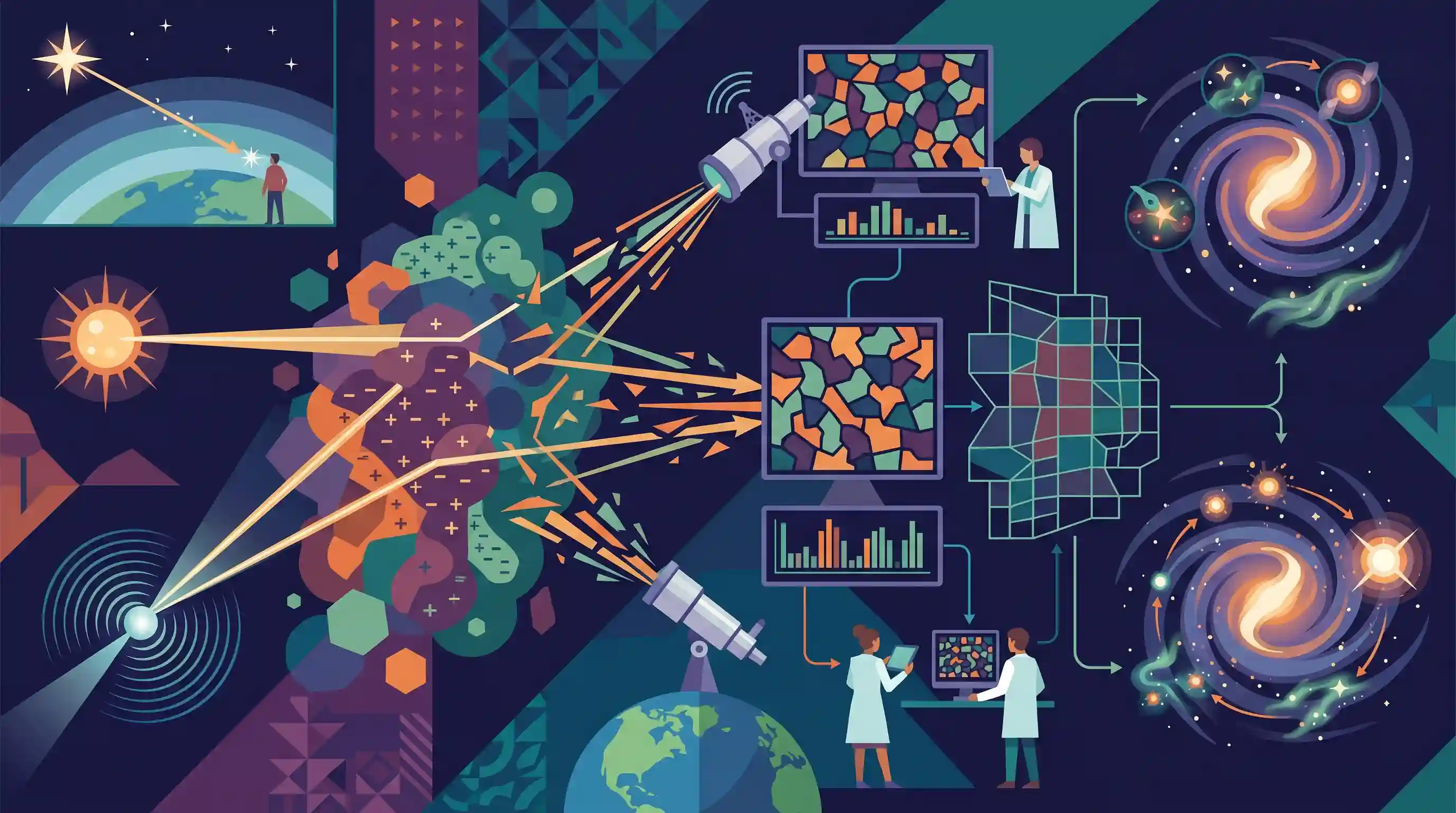
A recent astronomical study highlights how the 'twinkling' or scintillation of a distant star is being used to unveil the hidden secrets of plasma structures in our local cosmic neighbourhood. Just as Earth's atmosphere causes visible stars to twinkle by refracting light, the turbulent interstellar medium (ISM)—composed largely of ionized gas or plasma—causes electromagnetic emissions from distant stars and pulsars to scatter and scintillate. By carefully analyzing these scintillation patterns, researchers are able to map the density and intricate architecture of interstellar plasma. This provides unexpected insights into the physical properties of the space between stars, ultimately advancing our understanding of galactic structures, stellar evolution, and the dynamics of our Milky Way.
Key Points
- Astronomers have utilized the phenomenon of 'twinkling' (scintillation) of a star to study the invisible plasma structures in our cosmic neighbourhood.
- While stars appear to twinkle from Earth due to our planet's atmosphere, interstellar scintillation occurs when electromagnetic waves (like radio emissions from pulsars) pass through turbulent plasma in the interstellar medium (ISM).
- By observing how this starlight or radio emission is scattered and refracted, scientists can map the density, structure, and unexpected dynamics of these interstellar plasma clouds.
- The discovery offers novel insights into the composition of the Local Interstellar Medium, helping astrophysicists understand how cosmic materials are distributed and how they interact with stellar winds.
- This research underscores the critical role of advanced observational astronomy and radio telescopes in decoding the hidden physics of our galaxy.
Prelims Trap
"Stellar scintillation observed by radio telescopes is caused by Earth's atmospheric refraction."
Naked-eye twinkling is atmospheric. Interstellar scintillation, however, is caused by electromagnetic waves interacting with turbulent plasma in the Interstellar Medium (ISM).
Static Concepts Connected
What constitutes Plasma and the Interstellar Medium (ISM)?
- Plasma: The fourth state of matter, consisting of highly charged, hot gas with positive ions and free electrons. It makes up roughly 99% of the visible universe.
- Interstellar Medium (ISM): The matter filling the space between stars, predominantly composed of atomic and molecular hydrogen and helium gas, mixed with ionized plasma and cosmic dust.
What are Pulsars and how do they probe space?
- Neutron Star Remnants: Highly magnetized, rapidly rotating neutron stars formed after the gravitational collapse of massive stars.
- Cosmic Lighthouses: They emit highly regular beams of electromagnetic radiation (usually radio waves). As these waves pass through the ISM, plasma alters them, revealing cosmic structures.
Cross-Topic Patterns
Radio Telescopes & ISM Mapping
Interstellar mapping relies on advanced radio astronomy. Connect this observation technique to India's Giant Metrewave Radio Telescope (GMRT) and the global Square Kilometre Array (SKA) project.
Solar Wind & The Heliosphere
Understanding the Local Interstellar Medium (LISM) helps map the heliosphere's boundary, linking directly to solar missions like Aditya-L1 and studies of solar wind plasma.

Expect a 2026 physics question contrasting atmospheric scintillation (optical) with interstellar scintillation (radio) and ISM composition.
Linked PYQs · 2
Linked PYQs · 2
- 2023PrelimsGS1
Consider the following pairs: Objects in space Description 1. Cepheids: Giant clouds of dust and gas in space 2. Nebulae: Stars which brighten and dim periodically 3. Pulsars: Neutron stars that are formed when massive stars run out of fuel and collapse How many of the above pairs are correctly matched?
- 2022MainsGS3
Launched on 25th December, 2021, James Webb Space Telescope has been much in the news since then. What are its unique features which make it superior to its predecessor Space Telescopes ? What are the key goals of this mission ? What potential benefits does it hold for the human race?
