Madras High Court hears petitions over tragic Karur political stampede
Source:The Hindu ↗
Why It Matters
Stampedes at political and religious gatherings are recurring man-made disasters in India. This incident is important for UPSC aspirants as it underscores the necessity of shifting from reactive to proactive disaster management (crowd control protocols) and touches upon the constitutional debate of judicial activism when courts direct the executive to frame policies (e.g., mandating security deposits for political rallies).
Summary
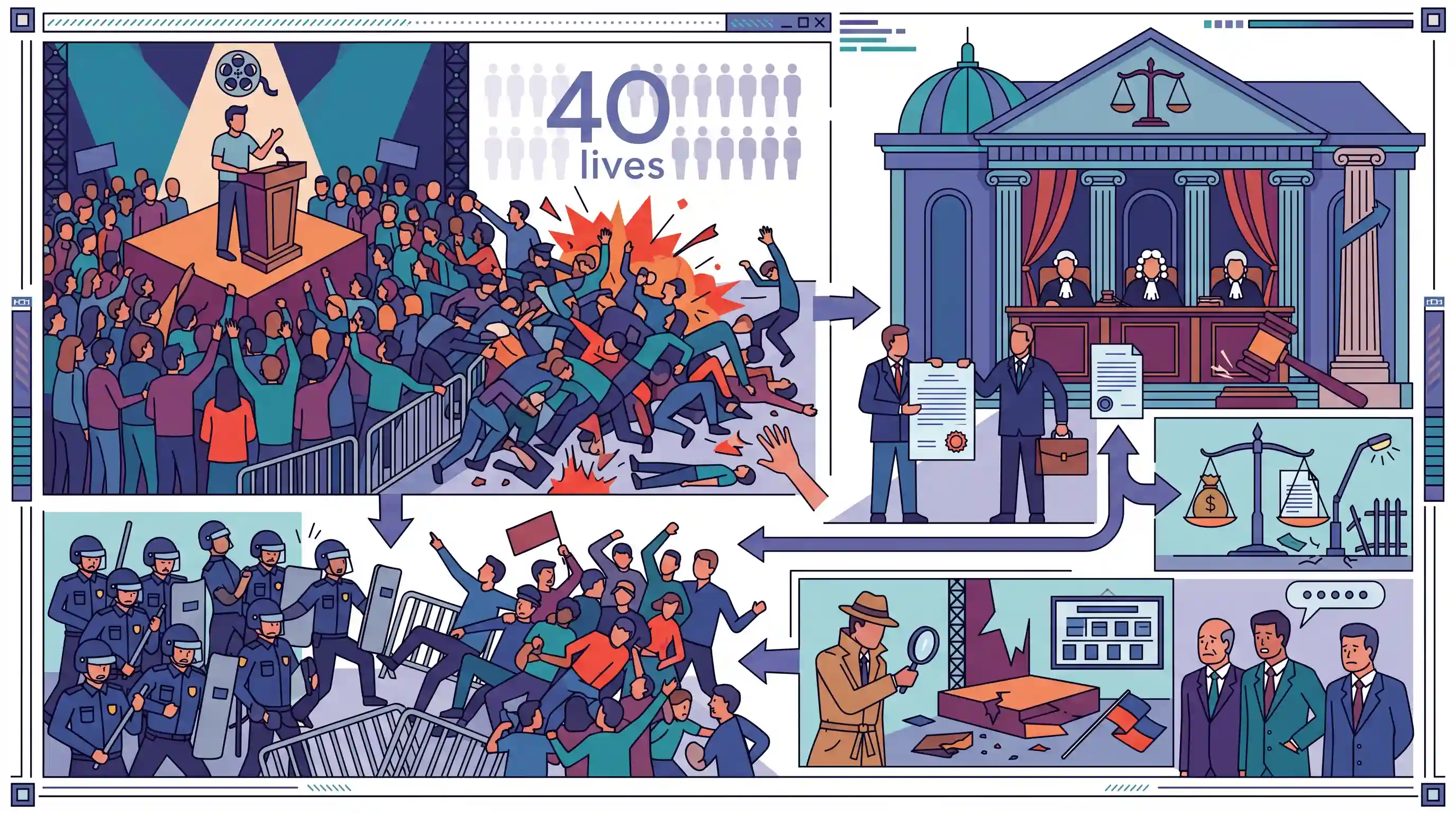
A tragic stampede at a political rally held by actor-turned-politician C. Joseph Vijay's party, TVK, in Karur district claimed 40 lives, prompting immediate judicial and administrative intervention. The Madras High Court is hearing petitions regarding the state's handling of the aftermath, while also previously urging the government to mandate security deposits for political rallies to cover property damage. The incident highlights critical failures in crowd management and raises governance questions regarding the regulation of mass political gatherings and judicial directives to the executive.
Key Points
- A stampede at a Tamilaga Vettri Kazhagam (TVK) political rally in Karur district resulted in 40 deaths and over 80 injuries due to severe crowd mismanagement.
- The Madurai Bench of the Madras High Court agreed to urgently hear a plea from the TVK alleging that the state government and police conducted autopsies without identifying the bodies.
- A separate impleading petition sought to restrain the TVK from holding further public gatherings without establishing adequate safety protocols.
- In a related context, a Madras High Court judge recently urged the State to formulate a policy to collect security deposits from political parties before granting permission for rallies, aiming to compensate for damage to public and private property.
- The Tamil Nadu government announced a one-person Commission of Inquiry headed by retired judge Aruna Jagadeesan to probe the stampede.
Important Terms
Tamilaga Vettri Kazhagam (TVK)

A regional political party in Tamil Nadu and Puducherry founded in 2024 by actor-turned-politician Vijay, focused on social justice and secularism.
UPSC context
Relevant for GS Paper II (Polity) concerning regional parties, electoral politics, and the influence of cinema in Indian politics.
Madras High Court
One of India's three original presidency High Courts (est. 1862), exercising appellate and original jurisdiction over Tamil Nadu and Puducherry.
UPSC context
Significant for GS Paper II (Judiciary) regarding high court jurisdiction, constitutional powers (Article 226), and historic legal institutions.
Madurai Bench of Madras High Court
A permanent seat of the Madras High Court established in 2004 to handle cases from 13 southern districts of Tamil Nadu.
UPSC context
Tests knowledge of High Court benches, decentralization of justice, and jurisdictional overlaps under GS Paper II (Governance/Judiciary).
Security Deposit (for Political Rallies)
A proposed mandatory financial bond from political parties to cover potential property damage and victim compensation during mass public gatherings.
UPSC context
Relates to GS Paper II (Judicial Activism) and GS Paper IV (Administrative Ethics) regarding accountability for public disorder and property loss.
Special Investigation Team (SIT)
A specialized investigative body often constituted by courts or governments to conduct fair, independent probes into high-profile incidents or tragedies.
UPSC context
Critical for GS Paper III (Internal Security) and GS Paper II regarding criminal justice reform and police accountability.
Public Interest Litigation (PIL)
A legal mechanism allowing citizens or groups to file litigation in courts for the protection of public interest and fundamental rights.
UPSC context
Core concept for GS Paper II (Judiciary) testing the evolution of judicial reach and social justice in India.
Prelims Trap
The recommendations of a Commission appointed under the Commissions of Inquiry Act, 1952 are legally binding on the State Government.
Commissions of Inquiry are purely fact-finding bodies. Their recommendations are advisory in nature and hold no statutory binding force on the government.
Static Concepts Connected
What are the powers of bodies constituted under the Commissions of Inquiry Act, 1952?
- Civil Court Powers: They have the powers of a civil court under the CPC 1908 to summon witnesses, demand documents, and receive evidence on affidavits.
- Fact-Finding Role: They act exclusively as investigative bodies; their findings are purely advisory and do not constitute a judicial pronouncement or mandate action.
- Legislative Tabling: The appropriate government must lay the Commission's report, along with an Action Taken Report (ATR), before the legislature within six months.
What is the legal framework governing crowd control and liability during mass gatherings?
- NDMA Guidelines: Stampedes are classified as man-made disasters. NDMA guidelines mandate scientific crowd size estimation, strict flow regulation, and emergency evacuation planning.
- Strict Liability: The Supreme Court in Kodungallur Film Society (2018) established that organizers can be held legally and financially liable for destroying public property during protests.
- State Subject: Regulation of mass political gatherings and crowd control inherently fall under 'Public Order' and 'Police', which are State Subjects (Entries 1 and 2, List II).
Cross-Topic Patterns
Article 21 and Dignity in Death
The High Court's intervention regarding unidentified bodies links disaster response protocols to Article 21, reinforcing that the fundamental right to dignity constitutionally extends to the deceased following mass casualties.
Judicial pressure on public order policy
The High Court urging the State to mandate "security deposits" for political rallies highlights a growing trend of constitutional courts pushing the executive to institutionalize financial accountability for public order disruptions.

Expect a GS2/GS3 question evaluating NDMA crowd management guidelines alongside the legal accountability of organizers for public damages.
Linked PYQs · 2
Linked PYQs · 2
- 2020MainsGS2
Judicial Legislation is antithetical to the doctrine of separation of powers as envisaged in the Indian Constitution. In this context justify the filing of large number of public interest petitions praying for issuing guidelines to executive authorities.
- 2020MainsGS3
Discuss the recent measures initiated in disaster management by the Government of India departing from the earlier reactive approach.
