TVK Chief Vijay Announces Electoral Debut from Two Constituencies
Source:The Hindu ↗
Why It Matters
This news highlights the entry of new regional parties into state politics, an ongoing phenomenon in Indian federalism. It also practically demonstrates the application of the Representation of the People Act, 1951, which permits a candidate to contest from up to two constituencies—a recurring topic in UPSC examinations regarding electoral reforms.
Summary
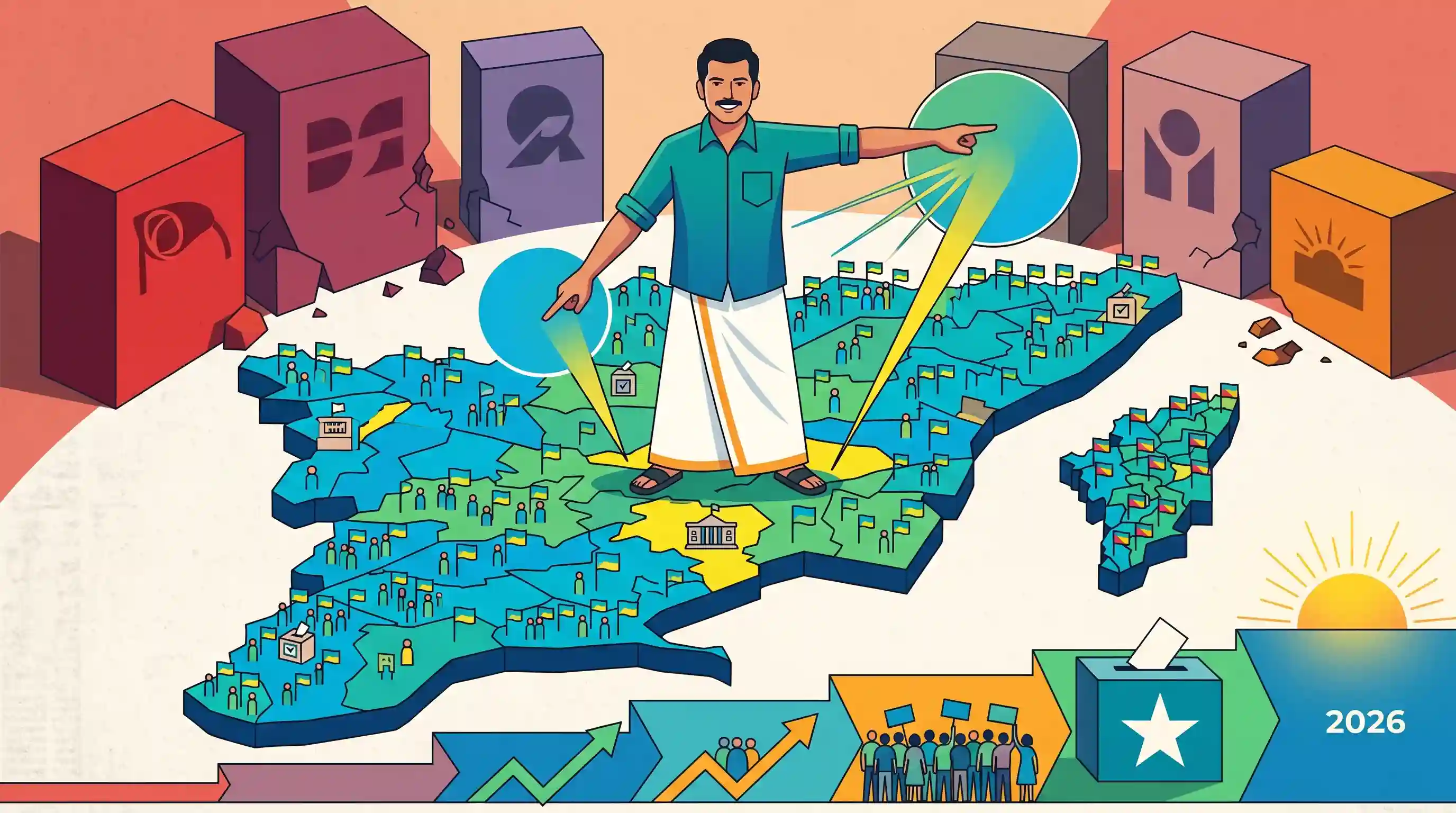
Actor C. Joseph Vijay, president of the newly formed Tamilaga Vettri Kazhagam (TVK), is set to make his electoral debut in the 2026 Tamil Nadu Assembly elections. He will be contesting from two constituencies—Perambur and Tiruchi East. The TVK has announced its intent to field candidates across all 234 constituencies in Tamil Nadu and 30 in Puducherry, challenging established political heavyweights in the state and marking a significant entry into regional politics.
Key Points
- Actor and Tamilaga Vettri Kazhagam (TVK) president C. Joseph Vijay will make his electoral debut by contesting from two constituencies: Perambur and Tiruchi East in the 2026 Tamil Nadu Assembly elections.
- By contesting from two seats, Vijay utilizes the provision under Section 33(7) of the Representation of the People Act, 1951, which restricts candidates to a maximum of two constituencies.
- The newly formed regional party announced its intent to field candidates in all 234 assembly constituencies in Tamil Nadu and 30 in Puducherry.
- The party has deliberately fielded candidates against political heavyweights such as Chief Minister M.K. Stalin and Deputy Chief Minister Udhayanidhi Stalin, highlighting the emergence of a new regional player.
Important Terms
Representation of the People Act (RPA), 1951

The primary legislation governing the conduct of elections in India, including party registration, candidate qualifications, and the prevention of corrupt practices.
UPSC context
GS Paper-II: Important for topics on Salient features of the Representation of People's Act and electoral reforms.
Section 33(7) of RPA, 1951
A provision in the RPA 1951 that allows a candidate to contest an election from a maximum of two constituencies simultaneously.
UPSC context
GS Paper-II: Relevant for debates on electoral integrity and the financial burden of subsequent bye-elections.
Tamilaga Vettri Kazhagam (TVK)
A regional political party in Tamil Nadu and Puducherry founded by actor C. Joseph Vijay, officially registered by the ECI in 2024.
UPSC context
GS Paper-II: Examples of regional parties and their role in the Indian political and federal system.
Section 29A of RPA, 1951
The specific legal provision within the RPA 1951 that mandates and outlines the process for the registration of political parties with the Election Commission.
UPSC context
GS Paper-II: Tests knowledge of the statutory powers of the Election Commission of India.
Election Symbols (Reservation and Allotment) Order, 1968
An order issued by the ECI to regulate the specification, reservation, choice, and allotment of election symbols and the recognition of political parties.
UPSC context
GS Paper-II: Critical for understanding how parties achieve 'National' or 'State' status and symbol disputes.
Regional Party
A political party that operates within a specific state or region, often championing local identity, language, or developmental interests.
UPSC context
GS Paper-II: Key to discussions on federalism, regionalism, and the evolution of the party system.
Prelims Trap
The Constitution of India restricts a candidate from contesting an election from more than two constituencies simultaneously.
The restriction to contest a maximum of two constituencies is a statutory limit under Section 33(7) of the RPA 1951 (added via a 1996 amendment), not a Constitutional mandate.
Static Concepts Connected
What are the rules regarding a candidate contesting from multiple constituencies?
- Statutory Limit: Section 33(7) of the Representation of the People Act, 1951 allows a person to contest from a maximum of two constituencies in a single election.
- 1996 Amendment: Before a 1996 amendment to the RPA, there was no legal cap on the number of seats a candidate could contest.
- Resignation Rule: Under Section 70 of the RPA, a candidate winning multiple seats must vacate all but one within a prescribed time limit (14 days), failing which all seats become vacant.
How are new political parties registered under Indian Law?
- Statutory Basis: The formation and registration of political parties are governed by Section 29A of the Representation of the People Act, 1951.
- Strict Timeline: An application must be submitted to the Election Commission of India within 30 days of the party's formation.
- Constitutional Allegiance: The party must pledge true faith and allegiance to the Constitution of India and the principles of socialism, secularism, and democracy.
Cross-Topic Patterns
Electoral Reforms and Bye-Election Costs
The ECI and Law Commission have repeatedly urged amending the RPA to restrict candidates to one seat, or forcing the vacating candidate to bear bye-election costs—a critical theme for GS2 Mains.
Regional Parties and Federal Dynamics
The continued rise of state-specific parties reflects localized democratic aspirations, altering national coalition dynamics and reinforcing federal checks against centralization tendencies.

Expect a Prelims 2026 question linking RPA 1951 Sec 33(7) limits, the 1996 amendment, and ECI recommendations on bye-election costs.
Linked PYQs · 4
Linked PYQs · 4
- 2021PrelimsGS1
Consider the following statements : 1. In India, there is no law restricting the candidates from contesting in one Lok Sabha election from three constituencies. 2. In 1991 Lok Sabha Election, Shri Devi Lal contested from three Lok Sabha constituencies. 3. As per the existing rules, if a candidate contests in one Lok Sabha election from many constituencies, his/her party should bear the cost of bye-elections to the constituencies vacated by him/her in the event of him/her winning in all the constituencies. Which of the statements given above is/are correct?
- 2022MainsGS2
“While the national political parties in India favour centralisation, the regional parties are in favour of State autonomy.” Comment.
- 2022MainsGS2
Discuss the procedures to decide the disputes arising out of the election of a Member of the Parliament or State Legislature under The Representation of the People Act, 1951. What are the grounds on which the election of any returned candidate may be declared void ? What remedy is available to the aggrieved party against the decision ? Refer to the case laws.
- 2020MainsGS2
There is a need for simplification of procedure for disqualification of persons found guilty of corrupt practices under the Representation of Peoples Act". Comment.
