Sea Level Rise and Climate Vulnerabilities of Tuvalu
Source:The Hindu ↗
ఇది ఎందుకు ముఖ్యం
It highlights the acute vulnerabilities of Small Island Developing States (SIDS) to sea-level rise and climate change, which is a central theme in global environmental governance and UPSC GS Paper 3 (Environment/Climate Change).
సారాంశం
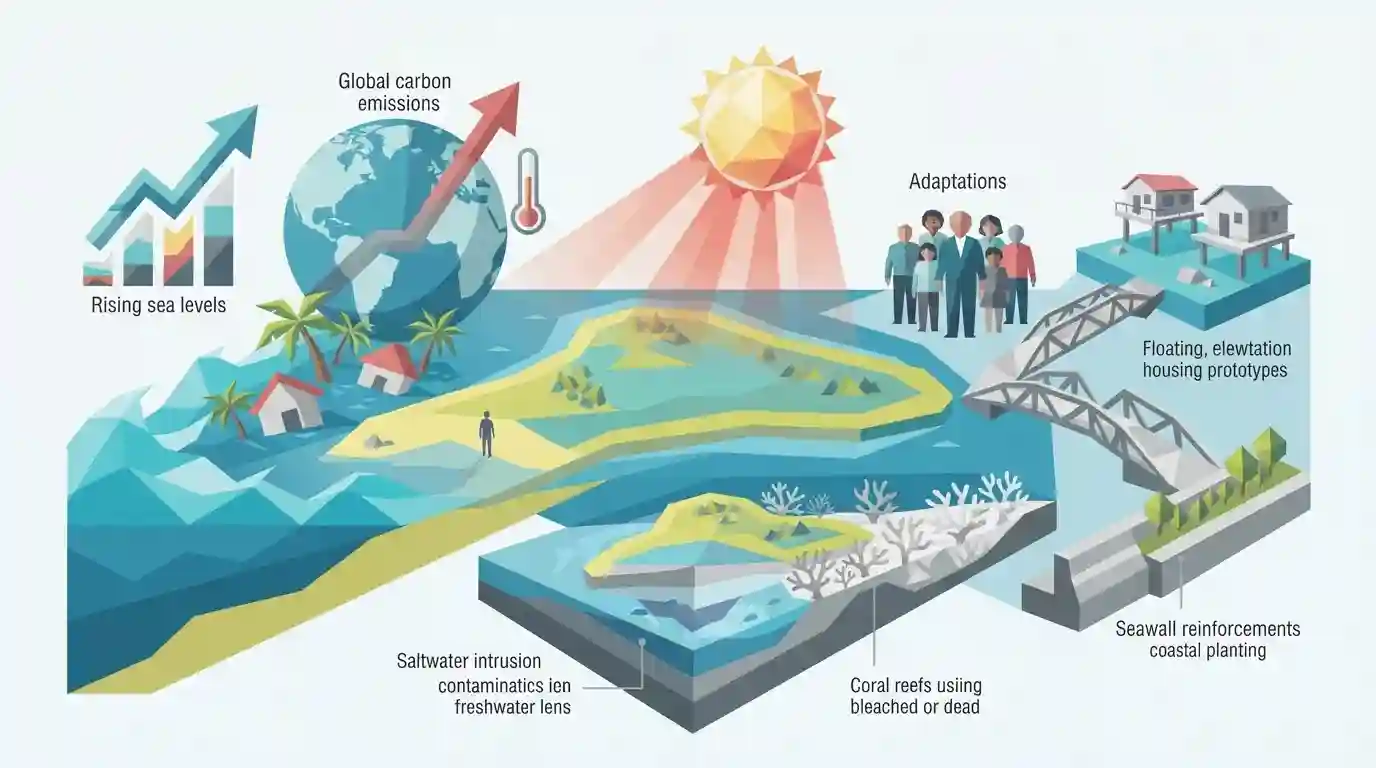
The article 'Tuvalu: Barely above water' details the severe climate change vulnerabilities faced by the low-lying Pacific island nation of Tuvalu due to rising sea levels, highlighting existential risks, environmental degradation, and the urgent need for international climate action and adaptation for Small Island Developing States (SIDS).
ముఖ్య అంశాలు
- Tuvalu, a low-lying island nation in the Pacific Ocean, is facing severe existential threats due to rising sea levels driven by climate change.
- Most of Tuvalu's land sits barely above sea level, making it highly vulnerable to coastal erosion, saltwater intrusion into freshwater lenses, and frequent tidal flooding.
- The article underscores the disproportionate vulnerability of Small Island Developing States (SIDS) to global warming despite contributing minimally to global greenhouse gas emissions.
- Adaptation strategies, legal frameworks for statehood preservation under sea-level rise, and international climate finance are critical for the survival of nations like Tuvalu.
ముఖ్యమైన పదాలు
Intergovernmental Panel on Climate Change (IPCC)

A UN body established in 1988 to assess scientific, technical, and socio-economic information concerning climate change, providing regular scientific reports to inform global climate policies.
UPSC context
UPSC GS Paper III (Environment & Ecology): Essential for questions on climate change reports, global warming trends, and scientific assessments.
Small Island Developing States (SIDS)
A group of low-lying coastal and island nations facing unique social, economic, and environmental vulnerabilities, particularly from sea-level rise and extreme weather events driven by climate change.
UPSC context
UPSC GS Paper III (Environment & Impact of Climate Change): Tests vulnerabilities of vulnerable developing nations and international climate negotiations.
ప్రిలిమ్స్ ఉచ్చు
loss of physical territory due to rising sea levels automatically terminates a nation's international legal statehood and sovereignty under the Montevideo Convention.
Aspirants often assume traditional international law requires a permanent physical territory for statehood, missing how Tuvalu's constitutional amendment and bilateral treaties seek to preserve sovereignty in perpetuity.
అనుసంధానమైన స్థిర భావనలు
What are the core criteria for statehood under the 1933 Montevideo Convention?
- Traditional Criteria: Defined territory, permanent population, government, and capacity to enter into relations with other states.
- Climate Challenge: Rising sea-level challenges the territorial criterion, prompting innovative legal frameworks like permanent statehood declarations and bilateral sovereignty guarantees.
What is the Alliance of Small Island States (AOSIS) and its role in climate negotiations?
- Coalition Profile: A coalition of small island and low-lying coastal countries that advocates for aggressive global emissions reduction and climate finance.
- Key Advocacy: Pushed for the 1.5°C threshold and loss-and-damage finance mechanisms at UNFCCC COPs.
అంతర-అంశ నమూనాలు
Climate-induced displacement and the Montevideo Convention statehood criteria
Tuvalu's permanent statehood declaration and the Falepili Union test classic Montevideo Convention criteria, linking environmental law with traditional sovereignty doctrines in international relations.
Rising sea levels and UNCLOS maritime boundaries
As SIDS face existential erasure, international law shifts toward preserving maritime boundaries, connecting climate adaptation with UNCLOS baselines and exclusive economic zones.

Expect a multi-statement question on SIDS statehood continuity, Montevideo criteria, and bilateral treaties like the Falepili Union.
అనుసంధాన PYQలు · 2
అనుసంధాన PYQలు · 2
- 2025PrelimsGS1
Consider the following statements : Statement I: Scientific studies suggest that a shift is taking place in the Earth's rotation and axis. Statement II: Solar flares and associated coronal mass ejections bombarded the Earth's outermost atmosphere with tremendous amount of energy. Statement III : As the Earth's polar ice melts, the water tends to move towards the equator. Which one of the following is correct in respect of the above statements?
- 2023MainsGS3
The Intergovernmental Panel on Climate Change (IPCC) has predicted a global sea level rise of about one metre by AD 2100. What would be its impact in India and the other countries in the Indian Ocean region?
