US Sanctions and Strategic Autonomy in India Foreign Policy
Source:The Hindu ↗
Why It Matters
The article provides a definitive case study (the Chabahar port) of the friction between India's pursuit of strategic autonomy and US global strategy. It is highly relevant for GS2 Mains questions on the limits of India's independent foreign policy, India-US diplomatic friction, and the geopolitical importance of regional connectivity projects.
Summary
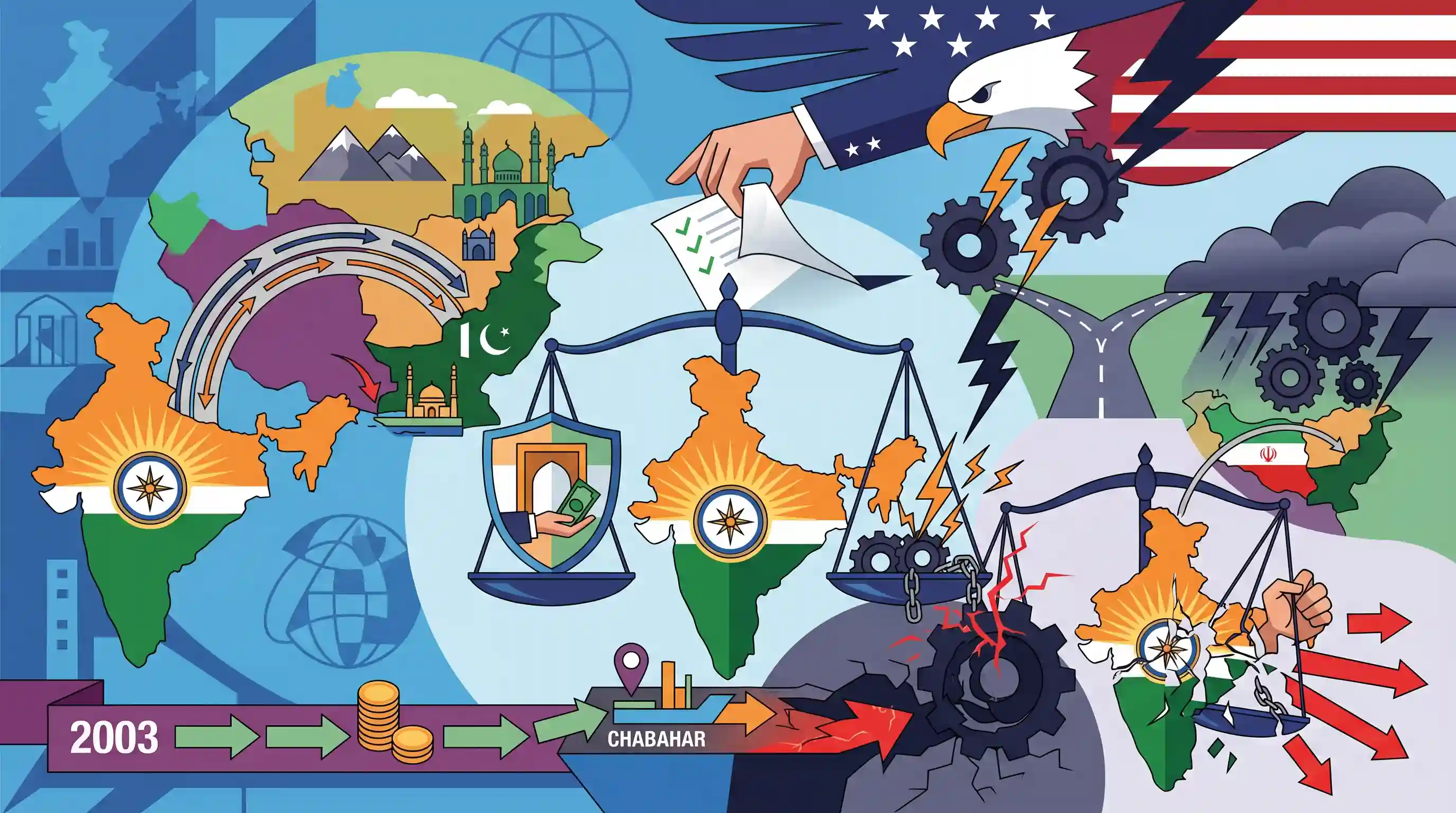
The editorial analyzes the critical juncture in India's independent foreign policy as the US allows its sanctions waiver for Iran's Chabahar port to lapse. Having invested heavily in the port and the Zaranj-Delaram highway since 2003 to bypass Pakistan and access Afghanistan and Central Asia, India now faces the threat of strict US sanctions. Tracing the project's evolution through the JCPOA and its subsequent derailment by the US 'maximum pressure' campaign, the article argues that abandoning Chabahar would not only end India's strategic connectivity plans but also severely damage its sovereign autonomy and ability to pursue an independent foreign policy in the face of external pressures.
Key Points
- The US has allowed its sanctions waiver on Iran's Chabahar port to lapse, forcing India to choose between abandoning a $620 million strategic investment and facing strict US sanctions.
- The Chabahar project, spanning decades of diplomatic effort under multiple Indian Prime Ministers, is critical for bypassing Pakistan to access Afghanistan and Central Asia.
- Following the US withdrawal from the JCPOA in 2018, India secured a temporary carve-out for humanitarian shipments, which has now ended under renewed US pressure.
- Yielding to US demands on Chabahar would severely undermine India's connectivity plans and damage its longstanding pursuit of strategic autonomy and an independent foreign policy.
Important Terms
Strategic Autonomy

A nation's sovereign ability to make foreign policy and defense decisions based on national interest, independent of external pressures or alliance obligations.
UPSC context
GS Paper-II (International Relations). Core concept for India's balancing act between major powers (USA, Russia, China) in a multipolar world.
Joint Comprehensive Plan of Action (JCPOA)
The 2015 landmark agreement between Iran and P5+1 powers (USA, UK, France, Russia, China, Germany) to limit Iran's nuclear program in exchange for sanctions relief.
UPSC context
GS Paper-II (International Relations). Tests understanding of West Asian geopolitics and global non-proliferation efforts affecting India's interests.
Chabahar Port
A strategic maritime facility in Iran's Sistan-Baluchestan province, providing India a direct trade route to Afghanistan and Central Asia while bypassing Pakistan.
UPSC context
GS Paper-II (India and its Neighborhood). Essential for questions on regional connectivity, International North-South Transport Corridor (INSTC), and countering China's Gwadar port.
Maximum Pressure Campaign
A U.S. policy involving intensified economic and diplomatic sanctions against Iran, initiated after the U.S. withdrawal from the JCPOA in 2018.
UPSC context
GS Paper-II (International Relations). Tests the impact of major powers' unilateral policies on regional stability and India's strategic investments.
Trilateral Agreement on Transport and Transit Corridors
A 2016 framework between India, Iran, and Afghanistan to develop a multi-modal transit corridor using Chabahar Port for regional trade and connectivity.
UPSC context
GS Paper-II (Bilateral and Multilateral Agreements). Highlights India’s institutional efforts to integrate South Asia with Central Asian markets.
Countering America's Adversaries Through Sanctions Act (CAATSA)
A U.S. federal law mandating sanctions against countries engaging in "significant transactions" with Russia, Iran, and North Korea's defense or intelligence sectors.
UPSC context
GS Paper-II (Effect of policies of developed countries). Tests understanding of external legal constraints on India’s defense and energy procurement choices.
Prelims Trap
Chabahar port is strategically located in the Persian Gulf.
Chabahar is located on the Gulf of Oman, NOT the Persian Gulf. Bandar Abbas is closer to the Strait of Hormuz. This is a classic map trap.
Static Concepts Connected
What are the key connectivity nodes linked to Chabahar Port?
- Zaranj-Delaram Highway: A 218-km route in Afghanistan built by India, linking the Iranian border to the Afghan Garland Highway network.
- INSTC Node: A 7,200-km multi-modal freight route linking India to Russia and Europe via Iran, bypassing the Suez Canal.
- Ashgabat Agreement: A multimodal transport agreement facilitating transit of goods between Central Asia and the Persian Gulf, complementing Chabahar.
How do US secondary sanctions operate against third-party countries?
- The Mechanism: They target non-US entities (like Indian firms) doing business with sanctioned countries, threatening their access to the US dollar and global financial system.
- CAATSA Context: Countering America's Adversaries Through Sanctions Act targets Iran, North Korea, and Russia, requiring specific waivers for Indian strategic projects or defence purchases.
Cross-Topic Patterns
Strategic Autonomy vs. Quad Alignment
India's refusal to abandon Chabahar highlights the tension between its deepening maritime Quad partnership with the US and its necessity for Eurasian continental connectivity.
De-dollarisation & Sanctions Evasion
Repeated exposure to US secondary sanctions accelerates India's push for Rupee Vostro accounts and alternative BRICS payment systems to insulate its strategic investments.

Map-based matching of ports (Chabahar, Duqm, Gwadar) to exact water bodies (Gulf of Oman) and corridors (INSTC) is highly likely in 2026.
Linked PYQs · 4
Linked PYQs · 4
- 2017PrelimsGS1
What is the importance of developing Chabahar Port by India?
- 2019MainsGS2
‘What introduces friction into the ties between India and the United States is that Washington is still unable to find for India a position in its global strategy, which would satisfy India's national self-esteem and ambitions.’ Explain with suitable examples.
- 2024MainsGS2
Critically analyse India's evolving diplomatic, economic and strategic relations with the Central Asian Republics (CARs) highlighting their increasing significance in regional and global geopolitics.
- 2025PrelimsGS1
India is one of the founding members of the International North-South Transport Corridor (INSTC), a multimodal transportation corridor, which will connect
