Critical Mineral Recycling and Urban Mining for Strategic Autonomy
Source:The Hindu ↗
Why It Matters
Crucial for understanding India's clean energy transition, supply chain security for critical minerals, and the role of circular economy and e-waste recycling in mitigating geopolitical vulnerabilities.
Summary
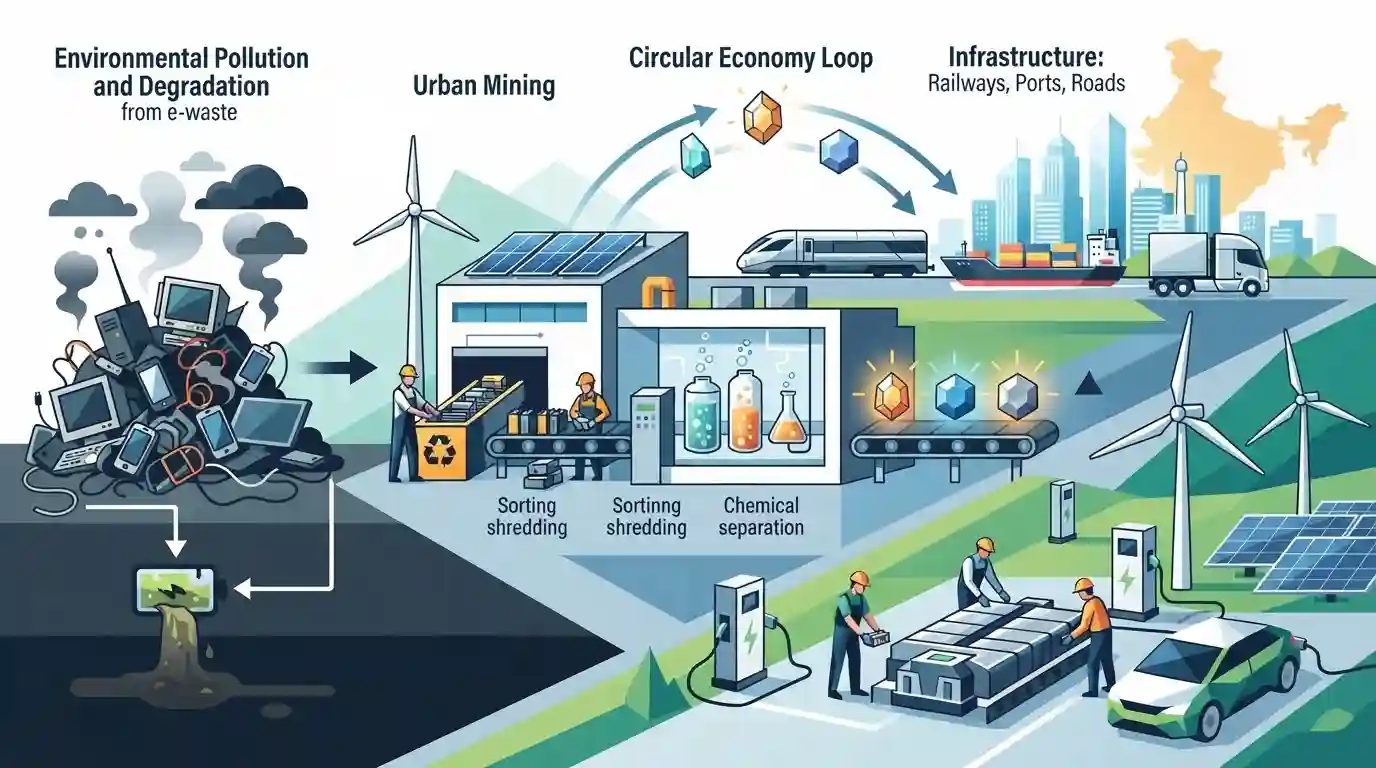
The article examines the strategic significance of turning battery waste into critical mineral wealth through recycling and urban mining. As global demand for electric vehicles and clean energy surges, securing critical minerals like lithium, cobalt, and nickel is paramount. The piece highlights how recycling spent lithium-ion batteries not only addresses massive e-waste and environmental hazards but also reduces import dependency, builds supply chain resilience, and fosters a circular economy in alignment with India's policy initiatives like the National Critical Mineral Mission.
Key Points
- Critical minerals such as lithium, cobalt, nickel, and graphite are vital for clean energy transition, electric vehicles, and high-tech manufacturing.
- Recycling spent lithium-ion batteries offers a dual benefit: mitigating severe e-waste environmental hazards and creating a secondary source of strategic mineral wealth.
- India faces geopolitical vulnerabilities and import dependencies for critical minerals, making domestic recycling, urban mining, and robust circular economy frameworks essential.
- Policy measures like the National Critical Mineral Mission and Battery Waste Management Rules provide a regulatory push, but technological and economic scaling hurdles remain.
Important Terms
National Critical Mineral Mission

A government initiative launched to secure India's supply chain of essential minerals like lithium, cobalt, and nickel through domestic exploration, global asset acquisition, and recycling to support clean energy transitions.
UPSC context
Important for GS Paper III (Economy/Infrastructure/Energy/Science & Technology), testing policies on resource security, strategic minerals, and green energy goals.
Static Concepts Connected
What are the key provisions and institutional framework of India's National Critical Mineral Mission?
- Mandate & Scope: Identifies and secures 30 critical minerals essential for economic development and low-carbon technologies.
- Value Chain Approach: Focuses on domestic exploration, overseas acquisition, strategic stockpiling, and advanced recycling/urban mining.
- Nodal Ministry: Anchored by the Ministry of Mines to reduce import dependency and build supply chain resilience by 2047.
Cross-Topic Patterns
Battery Recycling meets WTO Trade Rules
Urban mining and battery recycling intersect with international trade laws and WTO rules on secondary raw material exports and circular economy restrictions.
Critical Minerals and Indo-Pacific Security
Securing lithium and cobalt through recycling directly supports India's net-zero 2070 targets while reducing geopolitical vulnerability in the Indo-Pacific.

Expect a multi-statement prelims question combining National Critical Mineral Mission mandates with Battery Waste Management Rules provisions.
Linked PYQs · 3
Linked PYQs · 3
- 2026PrelimsGS1
Which of the following statements about Rare Earth Elements (REEs) and Critical Minerals is/are correct ? 1. Modern technological innovations including Artificial Intelligence, robotics and space exploration extensively utilise Rare Earth Elements (REEs). 2. China has the highest share in mining of REEs followed by India. 3. The Government of India launched the National Critical Mineral Mission (NCMM) in 2025 to establish a robust framework for self-reliance in the critical mineral sector. 4. Rare Earth Elements are a set of 13 metallic elements. Select the answer using the code given below :
- 2025PrelimsGS1
In the context of electric vehicle batteries, consider the following elements : I. Cobalt II. Graphite III. Lithium IV. Nickel How many of the above usually make up battery cathodes?
- 2025MainsGS3
How can India achieve energy independence through clean technology by 2047? How can biotechnology can play a crucial role in this endeavour?
