Delhi High Court Ruling on Mob Violence Arrests
Source:The Hindu ↗
Why It Matters
Highlights the critical role of the judiciary in restraining arbitrary police arrests during public disturbances, reinforcing the constitutional protection of personal liberty against sweeping law enforcement actions.
Summary
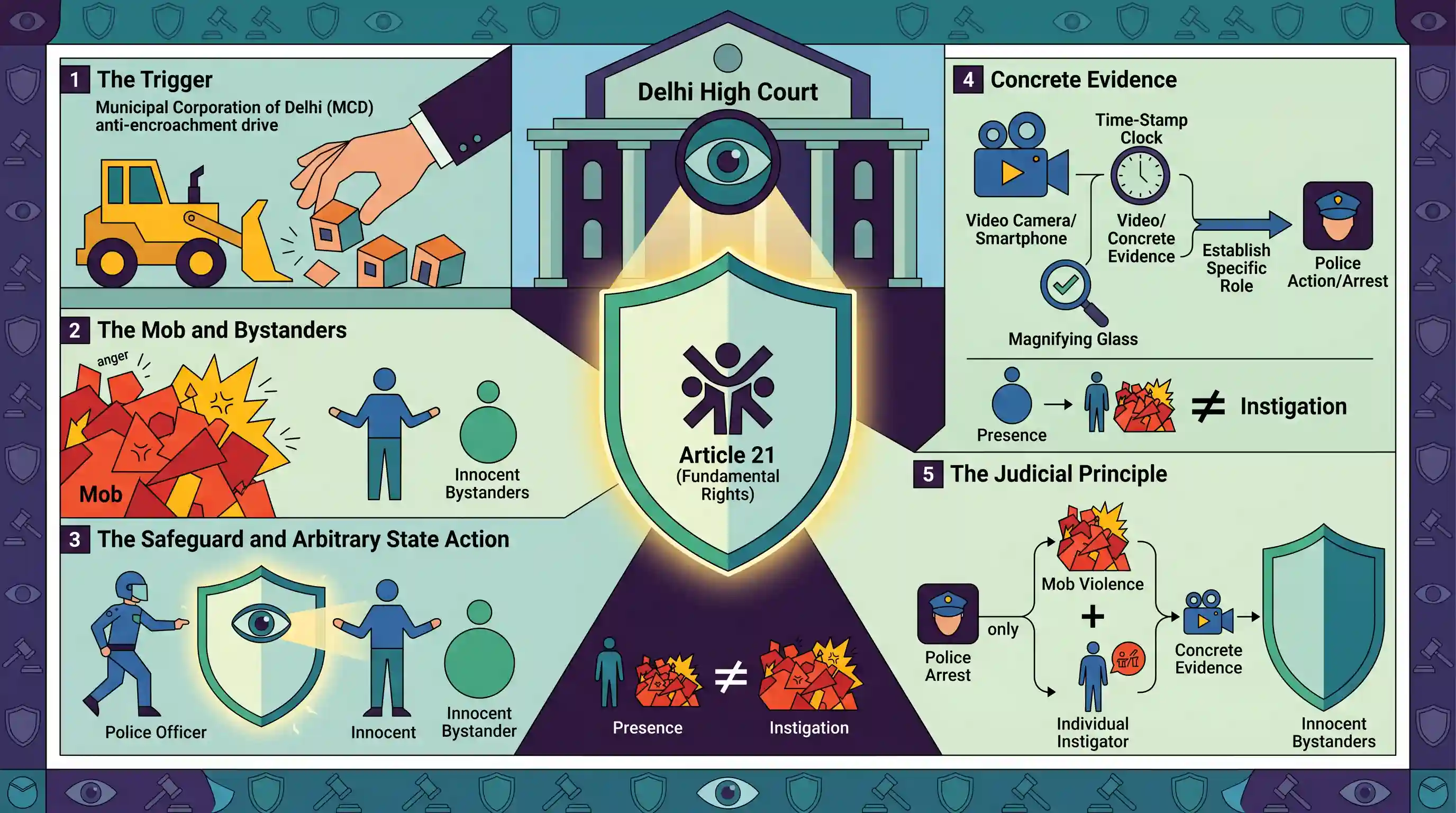
The Delhi High Court has directed the Delhi Police that innocent bystanders cannot be arbitrarily arrested merely for being present near a site of mob violence. While hearing an anticipatory bail plea regarding the Turkman Gate violence—which erupted during an MCD anti-encroachment drive—the court emphasized the need for concrete evidence, such as time-stamped videos, to establish an individual's specific role in instigating a crowd. The observation acts as a safeguard against arbitrary state action.
Key Points
- Delhi HC ruled that individual liberty must be protected against arbitrary arrests by law enforcement during instances of mob violence.
- The court mandated that police must identify the specific roles of individuals using objective evidence (e.g., time-stamped video footage) rather than executing blanket arrests of bystanders.
- The violence in question occurred during an anti-encroachment drive by the MCD near the Faiz-e-Elahi mosque at Turkman Gate.
- The judicial observation underscores the necessity of balancing the maintenance of public order with upholding the fundamental right to personal liberty under Article 21.
Important Terms
Article 21 (Fundamental Rights)

Guarantees that no person shall be deprived of their life or personal liberty except according to procedure established by law. It protects against arbitrary state action.
UPSC context
GS Paper 2 (Polity); core fundamental right, frequently tested via landmark judgments and its expansion through judicial activism.
Anticipatory Bail
A pre-arrest legal relief granted by a High Court or Sessions Court (Section 438 CrPC; Section 482 BNSS) preventing a person's detention in a non-bailable offense.
UPSC context
GS Paper 2 (Judiciary/Criminal Justice); relevant for balancing personal liberty and investigation powers.
Delhi High Court
The principal judicial authority for the National Capital Territory, established in 1966. It exercises original, appellate, and writ jurisdiction under Article 226 of the Constitution.
UPSC context
GS Paper 2 (Structure and Functioning of Judiciary); significant for its rulings on central-state disputes and constitutional liberties.
Delhi Police
A central police force under the administrative control of the Union Ministry of Home Affairs (MHA). It is responsible for law and order in the National Capital.
UPSC context
GS Paper 2 (Federalism/Union Territories); tests the unique administrative status of Delhi where police is a reserved central subject.
Municipal Corporation of Delhi (MCD)
The unified urban local body responsible for civic services in Delhi. It operates under the Delhi Municipal Corporation Act and the 74th Constitutional Amendment framework.
UPSC context
GS Paper 2 (Local Self-Government); tests knowledge of urban governance and the 74th Amendment Act.
Prelims Trap
Mere physical presence in an unlawful assembly makes a person criminally liable for its acts.
Under BNS Sec 189/190 (formerly IPC 141/149), liability requires 'intentional joining' and a 'common object'. Accidental bystanders are legally exempt.
Static Concepts Connected
What constitutes an "Unlawful Assembly" under Indian criminal law?
- Minimum size: An assembly must consist of five or more persons to qualify as unlawful under Section 189 of the BNS.
- Common object: Members must share an illegal objective, such as resisting the execution of law, committing mischief, or criminal trespass.
- Intentional participation: A person must intentionally join or continue in the assembly while being fully aware of its unlawful nature.
How does the Constitution protect against arbitrary executive arrests?
- Article 21 (Due Process): Deprivation of personal liberty must follow a 'procedure established by law' that is just, fair, and reasonable (Maneka Gandhi case).
- Article 19(1)(b): Grants the right to assemble peaceably and without arms, meaning innocent assembly cannot be criminalized without concrete public order violations.
- Habeas Corpus: Courts can issue this writ to demand justification for an individual's detention, forcing police to prove lawful authority and objective evidence.
Cross-Topic Patterns
Urban Demolitions vs. Article 21
Connects municipal evictions to the landmark Olga Tellis judgment, linking local urban governance mandates (anti-encroachment) with Article 21's right to livelihood.
Digital Evidence in Criminal Justice
The court's demand for time-stamped video evidence highlights the BNSS mandate integrating electronic evidence into police procedure to curb arbitrary arrests.

Expect a 2026 Prelims statement differentiating 'unlawful assembly' criteria under BNS from arbitrary detention safeguards under Article 22.
Linked PYQs · 2
Linked PYQs · 2
- 2017MainsGS3
Mob violence is emerging as a serious law and order problem in India. By giving suitable examples, analyze the causes and consequences of such violence.
- 2024MainsGS2
Right to privacy is intrinsic to life and personal liberty and is inherently protected under Article 21 of the constitution. Explain. In this reference discuss the law relating to D.N.A. testing of child in the womb to establish its paternity.
