Turkiye Arrest Warrants for Israeli Leadership and International Law
Source:The Hindu ↗
Why It Matters
It exemplifies the role of international law and genocide conventions as diplomatic tools in modern geopolitical conflicts. For India, understanding the complex Middle Eastern dynamics involving Israel, Turkiye, and US mediation is crucial, as instability or shifting alliances in West Asia directly impact India's strategic interests, energy security, and diaspora.
Summary
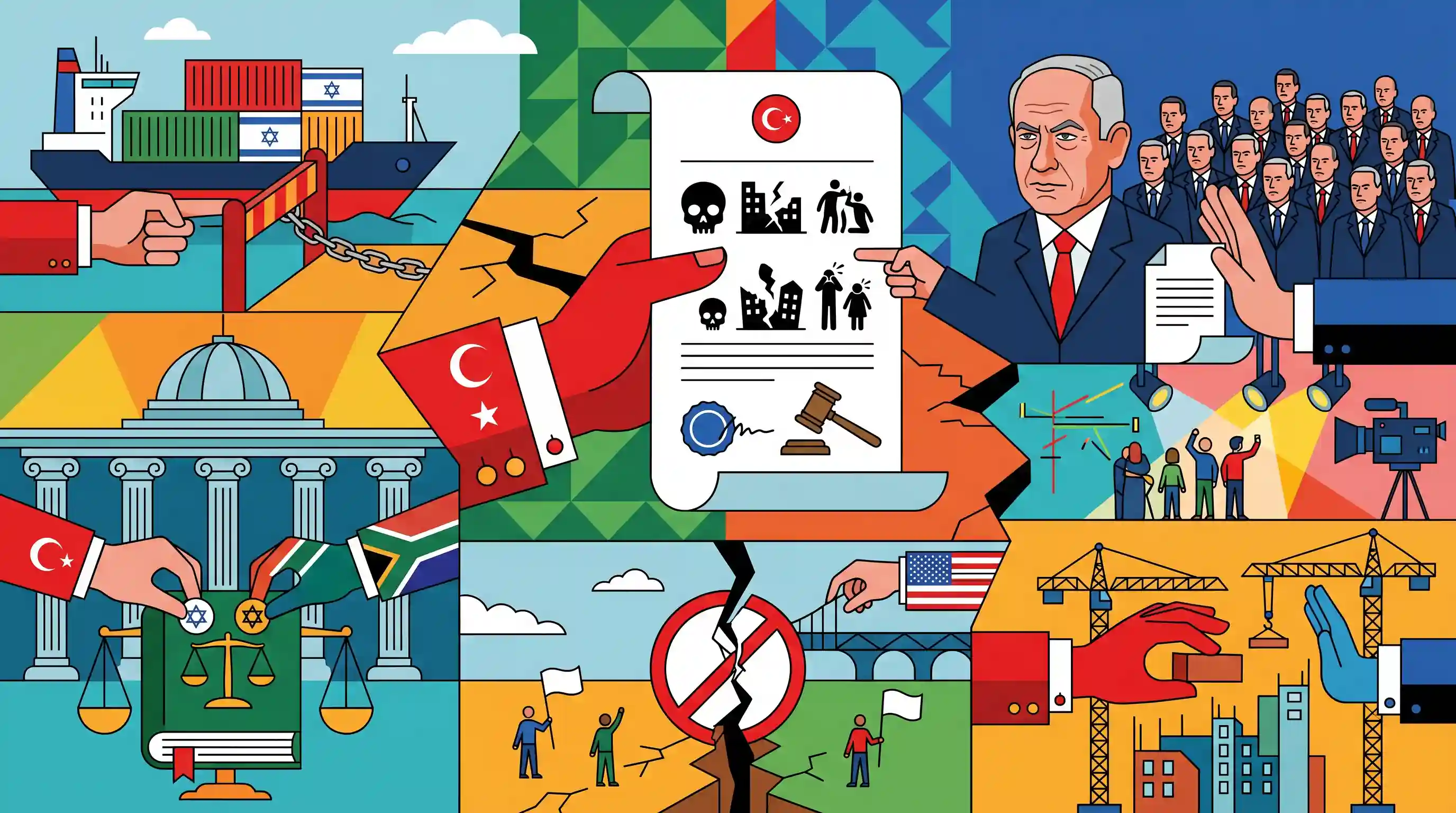
Turkiye has issued an arrest warrant for Israeli Prime Minister Benjamin Netanyahu and 36 other senior officials, alleging genocide and crimes against humanity during the war in Gaza. This legal move, initiated by the Istanbul prosecutor's office, further escalates tensions between Ankara and Jerusalem. Turkiye had previously halted bilateral trade with Israel and joined South Africa's genocide case at the International Court of Justice. Israel rejected the warrants, describing them as a public relations stunt by Turkish President Recep Tayyip Erdogan aimed at deflecting attention from his domestic political controversies. The friction comes at a critical time as a fragile ceasefire takes hold in Gaza under US mediation, and as Turkiye seeks, but is denied by Israel, a role in any post-war stabilization force in the territory.
Key Points
- Turkiye's Istanbul prosecutor issued arrest warrants for Israeli PM Benjamin Netanyahu and 36 other officials, accusing them of genocide and crimes against humanity in Gaza.
- The warrants target key Israeli figures including Defense Minister Israel Katz, National Security Minister Itamar Ben Gvir, and army chief Lt Gen Eyal Zamir.
- Turkiye has intensified its diplomatic stance against Israel by suspending bilateral trade and joining South Africa's ongoing genocide case at the International Court of Justice (ICJ).
- Israel dismissed the charges as a domestic political stunt by President Erdogan to distract from internal issues, such as the arrest of Istanbul's opposition mayor.
- The development occurs amid a fragile ceasefire in Gaza under US President Donald Trump's regional peace plan, while Israel rejects Turkiye's bid to join a proposed post-war Gaza stabilization force.
Important Terms
International Court of Justice (ICJ)

The UN's principal judicial organ that settles legal disputes between member states. It lacks jurisdiction over individuals, focusing instead on state responsibility for treaty violations, like the Genocide Convention.
UPSC context
GS Paper 2 (International Relations); tests understanding of UN organs and their role in global conflict resolution.
International Criminal Court (ICC)
An independent permanent court that prosecutes individuals for genocide, war crimes, and crimes against humanity. It is governed by the Rome Statute, to which India and Turkiye are not signatories.
UPSC context
GS Paper 2 (International Relations); critical for distinguishing between state-level and individual-level international legal accountability.
Genocide Convention
A 1948 UN treaty (ratified by India in 1959) that defines genocide and obligates states to prevent and punish it. It was the first human rights treaty adopted by the UNGA.
UPSC context
GS Paper 2 (International Treaties); tests knowledge of international humanitarian law and India's legal obligations.
Universal Jurisdiction
A legal principle allowing a state to claim jurisdiction over persons accused of international crimes (like genocide) regardless of where the crime was committed or the nationality of the accused.
UPSC context
GS Paper 2 (International Law); relevant for discussing the reach of domestic courts in global human rights issues.
Hamas
A Palestinian political and militant organization. Since 2007, it has governed the Gaza Strip and is a central party in the ongoing conflict with Israel.
UPSC context
GS Paper 2 (West Asia Geopolitics); essential for understanding regional security dynamics and India's "Extended Neighbourhood" policy.
Crimes Against Humanity
Widespread or systematic attacks directed against any civilian population, such as murder, extermination, or persecution. Unlike genocide, these do not require the "intent to destroy" a specific group.
UPSC context
GS Paper 2 (International Relations/Law); tests precision in defining international criminal charges often mentioned in news.
Prelims Trap
The International Court of Justice (ICJ) can issue arrest warrants against national leaders for genocide.
The ICJ resolves legal disputes between states (e.g., South Africa vs. Israel). Arrest warrants against individuals are issued by the ICC or by national courts invoking 'Universal Jurisdiction'.
Static Concepts Connected
What is the principle of Universal Jurisdiction in international law?
- Core Mechanism: Allows a state's domestic courts to try individuals for grave international crimes, regardless of where the crime occurred or the nationality of the perpetrators/victims.
- Covered Crimes: Typically applied to jus cogens (peremptory norms) violations such as genocide, war crimes, piracy, and crimes against humanity.
- Sovereign Conflict: Frequently creates diplomatic friction, as it overrides traditional territorial jurisdiction and tests the boundaries of diplomatic and sovereign immunity.
How does the ICJ differ from the ICC?
- Jurisdictional Subject: The ICJ handles legal disputes between UN member states. The ICC prosecutes individuals for international crimes.
- UN Affiliation: The ICJ is the principal judicial organ of the UN. The ICC is an independent body established by the Rome Statute (not a UN organ).
- Enforcement: ICJ judgments are binding on states but rely on the UNSC for enforcement. The ICC issues arrest warrants reliant on member-state cooperation.
Cross-Topic Patterns
West Asia De-hyphenation vs Polarization
Turkiye's hardline stance and trade suspension contrasts with India's 'de-hyphenation' policy, where New Delhi carefully balances robust strategic ties with Israel alongside historic support for a sovereign Palestinian state.
UN Peacekeeping and Host State Consent
Israel's rejection of Turkiye in a proposed Gaza stabilization force highlights a foundational requirement of international peacekeeping: the operation must have the express consent of the main conflict parties.

Expect a 2026 Prelims question contrasting ICJ and ICC jurisdictions alongside the application of 'Universal Jurisdiction'.
Linked PYQs · 3
Linked PYQs · 3
- 2018MainsGS2
“India’s relations with Israel have, of late, acquired a depth and diversity, which cannot be rolled back.” Discuss.
- 2025MainsGS2
"Energy security constitutes the dominant kingpin of India's foreign policy, and is linked with India's overarching influence in Middle Eastern countries.” How would you integrate energy security with India's foreign policy trajectories in the coming years?
- 2018PrelimsGS1
"Rule of Law Index" is released by which of the following?
