Glacial lake outburst floods threaten Himalayan disaster resilience
Source:The Hindu ↗
આ શા માટે મહત્વનું છે
GLOFs represent one of the most immediate and destructive consequences of climate change in the Himalayas. Understanding their causes and mitigation strategies is crucial for disaster management and sustainable development in the Indian subcontinent, frequently tested in UPSC GS1 and GS3.
સારાંશ
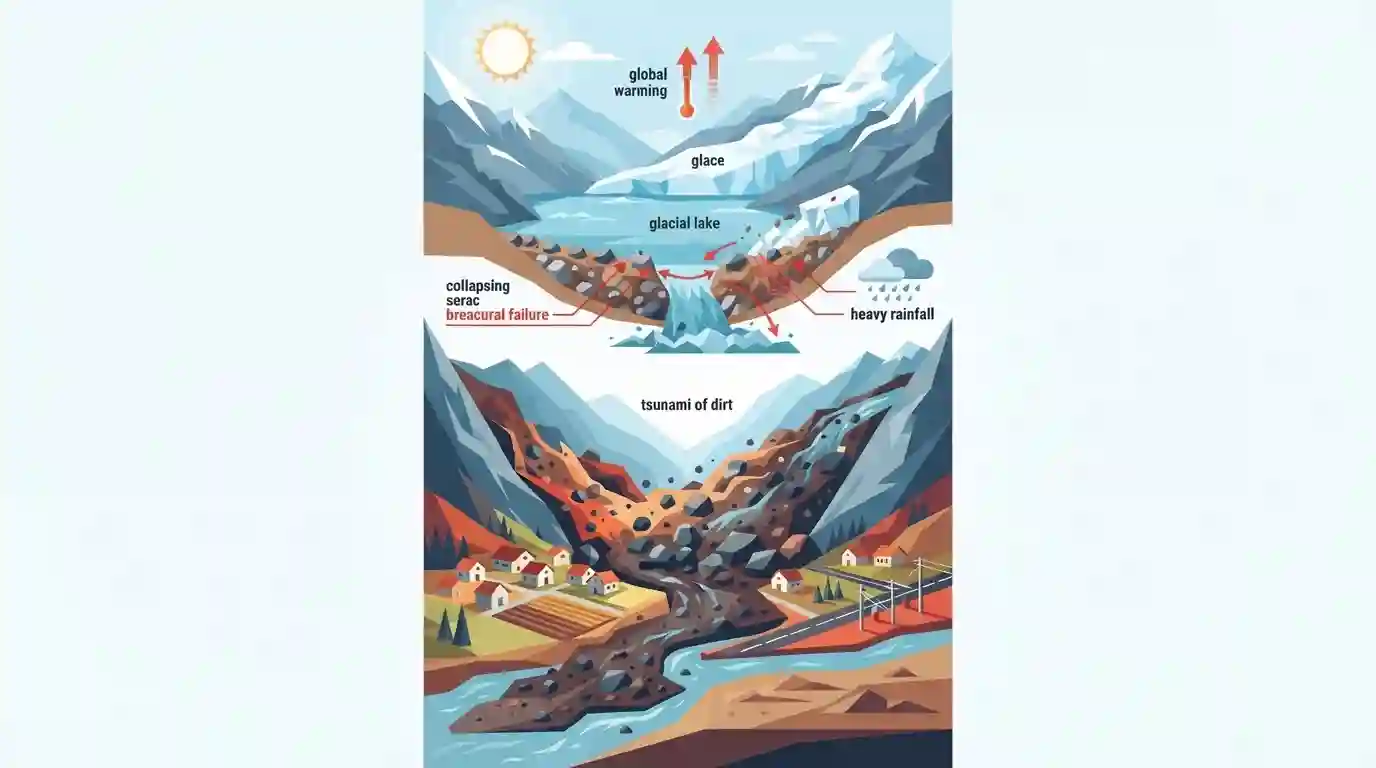
The article explores the causes and devastating mechanics behind a recent Glacial Lake Outburst Flood (GLOF) in Nepal, characterized as a "tsunami of dirt." Driven by global warming, accelerated glacial melt is expanding unstable moraine-dammed lakes in the Himalayas. When these fragile barriers breach—due to avalanches, heavy precipitation, or structural failure—they release catastrophic debris flows packed with mud, rocks, and water. The disaster highlights the escalating vulnerability of Himalayan communities and infrastructure to climate-induced hazards, reinforcing the critical need for advanced monitoring, early warning systems, and robust disaster mitigation strategies.
મુખ્ય મુદ્દા
- Climate change is accelerating the melting of Himalayan glaciers, leading to the rapid expansion of unstable moraine-dammed glacial lakes.
- Glacial Lake Outburst Floods (GLOFs) occur when these fragile dams breach, unleashing immense volumes of water.
- The resulting floods pick up massive amounts of sediment, transforming into devastating debris flows ("tsunamis of dirt") that wipe out downstream settlements and infrastructure.
- The incident underscores the urgent need for continuous monitoring of glacial lakes, hazard zonation mapping, and the deployment of effective early warning systems in vulnerable mountain ecosystems.
પ્રિલિમ્સ ટ્રેપ
"Moraine-dammed lakes are stable, natural reservoirs securely enclosed by solid bedrock."
Moraine dams are formed by unconsolidated glacial debris (rocks, dirt, ice), making them highly unstable and prone to sudden structural failure.
સંલગ્ન સ્થિર ખ્યાલો
How do moraine-dammed lakes form and what triggers a GLOF?
- Formation: Retreating glaciers leave behind unconsolidated debris (moraines) that trap glacial meltwater, forming fragile, natural reservoirs.
- Triggers: Avalanches, extreme precipitation, or seismic activity can displace water rapidly, overtopping or bursting the fragile moraine barrier.
- Debris Flow: The breach releases a hyper-concentrated flow of water, mud, and boulders (a debris flow), vastly multiplying the destructive force downstream.
What are the NDMA guidelines for mitigating GLOF hazards?
- Risk Assessment: Identifying and prioritizing high-risk glacial lakes through continuous satellite monitoring and hazard zonation mapping.
- Structural Mitigation: Reducing lake water volume through controlled breaching, pumping, siphoning, or excavating drainage tunnels.
- Early Warning System: Deploying Automated Weather and Water Stations (AWWS) with sensor-based acoustic alerts for vulnerable downstream settlements.
આંતર-વિષય પેટર્ન
Hydro-projects vs. GLOF risks
The proliferation of run-of-the-river hydroelectric dams in the Himalayas frequently clashes with escalating GLOF risks, mirroring the catastrophic Teesta-III dam washout in Sikkim.
Elevation-Dependent Warming (EDW)
The Hindu Kush Himalayas are warming twice as fast as the global average due to EDW, linking global emission targets directly to regional water security and permafrost thawing.

Expect a multi-statement question combining moraine dam fragility, Elevation-Dependent Warming (EDW), and NDMA's structural mitigation.
સંલગ્ન PYQ · 4
સંલગ્ન PYQ · 4
- 2014MainsGS1
Bring out the relationship between the shrinking Himalayan glaciers and the symptoms of climate change in the Indian sub-continent.
- 2020MainsGS1
How will the melting of Himalayan glaciers have a far-reaching impact on the water resources of India?
- 2016MainsGS1
The Himalayas are highly prone to landslides. Discuss the causes and suggest suitable measures of mitigation.
- 2019MainsGS3
Disaster preparedness is the first step in any disaster management process. Explain how hazard zonation mapping will help disaster mitigation in the case of landslides.
