Andaman and Nicobar Tsunami Monitoring Next Generation System
Source:Indian Express ↗
Why It Matters
Understanding the mechanisms of tsunamis and the technological advancements in early warning systems is crucial for UPSC candidates, as disaster preparedness and geographical vulnerabilities of India's island territories are recurring themes in both GS1 (Geography) and GS3 (Disaster Management).
Summary
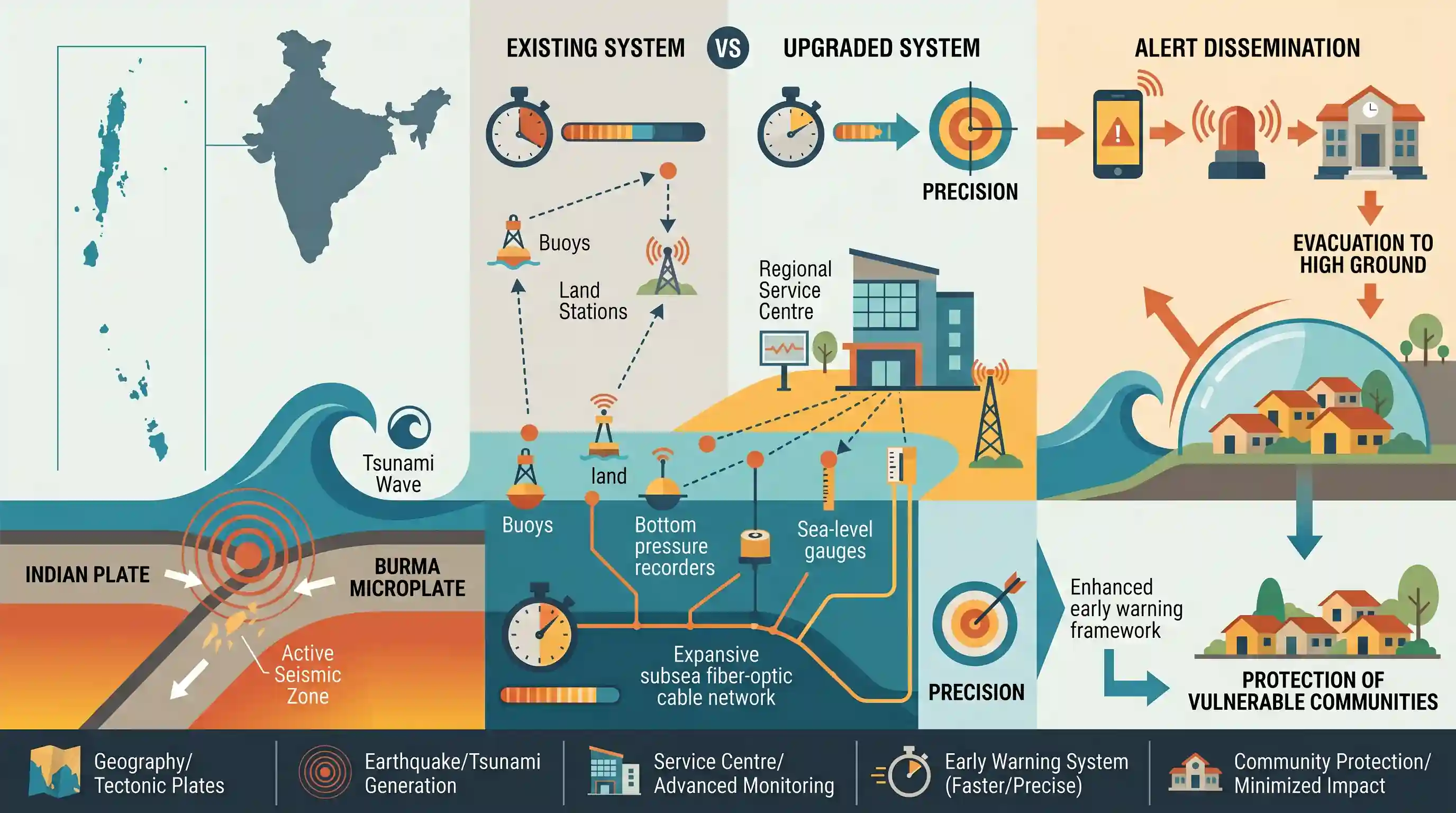
The Andaman and Nicobar Islands are set to receive a dedicated regional service centre equipped with a 'next-generation system' to significantly enhance tsunami monitoring. Given the archipelago's proximity to highly active seismic zones and tectonic plate boundaries, it faces an elevated risk of earthquakes and subsequent tsunamis. The new monitoring facility will bolster the existing early warning framework, enabling faster and more precise alerts. This infrastructural upgrade is a critical step in proactive disaster management, aiming to protect vulnerable coastal communities and minimize potential catastrophic impacts.
Key Points
- A new regional service centre featuring a 'next-generation system' will be established in the Andaman and Nicobar Islands to upgrade tsunami monitoring.
- The facility aims to provide faster and more accurate localized alerts, reducing the response time in the event of an undersea earthquake.
- The Andaman and Nicobar archipelago is situated near an active tectonic plate boundary (subduction zone), making it highly vulnerable to tsunamigenic earthquakes.
- This development represents a shift toward more proactive disaster risk reduction and strengthens India's overall early warning infrastructure.
Important Terms
Indian National Centre for Ocean Information Services (INCOIS)

An autonomous body under the Ministry of Earth Sciences providing ocean information and advisory services, including Potential Fishing Zone (PFZ) advisories and tsunami early warnings to various stakeholders.
UPSC context
GS Paper III (Science & Tech/Disaster Management); tests knowledge of institutional mechanisms for coastal security and oceanic research.
Sendai Framework for Disaster Risk Reduction
A 15-year (2015-2030) international agreement adopted by the UN to reduce disaster risk and losses in lives, livelihoods, and health, emphasizing a proactive mitigation-centric approach.
UPSC context
GS Paper III (Disaster Management); tests awareness of global protocols and India's commitment to international disaster risk reduction targets.
Ministry of Earth Sciences (MoES)
The Indian government ministry responsible for providing scientific services related to meteorology, oceanography, seismology, and geophysics to mitigate the impact of natural disasters.
UPSC context
GS Paper II (Governance) and Paper III; tests knowledge of the executive framework governing earth sciences and disaster prediction.
Regional Service Centre (RSC)
A proposed specialized facility in the Andaman and Nicobar Islands (Swaraj Dweep) designed to detect both seismic and non-seismic tsunamis using next-generation acoustic sensors and sub-sea cables.
UPSC context
GS Paper III (Disaster Management); tests knowledge of proactive infrastructure upgrades and localized mitigation strategies for high-risk seismic zones.
Indian Tsunami Early Warning Centre (ITEWC)
A nodal facility operated by INCOIS that utilizes a network of seismic stations and tide gauges to provide real-time tsunami advisories for the Indian Ocean region.
UPSC context
GS Paper III (Science & Tech); tests understanding of India's role as a regional Tsunami Service Provider (TSP) under UNESCO-IOC.
Subduction Zone
A tectonic plate boundary where one plate sinks beneath another into the mantle; the Sumatra-Andaman subduction zone is a major source of seismic activity in the Indian Ocean.
UPSC context
GS Paper I (Geography); tests conceptual clarity on plate tectonics and their role in generating natural hazards like tsunamis.
Prelims Trap
"The Indian Tsunami Early Warning Centre (ITEWC) operates under the National Disaster Management Authority (NDMA)."
While NDMA handles disaster response broadly, the Indian Tsunami Early Warning Centre (ITEWC) is hosted by INCOIS, an autonomous body under the Ministry of Earth Sciences.
Static Concepts Connected
Why are the Andaman and Nicobar Islands highly vulnerable to tsunamis?
- Active Subduction Zone: The islands are located along the Sunda Trench where the Indian plate subducts beneath the Burma microplate, generating high-magnitude earthquakes.
- Tectonic Volcanism: The presence of active volcanism, such as Barren Island, acts as surface evidence of the intense, ongoing tectonic volatility beneath this oceanic crust.
What are the key technical components of a Tsunami Early Warning System?
- Seismic Stations: Networked seismometers detect submarine earthquakes, calculating their magnitude and shallow depth to assess tsunamigenic potential.
- Bottom Pressure Recorders: Installed on the ocean floor (often with DART buoys), these sensors detect anomalous changes in water column pressure caused by passing tsunami waves.
- Tide Gauges: Coastal instruments that physically confirm tsunami wave arrival and measure its exact height and coastal inundation extent.
Cross-Topic Patterns
Disaster tech as maritime statecraft
Upgrading early warning systems in A&N bolsters India's capacity to share real-time alerts with littoral neighbors, reinforcing its role as a net security provider in the Indian Ocean Region (IOR).
Sendai Framework Target G alignment
The 'next-gen' centre directly acts on Sendai Target G, which mandates a substantial global increase in the availability of and access to multi-hazard early warning systems by 2030.

Expect a multi-statement prelims question linking plate boundaries (Burma microplate) to oceanography (DART buoys) and INCOIS governance.
Linked PYQs · 4
Linked PYQs · 4
- 2025MainsGS1
What are Tsunamis? How and where are they formed? What are their consequences? Explain with examples.
- 2020MainsGS3
Discuss the recent measures initiated in disaster management by the Government of India departing from the earlier reactive approach.
- 2013MainsGS3
How important are vulnerability and risk assessment for pre-disaster management ? As an administrator, what are key areas that you would focus on in a Disaster Management System.
- 2024MainsGS3
What is disaster resilience? How is it determined? Describe various elements of a resilience framework. Also mention the global targets of Sendai Framework for Disaster Risk Reduction (2015–2030).
