US Peace Plan for Russia Ukraine War and Strategic Implications
Source:Indian Express ↗
Why It Matters
It highlights the shifting geopolitical landscape under the Trump administration, emphasizing the immediate impacts on global security architectures like NATO, and the direct challenges for India's strategic autonomy, defense procurement, and energy security.
Summary
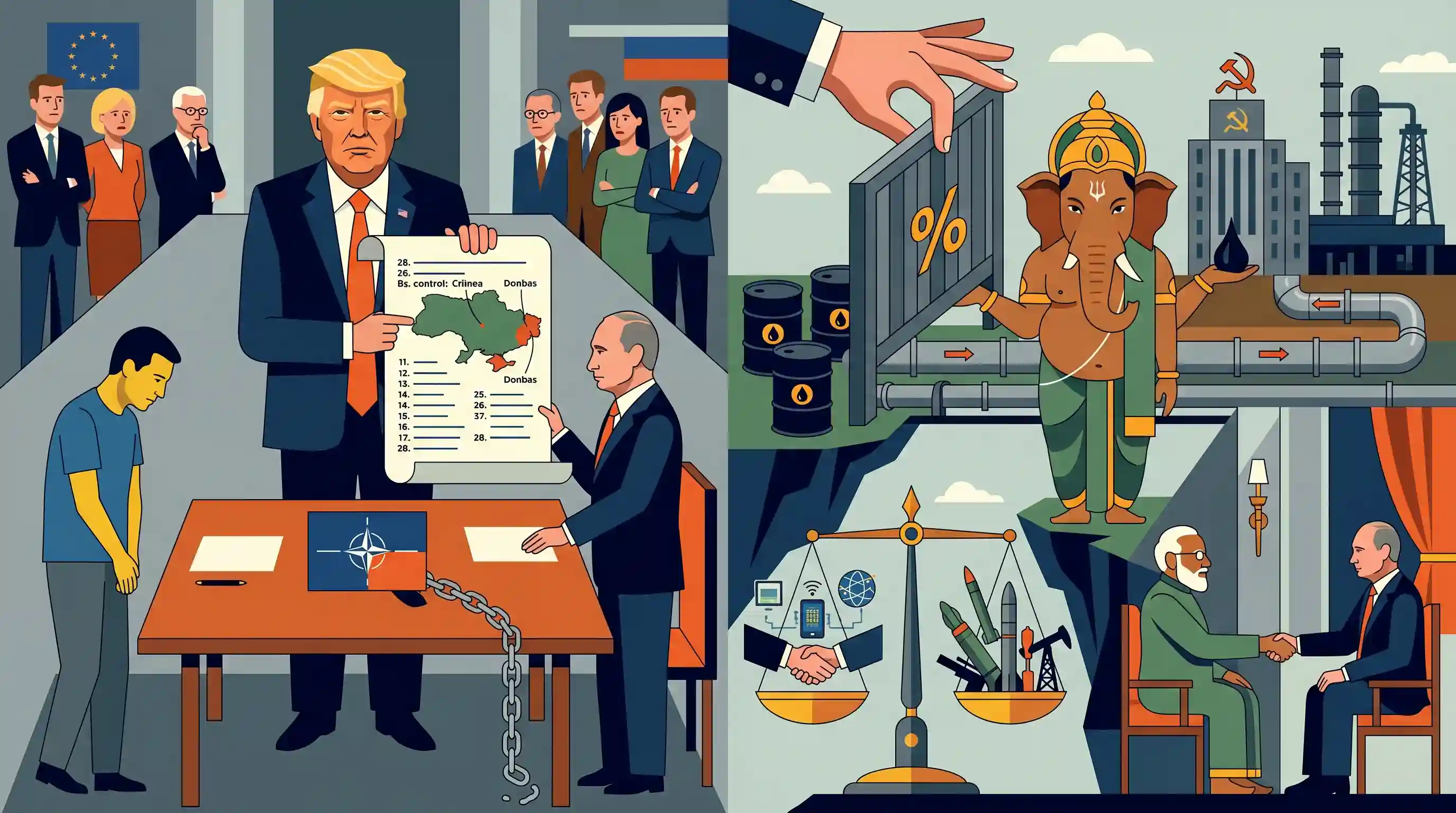
Donald Trump’s proposed 28-point peace plan to end the Russia-Ukraine war heavily favors Moscow by recognizing Russian control over Crimea and the Donbas, barring Ukraine from NATO, and lifting sanctions to reintegrate Russia into the G8. Drafted without European or Ukrainian consultation, the plan risks further destabilizing European security while reflecting Ukraine's currently weakened position. For India, a potential US-Russia thaw presents a complex challenge: while it may reduce broader geopolitical tensions, India currently faces a 25% US tariff penalty on its Russian crude oil purchases. Consequently, New Delhi must delicately balance its deepening strategic ties with Washington against its foundational defense and energy relationship with Moscow, particularly ahead of Vladimir Putin's upcoming visit to India.
Key Points
- Donald Trump’s 28-point peace plan offers major concessions to Russia, including de facto control over Crimea, Luhansk, and Donetsk, while barring Ukraine from joining NATO.
- The plan proposes lifting sanctions on Russia and paving the way for its reintegration into the global economy via the G8.
- Drafted by US and Russian envoys without consulting Ukraine or European allies, the proposal raises significant European security concerns.
- India currently faces a 25% US tariff penalty on its purchases of Russian crude oil, highlighting immediate economic frictions with Washington.
- New Delhi must carefully navigate this shifting US-Russia dynamic, balancing its deepening strategic partnership with the US against its historic defense and energy ties with Russia.
Important Terms
Trump's 28-point Ukraine peace plan

A 2025 diplomatic framework proposing Ukrainian territorial concessions (Crimea, Donbas), military limits, and a permanent NATO membership ban to end the war and reintegrate Russia into the global economy.
UPSC context
GS Paper II (International Relations). Tests understanding of conflict resolution, major power diplomacy, and impact on global security architecture.
Strategic Autonomy
India’s foreign policy principle of maintaining independent decision-making and diverse partnerships (e.g., balancing US and Russia) based on national interest rather than formal alliance commitments.
UPSC context
GS Paper II. Core concept for explaining India's response to the Ukraine war and its 'multi-alignment' strategy.
NATO (North Atlantic Treaty Organization)
An intergovernmental military alliance of 32 member states; its eastward expansion is a primary Russian security concern and a key 'red line' in peace negotiations.
UPSC context
GS Paper II. Essential for analyzing European security and the geopolitical drivers of the Russia-Ukraine conflict.
G8 (Group of Eight)
An informal forum of major economies (G7 plus Russia); Russia was suspended in 2014. Proposed readmission signifies a shift toward normalizing Western-Russian diplomatic and economic relations.
UPSC context
GS Paper II. Relates to global governance, international groupings, and the use of economic reintegration as a diplomatic tool.
Geoeconomics
The use of economic tools (like the 25% US tariff penalty on Indian imports) to achieve geopolitical goals, forcing nations to balance trade interests against strategic energy security.
UPSC context
GS Paper II & III. Tests understanding of how international trade policies and sanctions influence energy security and bilateral diplomacy.
Prelims Trap
"Russia was suspended from both the G8 and the G20 following its annexation of Crimea in 2014."
Russia was suspended from the G8 in 2014 (reverting it to the G7), but it was never expelled from the G20, remaining an active participant.
Static Concepts Connected
What comprises the Donbas region and its strategic value?
- Territories: Geographically covers the Donetsk and Luhansk oblasts in eastern Ukraine, sharing a direct land border with Russia.
- Economic hub: Historically a massive industrial center dominating coal mining, heavy machinery, and metallurgical production.
- Maritime access: Controls strategic maritime access to the Sea of Azov via key port cities like Mariupol.
What mechanisms do nations use to enforce secondary economic sanctions?
- Secondary Sanctions: Penalties targeting third-party countries or foreign entities for conducting business with a primary sanctioned state.
- Tariff Penalties: Leveraging punitive import duties (like a 25% tariff) to economically penalize a neutral nation's trade behavior.
- Price Caps: Forbidding domestic maritime/insurance services from facilitating the transport of commodities sold above a strict price ceiling.
Cross-Topic Patterns
Energy Autonomy vs US Trade Tariffs
India's discounted Russian crude imports attracting a 25% US tariff highlights the collision between domestic inflation-control (energy security) and strategic trade partnerships.
Neutral Buffer States vs NATO Open Door
Forcing Ukraine to swear off NATO revives the geopolitical concept of neutral "buffer states," directly conflicting with NATO’s Article 10 Open Door policy.

Expect a 2026 Mains GS-2 question on how a US-Russia thaw and subsequent peace deals alter India's strategic balancing and trade autonomy.
Linked PYQs · 3
Linked PYQs · 3
- 2023MainsGS2
‘The expansion and strengthening of NATO and a stronger US-Europe strategic partnership works well for India.’ What is your opinion about this statement ? Give reasons and examples to support your answer.
- 2020MainsGS2
What is the significance of Indo-US defence deals over Indo-Russian defence deals? Discuss with reference to stability in the Indo-Pacific region.
- 2025MainsGS2
"The reform process in the United Nations remains unresolved, because of the delicate imbalance of East and West and entanglement of the USA vs. Russo-Chinese alliance.” Examine and critically evaluate the East-West policy confrontations in this regard.
