Global Protectionism and Strategic Trade Policy Options for India
Source:Indian Express ↗
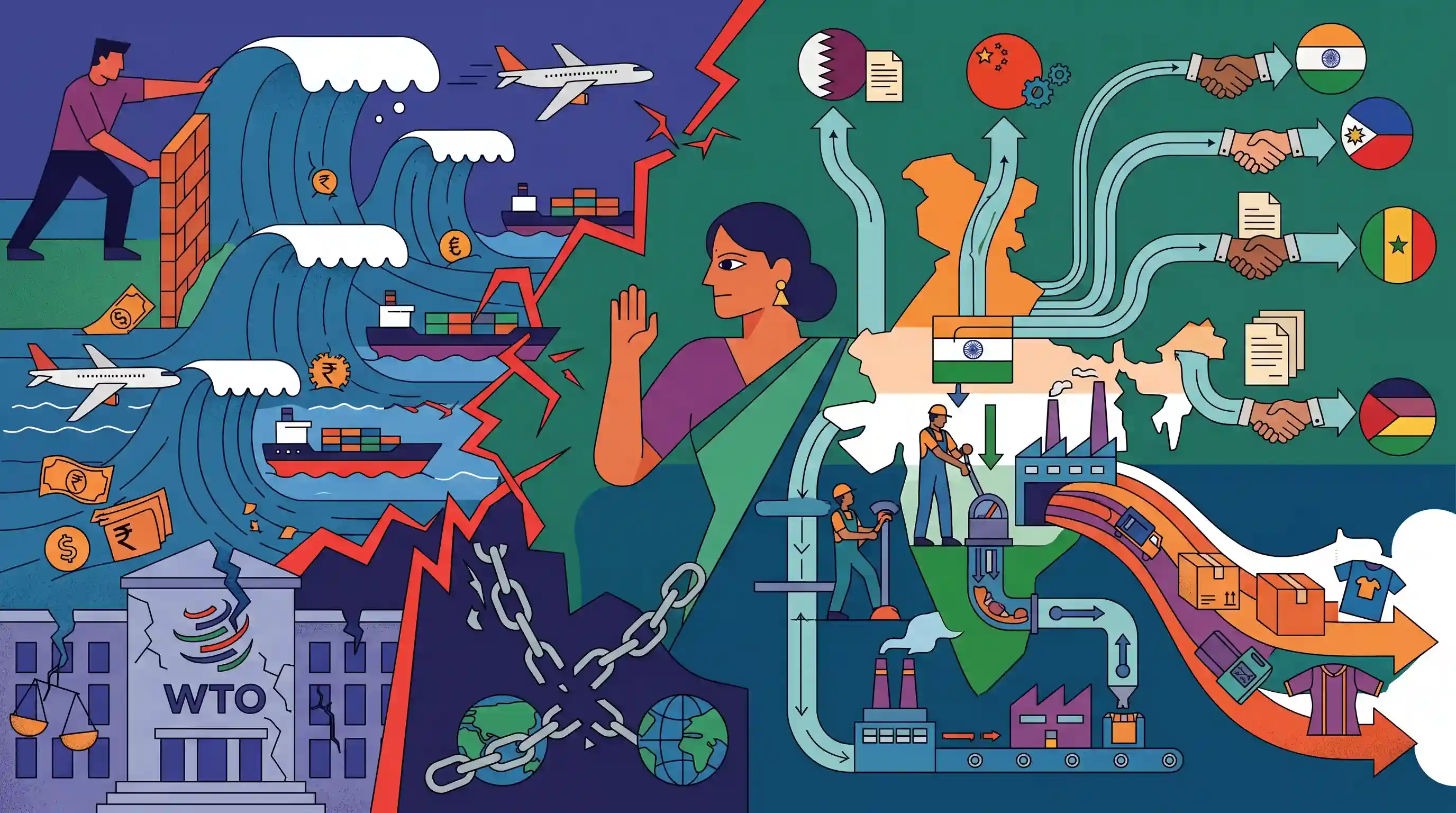
Why It Matters
With global trade experiencing a structural shift towards protectionism, understanding the macroeconomic impacts of tariffs and trade wars is vital for UPSC aspirants. It forms the core of GS3 questions on trade policies and export competitiveness, as well as GS2 questions regarding the relevance of the WTO and the shift towards bilateral agreements.
Summary
The article examines the implications of Donald Trump's proposed tariffs on the global trading system, highlighting the growing trend of protectionism and the weakening of the World Trade Organization (WTO). This shift toward bilateralism and trade wars threatens global supply chains and macroeconomic stability. For India, the changing landscape presents both challenges and a pressing need for strategic recalibration. To protect its export competitiveness, India must proactively forge bilateral Free Trade Agreements (FTAs), rationalize domestic import tariffs, and pursue structural reforms to integrate more deeply into Global Value Chains (GVCs), rather than adopting retaliatory protectionist measures.
Key Points
- Donald Trump's proposed tariffs and protectionist trade policies pose a significant threat to the rules-based multilateral trading system overseen by the WTO.
- The shift away from free trade towards bilateralism and protectionism risks triggering global trade wars, disrupting supply chains, and affecting macroeconomic stability.
- India's export sector is vulnerable to global tariff hikes, necessitating strategic shifts in its trade policy to maintain competitiveness.
- To navigate this environment, India must actively pursue bilateral Free Trade Agreements (FTAs) with key partners rather than relying solely on the weakened multilateral system.
- Domestically, India needs to undertake structural reforms, such as rationalizing import tariffs and boosting integration into Global Value Chains (GVCs), to strengthen its export-oriented manufacturing.
Important Terms
Free Trade Agreements (FTAs)

A formal trade pact between two or more countries to reduce or eliminate tariffs, quotas, and other barriers to facilitate cross-border trade in goods and services.
UPSC context
GS-II and GS-III; tests India’s strategic trade diplomacy and shift toward comprehensive bilateral partnerships like CEPA.
World Trade Organization (WTO)
The only global international body regulating trade rules between nations, ensuring fair, transparent, and predictable commerce based on consensus and multilateral agreements.
UPSC context
GS-II and GS-III; evaluates the effectiveness of global trade governance and dispute resolution mechanisms under stress.
Global Value Chains (GVCs)
A series of production stages where at least two stages happen in different countries, adding value through design, manufacturing, and marketing across borders.
UPSC context
GS-III (Economy); tests India's manufacturing competitiveness and integration into global supply networks via PLI schemes.
Protectionism
Economic policy of restricting imports through tariffs, quotas, or subsidies to shield domestic industries from foreign competition, often sparking retaliatory trade wars.
UPSC context
GS-III; examines trade-offs between domestic self-reliance (Atmanirbhar Bharat) and maintaining global export competitiveness.
Most Favored Nation (MFN)
A core WTO principle mandating that any trade advantage granted to one partner must be extended unconditionally to all other member countries, ensuring non-discrimination.
UPSC context
GS-II and GS-III; tests knowledge of foundational trade rules and legal exceptions for regional trade blocs.
Bilateralism
The conduct of trade or political relations between two countries, involving direct negotiations for faster, targeted agreements compared to broader multilateral processes.
UPSC context
GS-II; focuses on India's transition toward tailored trade pacts (CEPA/ECTA) and challenges to rules-based global order.
Prelims Trap
Under WTO rules, 'Most Favoured Nation' (MFN) status means granting special, lower tariff rates exclusively to an allied nation.
MFN actually mandates non-discrimination. A standard tariff rate offered to one WTO member must be applied to all. Free Trade Agreements (FTAs) are permitted exceptions to MFN.
Static Concepts Connected
What is the difference between Bound and Applied Tariffs under the WTO?
- Bound Tariffs: The maximum tariff rate a WTO member formally commits not to exceed. India's average bound rate is exceptionally high globally (around 48.5%).
- Applied Tariffs: The actual tariff rate charged at the border. India's applied rate is lower (~13.8%) but remains a barrier to intermediate imports.
- Water in Tariff: The gap between bound and applied rates. It gives governments policy space to raise actual border tariffs without violating WTO commitments.
How do Free Trade Agreements (FTAs) coexist with the WTO's MFN principle?
- MFN Principle: Mandates non-discrimination (GATT Article I). Any trade favor or lower tariff given to one country must be given to all other WTO members.
- FTA Exception: GATT Article XXIV allows countries to bypass MFN to form FTAs or Customs Unions, provided they eliminate duties on 'substantially all trade' between them.
Cross-Topic Patterns
PLI Scheme + Import Tariffs clash
India's push for PLI-driven exports is hindered by high tariffs on intermediate components, creating a clash between "Atmanirbhar" import substitution and necessary Global Value Chain (GVC) integration.
WTO Paralysis driving FTA strategy
With the US blocking WTO Appellate Body appointments since 2019, India's recent rush for bilateral FTAs (UAE, Australia, EFTA) reflects a strategic hedge against a collapsing multilateral trade system.

Expect a 2026 prelims statement testing the gap between 'Bound' and 'Applied' tariffs, linked to India's MFN rates and WTO obligations.
Linked PYQs · 5
Linked PYQs · 5
- 2025MainsGS3
What are the challenges before the Indian economy when the world is moving away from free trade and multilateralism to protectionism and bilateralism? How can these challenges be met?
- 2018MainsGS3
How would the recent phenomena of protectionism and currency manipulations in world trade affect macroeconomic stability of India?
- 2016MainsGS2
The broader aims and objectives of WTO are to manage and promote international trade in the era of globalization. But the Doha round of negotiations seem doomed due to differences between the developed and the developing countries." Discuss in the Indian perspective.
- 2023PrelimsGS1
Consider the following statements: Statement-I: India accounts for 3.2% of global export of goods. Statement-II: Many local companies and some foreign companies operating in India have taken advantage of India's 'Production-linked Incentive' scheme. Which one of the following is correct in respect of the above statements?
- 2020PrelimsGS1
With reference to Trade-Related Investment Measures (TRIMS), which of the following statements is/are correct? 1. Quantitative restrictions on imports by foreign investors are prohibited. 2. They apply to investment measures related to trade in both goods and services. 3. They are not concerned with the regulation of foreign investment. Select the correct answer using the code given below:
