Chief Economic Advisor Assesses Short Term Impact of US Tariffs
Source:Indian Express ↗
Why It Matters
The article analyzes the macroeconomic impact of evolving US trade policies (such as tariffs and protectionism) on India's export competitiveness. It offers a critical perspective on how India's domestic economic resilience can buffer against global shifts away from multilateralism.
Summary
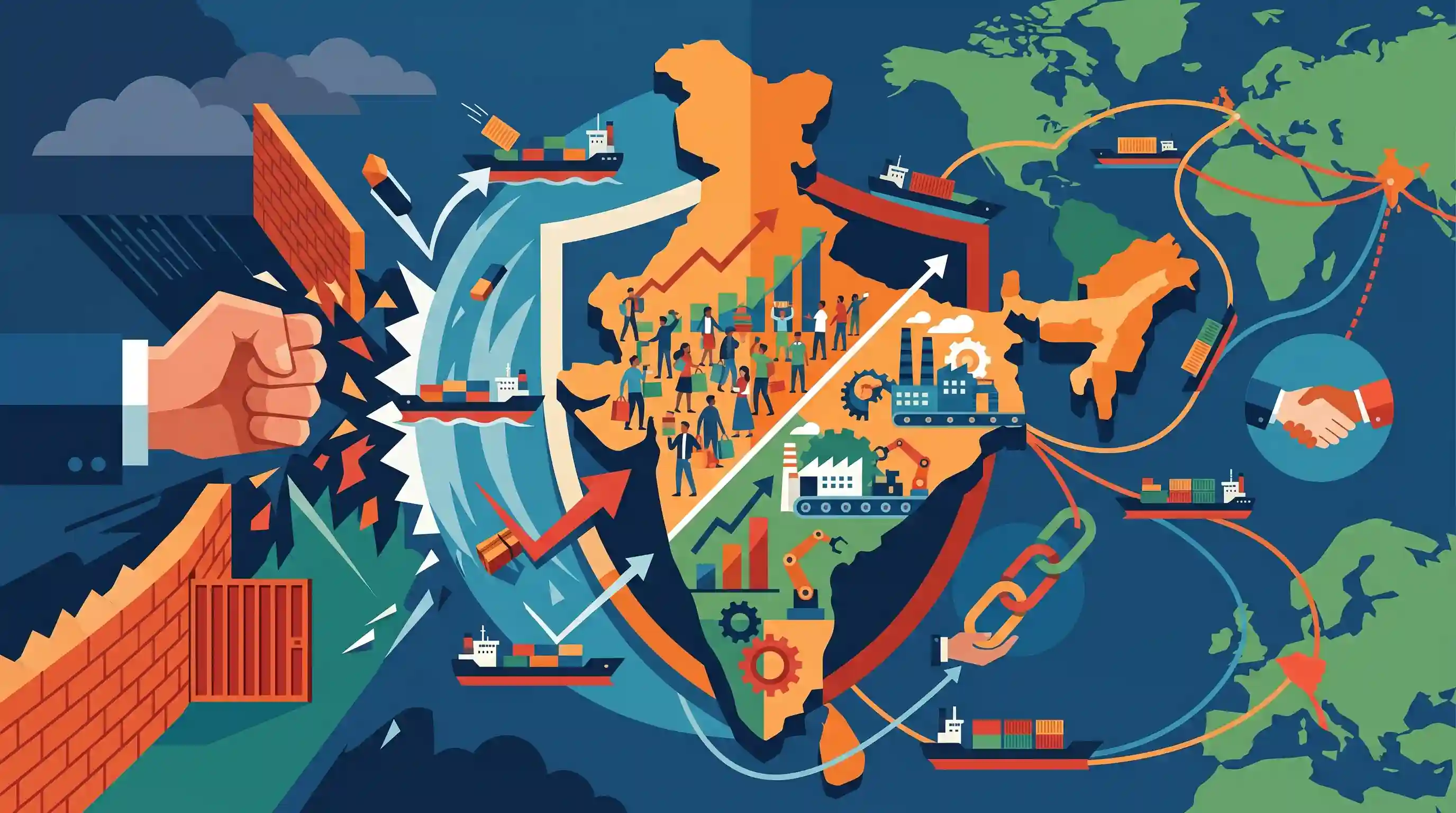
Chief Economic Advisor (CEA) V. Anantha Nageswaran commented that the protectionist tariff policies proposed by US President-elect Donald Trump might deliver a short-term blow to the Indian economy, but their long-term impact will be limited. He highlighted that while such trade barriers could temporarily disrupt global trade and India's exports, India's robust domestic demand, diversified trade partnerships, and growing manufacturing sector will help absorb the shock. Nageswaran emphasized the necessity for India to build macroeconomic resilience and enhance domestic competitiveness amidst a broader global shift from free trade and multilateralism towards protectionism and bilateral trade agreements.
Key Points
- The incoming US administration under President-elect Donald Trump is expected to implement higher trade tariffs, posing initial challenges for Indian exports and the broader trade balance.
- Chief Economic Advisor (CEA) V Anantha Nageswaran stated that while the tariffs will act as a short-term blow to India, the overall adverse impact will be short-lived.
- The global economic environment is witnessing a structural shift away from multilateral free trade towards protectionism and bilateralism, bringing new challenges for emerging economies.
- India is positioned to absorb these external trade shocks due to its strong domestic macroeconomic fundamentals, robust domestic demand, and ongoing structural reforms.
- To navigate these global trade uncertainties, India must continue diversifying its export markets and boost its manufacturing competitiveness through initiatives like the PLI scheme.
Important Terms
Protectionism

A policy of protecting domestic industries from foreign competition by imposing tariffs, quotas, or other trade barriers on imported goods.
UPSC context
GS Paper 3 (Economy) and GS Paper 2 (IR); tests understanding of global trade barriers and impact on Indian exports.
Multilateralism
A system of organizing international relations and trade based on cooperation between three or more nations, typically through institutions like the WTO.
UPSC context
GS Paper 2 (Global Groupings); essential for discussing the crisis in global governance and shifts toward bilateral trade.
Macroeconomic Resilience
An economy's capacity to withstand, absorb, and recover from external shocks while maintaining stability in growth and financial health.
UPSC context
GS Paper 3 (Indian Economy); tests knowledge of India's fundamental stability in the face of global volatility.
Production-Linked Incentive (PLI) Scheme
A government program offering financial incentives to manufacturers based on their incremental production and sales, aimed at boosting domestic manufacturing capacity.
UPSC context
GS Paper 3 (Industrial Policy); vital for analyzing 'Atmanirbhar Bharat' and India’s global manufacturing competitiveness.
Tariff
A tax or duty imposed by a government on imported goods, used to raise revenue and protect domestic producers by making imports more expensive.
UPSC context
GS Paper 3 (External Sector); fundamental for understanding trade wars, fiscal measures, and their inflationary impacts.
Bilateral Trade Agreements
Commercial treaties between two sovereign nations intended to reduce trade barriers and facilitate the exchange of goods and services.
UPSC context
GS Paper 2 (Bilateral Agreements); relevant for evaluating India’s shift toward focused FTAs over stalled multilateral negotiations.
Prelims Trap
India's recent economic growth is primarily driven by export-led manufacturing and global trade integration.
India's resilience against trade shocks stems from its growth being heavily domestic-consumption driven (~60% of GDP), not export-reliant.
Static Concepts Connected
What are Bound Rates and Applied Rates under WTO rules?
- Bound Rate: The absolute maximum ceiling for a tariff on a specific product that a WTO member officially commits to not exceed.
- Applied Rate: The actual tariff charged at the border. It can fluctuate based on domestic policy but must remain at or below the bound rate.
- National Security Exception: Unilateral tariff increases by the US often invoke WTO's 'national security exception' (Article XXI) to bypass these bound rate commitments.
How does the PLI Scheme differ from pre-1991 import substitution?
- Global Scale Focus: PLI explicitly rewards incremental sales and production to create global manufacturing champions, rather than just protecting inefficient domestic players.
- GVC Integration: The ultimate objective is to insert India into Global Value Chains (GVCs) to capture export markets, unlike inward-looking import substitution.
Cross-Topic Patterns
Protectionism vs Atmanirbhar Bharat
While Western economies deploy unilateral tariffs defensively, India's PLI scheme pairs strategic trade barriers with domestic capacity-building to achieve global competitiveness and integration.
Exchange Rates as Automatic Stabilizers
US tariffs may initially widen India's Current Account Deficit by hurting exports. This triggers natural Rupee depreciation, which then automatically restores price competitiveness for Indian goods.

Expect a GS3 Mains question in 2026 contrasting Western protectionist tariffs with India's PLI-driven strategic GVC integration.
Linked PYQs · 4
Linked PYQs · 4
- 2018MainsGS3
How would the recent phenomena of protectionism and currency manipulations in world trade affect macroeconomic stability of India?
- 2025MainsGS3
What are the challenges before the Indian economy when the world is moving away from free trade and multilateralism to protectionism and bilateralism? How can these challenges be met?
- 2012MainsGS2
Discuss the likely negative impact of the protectionist measures proposed by the US on India's software industry.
- 2023PrelimsGS1
Consider the following statements: Statement-I: India accounts for 3.2% of global export of goods. Statement-II: Many local companies and some foreign companies operating in India have taken advantage of India's 'Production-linked Incentive' scheme. Which one of the following is correct in respect of the above statements?
