Economic Nationalism and Global Impacts on BRICS
Source:The Hindu ↗
Why It Matters
Understanding the intersection of US domestic policies (protectionism) and global geopolitics is crucial for UPSC aspirants. It highlights how India must balance bilateral challenges (like IT sector impacts) with multilateral strategies (like BRICS initiatives) to navigate a changing global economic order.
Summary
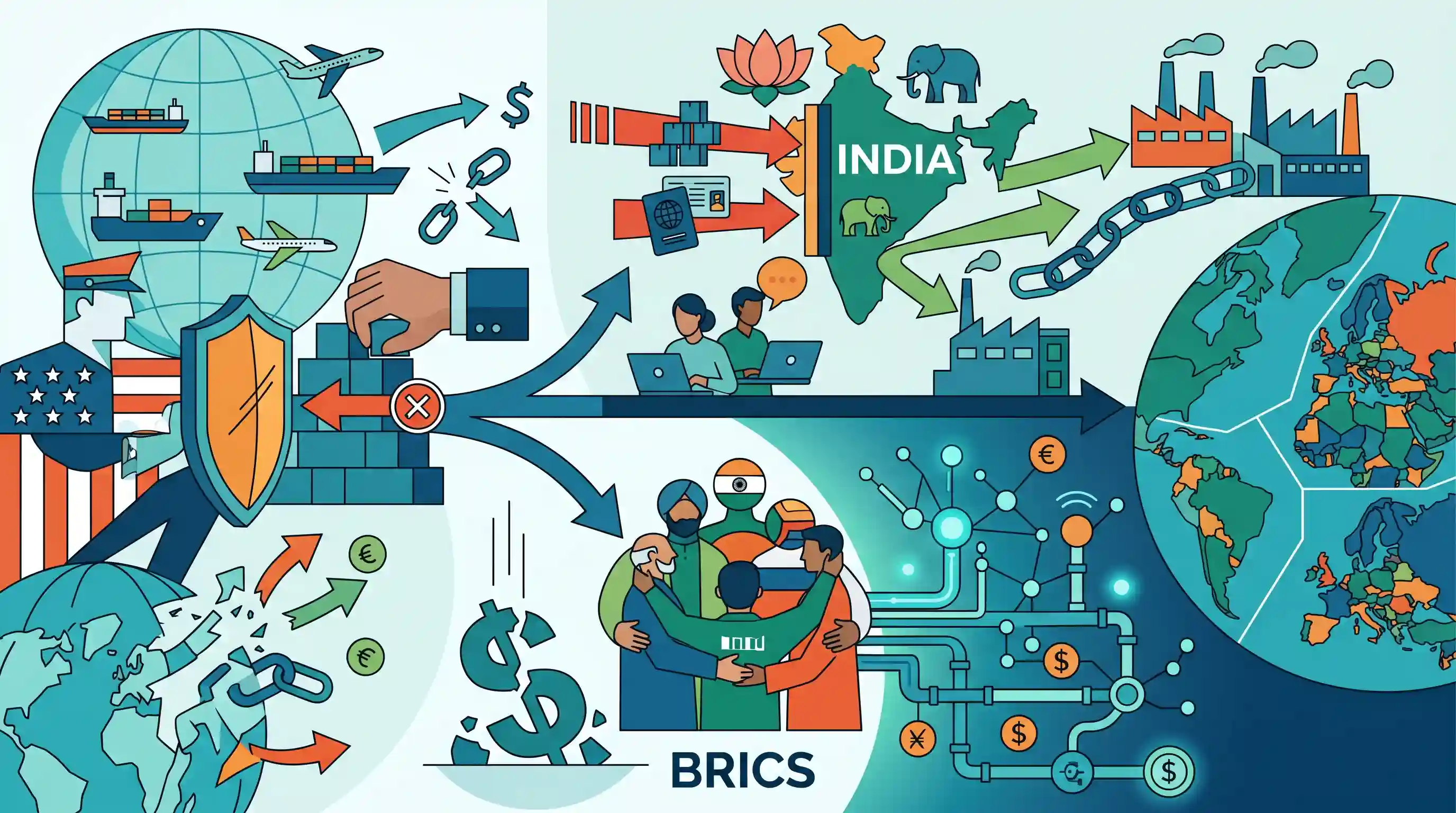
The article examines the global ramifications of Donald Trump's economic nationalism, characterized by protectionist trade policies and the 'America First' doctrine. For India, this approach creates friction through potential tariffs on exports and tightened H-1B visa regulations that impact the IT sector, although it simultaneously offers supply chain opportunities via the 'China Plus One' strategy. Furthermore, US economic unilateralism is pushing the BRICS nations closer together, accelerating their collective drive towards de-dollarization and the creation of alternative financial architectures to reduce reliance on the US dollar and the SWIFT system. Ultimately, these dynamics underscore the ongoing transition from globalized free trade to a fragmented, multipolar world order.
Key Points
- Donald Trump's economic nationalism and 'America First' approach relies heavily on protectionism, including higher tariffs and stricter trade barriers, fundamentally altering global trade.
- For India, these policies present a dual challenge: potential restrictions on H-1B visas threatening the IT sector, and tariffs impacting major exports like pharmaceuticals, steel, and textiles.
- Conversely, heightened US-China trade tensions could benefit India if it successfully capitalizes on the 'China Plus One' supply chain diversification strategy.
- In response to US financial dominance and weaponization of the dollar, the BRICS grouping is expected to accelerate its de-dollarization agenda, exploring local currency trade and alternative payment systems bypassing SWIFT.
- The ripple effects signify a broader geopolitical shift away from multilateral free trade toward bilateralism, protectionism, and a multipolar economic order.
Important Terms
America First

A foreign policy doctrine prioritizing American national interests, sovereignty, and economic self-sufficiency. It emphasizes protectionism, bilateralism over multilateral agreements, and the reshoring of manufacturing to reduce trade deficits.
UPSC context
GS Paper 2: Effect of policies of developed countries on India’s interests; tests understanding of protectionism versus globalization.
H-1B Visa Program
A US non-immigrant visa allowing employers to hire high-skilled foreign workers in 'specialty occupations'. Indians receive approximately 70% of these visas, making it vital for India's IT exports and remittances.
UPSC context
GS Paper 2: Indian Diaspora and International Relations; crucial for questions on India-US strategic and economic ties.
De-dollarization
The strategic process of reducing reliance on the US dollar for international trade and foreign exchange reserves. It involves using local currencies or alternative financial systems to mitigate risks from US sanctions.
UPSC context
GS Paper 3: Economy (Monetary Policy) and GS Paper 2; relevant for discussions on a multipolar financial order.
China Plus One Strategy
A business strategy encouraging multinational corporations to diversify their supply chains by establishing manufacturing hubs in countries other than China to mitigate geopolitical risks and over-reliance.
UPSC context
GS Paper 3: Economy (Manufacturing and Supply Chains); tests India’s potential as a global manufacturing alternative.
BRICS
An intergovernmental organization comprising major emerging economies (Brazil, Russia, India, China, South Africa + new members). It seeks to amplify the voice of the Global South and reform global governance institutions.
UPSC context
GS Paper 2: Bilateral, regional and global groupings; central to India's role in the emerging world order.
World Trade Organization (WTO)
The only global international organization dealing with the rules of trade between nations. It facilitates free, fair, and rules-based trade but currently faces challenges from rising protectionism and judicial paralysis.
UPSC context
GS Paper 2: Important International institutions; tests knowledge of multilateral trade governance and contemporary challenges.
Prelims Trap
BRICS nations have officially launched a unified common currency to replace the US Dollar.
While BRICS promotes local currency settlement and alternative payment systems to bypass SWIFT, there is currently no unified or officially launched "BRICS currency."
Static Concepts Connected
What is the SWIFT system and how does it function?
- Messaging Network: It is a secure messaging network used by banks globally to transmit information and instructions, but it does not actually hold or move funds.
- Governance: It is a cooperative society based in Belgium, overseen by the central banks of the G-10 countries, the ECB, and the National Bank of Belgium.
- Sanctions Mechanism: Disconnecting a nation's banks from SWIFT (like Russia recently) effectively paralyzes their ability to conduct dollar-based international trade.
What are the key US work visa categories impacting the Indian diaspora?
- H-1B Visa: A non-immigrant visa allowing US employers to temporarily employ foreign workers in specialty occupations, heavily utilized by the Indian IT sector.
- L-1 Visa: A non-immigrant visa designed specifically for intracompany transfers of executives, managers, or specialized knowledge employees within multinational firms.
- EB-5 Visa: An employment-based immigrant visa offering a path to permanent residency (Green Card) for foreigners who make significant capital investments in US commercial enterprises.
Cross-Topic Patterns
Protectionism and WTO's Appellate Crisis
Rising unilateral US tariffs violate WTO's Most-Favored-Nation (MFN) principles, directly connecting to the ongoing paralysis of the WTO's Appellate Body caused by US vetoes on judge appointments.
RBI's Vostro accounts and BRICS De-dollarization
The BRICS push for alternative payment networks perfectly aligns with the RBI's recent frameworks for invoicing international trade in INR using Special Rupee Vostro Accounts (SRVA).

A combined GS2/GS3 question linking US protectionism (tariffs/visas) to India's 'China Plus One' manufacturing opportunities is expected.
Linked PYQs · 5
Linked PYQs · 5
- 2012MainsGS2
Discuss the likely negative impact of the protectionist measures proposed by the US on India's software industry.
- 2025MainsGS3
What are the challenges before the Indian economy when the world is moving away from free trade and multilateralism to protectionism and bilateralism? How can these challenges be met?
- 2018MainsGS3
How would the recent phenomena of protectionism and currency manipulations in world trade affect macroeconomic stability of India?
- 2019MainsGS2
‘What introduces friction into the ties between India and the United States is that Washington is still unable to find for India a position in its global strategy, which would satisfy India's national self-esteem and ambitions.’ Explain with suitable examples.
- 2015PrelimsGS1
The 'Fortaleza Declaration', recently in the news, is related to the affairs of
