US Nuclear Testing Resumption and Global Security Impact
Source:Indian Express ↗
Why It Matters
Global nuclear non-proliferation architectures (NPT, CTBT) and the nuclear arms race are critical components of the UPSC GS2 syllabus (International Relations) and GS3 (Security). Changes in the nuclear posture of major powers directly impact global stability and India's strategic calculations, given its unique status as a recognized nuclear power outside the NPT framework.
Summary
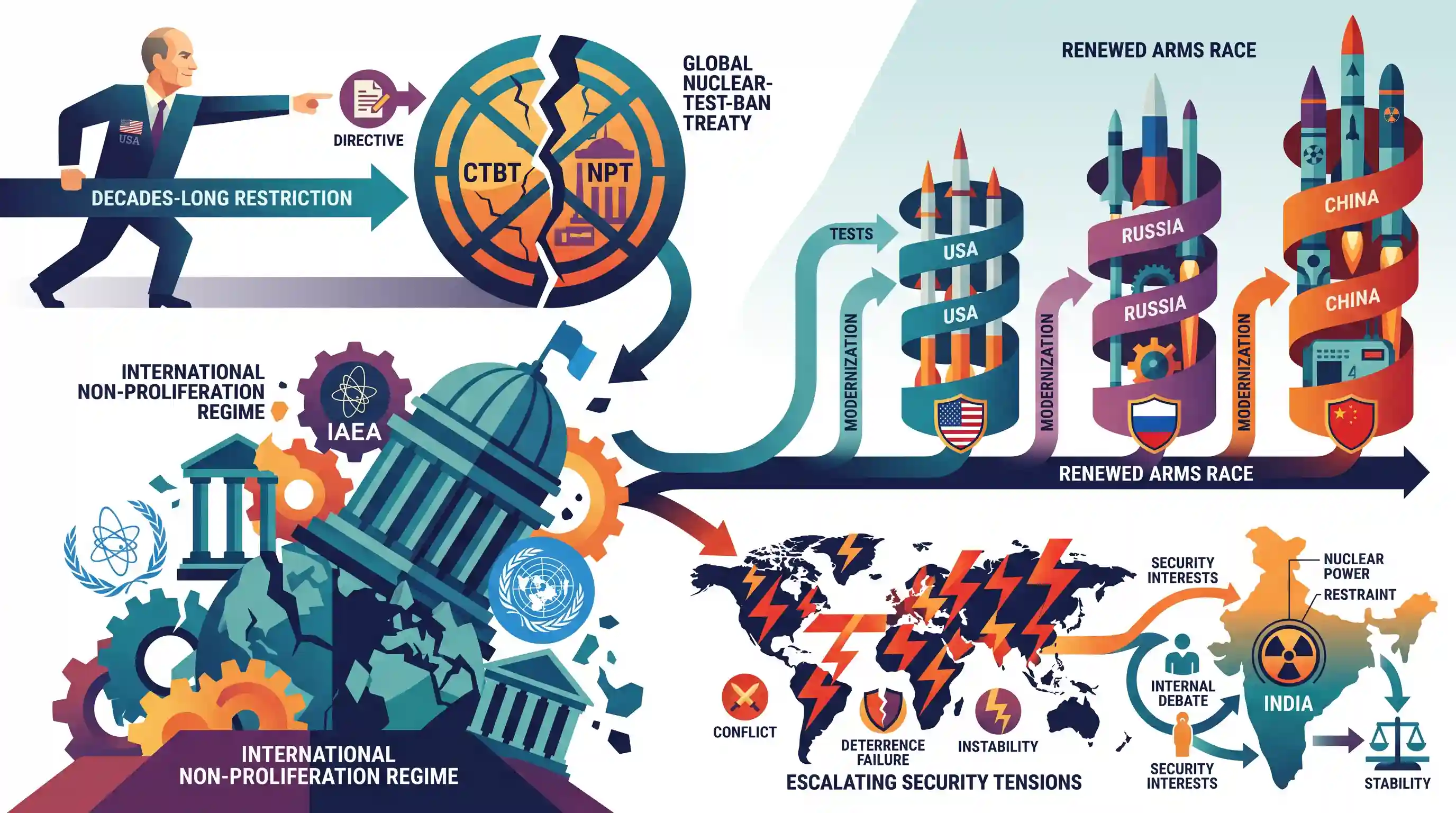
The article examines the profound geopolitical implications of a directive by Donald Trump to resume US nuclear weapons testing. Such a policy shift would break decades of adherence to the nuclear testing moratorium and undermine the Comprehensive Nuclear-Test-Ban Treaty (CTBT). It warns that this action would inevitably trigger a renewed arms race, as adversaries like China and Russia would likely respond by resuming their own nuclear tests to modernize their arsenals. The article underscores how this approach reflects a dangerous misunderstanding of strategic deterrence, threatening to dismantle the global non-proliferation regime and drastically escalate international security tensions.
Key Points
- A potential directive by the US to resume nuclear weapons testing marks a severe departure from the long-standing global moratorium and the spirit of the Comprehensive Nuclear-Test-Ban Treaty (CTBT).
- Such a move is highly likely to provoke immediate symmetric responses from Russia and China, prompting them to conduct their own tests to modernize their nuclear arsenals.
- The resumption of testing threatens to completely unravel the global nuclear non-proliferation architecture, placing intense strain on the NPT framework.
- The decision reflects a dangerous underestimation of the fragility of strategic deterrence and risks igniting a new, unrestrained global nuclear arms race.
- This geopolitical shift would destabilize international security, complicating the strategic environment for all nations, including non-signatories to the NPT like India.
Important Terms
Comprehensive Nuclear-Test-Ban Treaty (CTBT)

A multilateral treaty banning all nuclear explosions for military or civilian purposes. It has not entered into force because several key states, including India and the U.S., have not ratified it.
UPSC context
GS-II: International Relations. Critical for understanding global disarmament efforts and India's refusal to sign due to the treaty's discriminatory nature.
Treaty on the Non-Proliferation of Nuclear Weapons (NPT)
A 1968 landmark treaty aiming to prevent the spread of nuclear weapons, promote disarmament, and peaceful nuclear energy. India is a non-signatory, viewing it as "nuclear apartheid."
UPSC context
GS-II: International Relations. Tests knowledge of global non-proliferation pillars and India's strategic autonomy in nuclear policy.
Strategic Deterrence
A military strategy aimed at preventing aggression by convincing an adversary that the costs of an attack will outweigh any potential benefits, often through the threat of nuclear retaliation.
UPSC context
GS-III: Internal Security/Defense. Essential for analyzing India's "No First Use" policy and "Credible Minimum Deterrence" doctrine.
Nuclear Testing Moratorium
A voluntary or formal suspension of nuclear weapons testing. India has maintained a unilateral moratorium since 1998, while the U.S. and Russia have followed an informal one for decades.
UPSC context
GS-III: Security. Relevant for understanding India’s responsible nuclear behavior and regional stability in South Asia.
Arms Race
A competitive buildup of weapons and military technology between rival nations. Resuming nuclear tests is seen as a catalyst for a modernized, multi-polar arms race.
UPSC context
GS-II: Effect of policies of developed countries. Analyzes how U.S.-China-Russia rivalry impacts global security and India's defense preparedness.
Non-Proliferation Regime
The international framework of treaties (NPT, CTBT), export control groups, and the IAEA aimed at stopping the spread of nuclear weapons and ensuring peaceful use of technology.
UPSC context
GS-II: International Institutions. Focuses on the challenges to global governance and the breakdown of multilateral security architectures.
Prelims Trap
The US resumption of tests will violate the legally binding provisions of the CTBT.
The CTBT has never formally entered into force. The current global pause in nuclear explosions is based on voluntary state moratoriums, not legally enforceable global treaty law.
Static Concepts Connected
What are the core differences between the NPT and CTBT regarding India's opposition?
- NPT discrimination: Divides the world into 5 recognized Nuclear Weapon States (tested pre-1967) and non-nuclear states. India rejected this arbitrary divide as inherently discriminatory.
- CTBT loopholes: Bans explosive testing but lacks a comprehensive time-bound disarmament plan. It also allows sub-critical testing, which India argued favored existing nuclear powers.
- Voluntary moratorium: Despite rejecting both treaties, India declared a voluntary moratorium on further nuclear explosive testing following its Pokhran-II tests in 1998.
What is the Annex-2 requirement for the CTBT?
- 44-State condition: The CTBT cannot legally enter into force until 44 specific nuclear-technology-holder nations (listed in Annex-2) officially ratify the agreement.
- Current holdouts: Eight nations have halted its enforcement. India, Pakistan, and North Korea haven't signed; the US, China, Israel, Iran, and Egypt signed but haven't ratified.
Cross-Topic Patterns
NSG waiver & testing moratorium link
India's unique 2008 NSG waiver allowing civilian nuclear trade is practically tied to its voluntary testing moratorium. A global resumption of tests pressures India's long-standing strategic posture.
Sub-critical tests vs. Explosive tests
For years, nuclear weapon states modernized arsenals using sub-critical tests (no nuclear yield). Resuming explosive tests signifies a dangerous shift from technical necessity to aggressive geopolitical signaling.

Expect a 2026 Prelims question testing the difference between NPT's 1967 cutoff date and CTBT's Annex-2 ratification holdouts.
Linked PYQs · 2
Linked PYQs · 2
- 2018PrelimsGS1
What is/are the consequence/consequences of a country becoming the member of the 'Nuclear Suppliers Group'? 1. It will have access to the latest and most efficient nuclear technologies. 2. It automatically becomes a member of "The Treaty on the Non-Proliferation of Nuclear Weapons (NPT)". Which of the statements given above is/are correct?
- 2015PrelimsGS1
Consider the following countries: 1. China 2. France 3. India 4. Israel 5. Pakistan Which among the above are Nuclear Weapons States as recognized by the Treaty on the Non-Proliferation of Nuclear Weapons, commonly known as Nuclear Non-Proliferation Treaty (NPT)?
