US Implements Steep Tariffs on Major Trading Partners
Source:The Hindu ↗
Why It Matters
The imposition of punitive US tariffs targeting India's purchase of Russian oil presents a direct challenge to India's strategic autonomy and energy security policy. Furthermore, it exemplifies the broader global trend of rising protectionism and trade wars, impacting India's macroeconomic stability and export competitiveness.
Summary
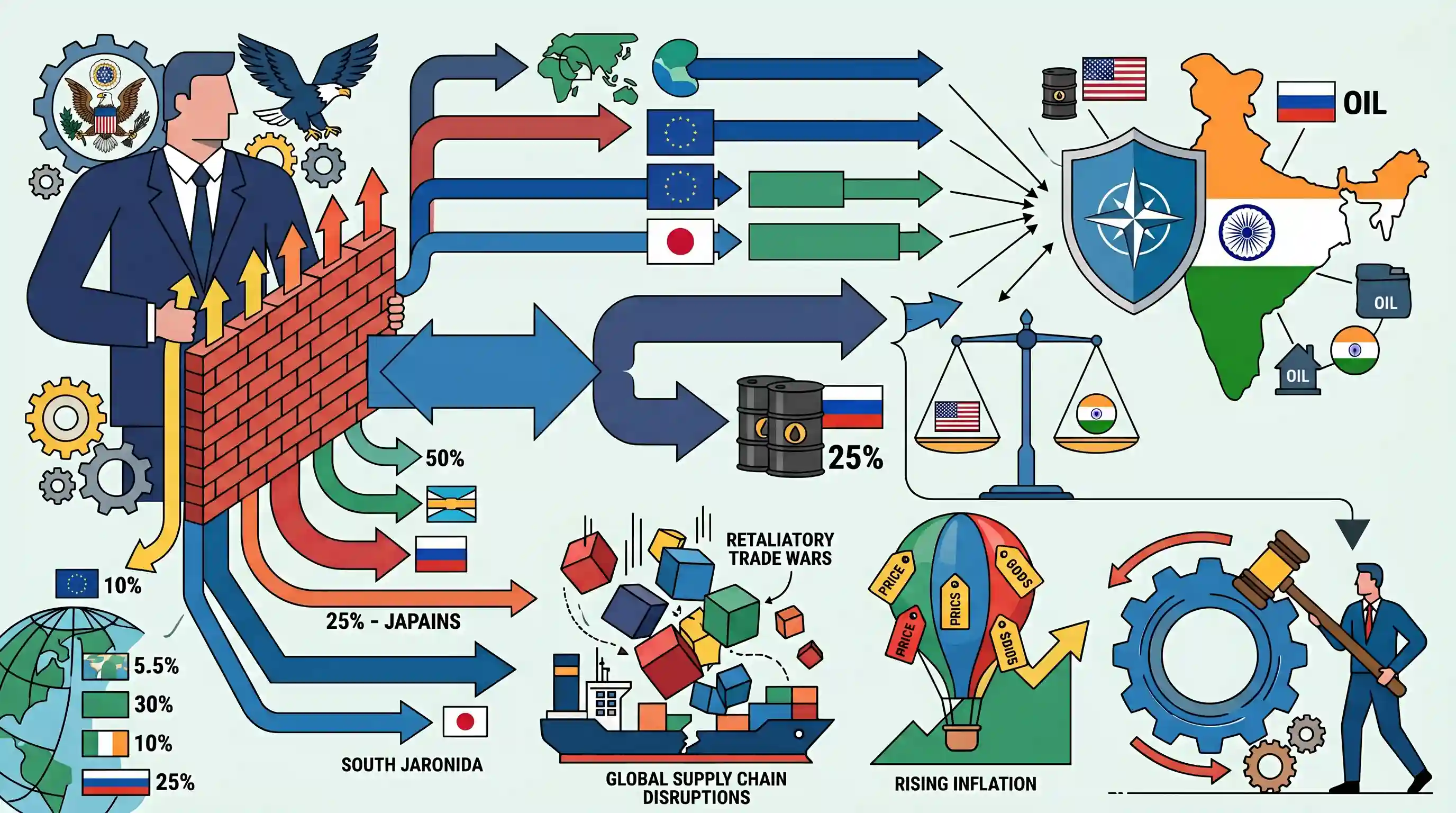
The United States under President Donald Trump has implemented broad and steep tariffs on goods from major trading partners, with rates ranging from 10% to 50%, in a bid to reduce the U.S. trade deficit. India has been hit with a 50% total tariff, including a 25% penalty for continuing to buy Russian oil, highlighting friction between U.S. trade policy and India's strategic autonomy. While some allies negotiated lower rates, the sweeping protectionist moves carry risks of retaliatory trade wars, global supply chain disruptions, and rising inflation.
Key Points
- The US administration has enforced sweeping tariffs ranging from 10% to 50% on imports from its major trading partners to shrink its trade deficit.
- India faces a severe 50% combined tariff rate, consisting of a 25% baseline tariff and a 25% penalty specifically targeting its continued purchase of Russian oil.
- Several allies, including the EU, Britain, Japan, and South Korea, successfully negotiated significant reductions to their respective tariff rates.
- To prevent tariff evasion, the US imposed an additional 40% duty on goods transshipped through third countries.
- The broad protectionist measures threaten to trigger retaliatory actions, disrupt global supply chains, and exacerbate domestic and global inflation.
Important Terms
Protectionism

The economic policy of restricting imports through tariffs, quotas, or regulations to protect domestic industries from foreign competition and reduce trade deficits.
UPSC context
GS Paper 3 (Economy) and GS Paper 2 (International Relations); tests understanding of global trade barriers and their impact on Indian exports.
Strategic Autonomy
A nation's ability to pursue its national interests and adopt independent foreign policy without being coerced by other states, especially in trade and energy.
UPSC context
GS Paper 2 (International Relations); key to India's multi-alignment strategy and handling of U.S.-Russia-India dynamics.
Trade Deficit
An economic condition where the value of a country's imports exceeds its exports; often cited by the U.S. as justification for protectionist tariffs.
UPSC context
GS Paper 3 (Economy); important for analyzing Balance of Payments (BoP) and bilateral economic frictions.
U.S. Customs and Border Protection (CBP)
The primary U.S. federal law enforcement agency responsible for regulating international trade, collecting duties, and enforcing trade laws at borders.
UPSC context
GS Paper 2; relevant for understanding the administrative enforcement of foreign trade policies and sanctions.
Retaliatory Tariffs
Tariffs imposed by a country in response to tariffs placed on its own exports by a trading partner, often escalating into trade wars.
UPSC context
GS Paper 3; tests knowledge of WTO rules and the spiral effects of global trade conflicts.
Secondary Sanctions
Economic penalties applied to parties (like India) for engaging in trade with a sanctioned country (like Russia), even if the parties are not directly sanctioned.
UPSC context
GS Paper 2; critical for discussing "extraterritoriality" and its impact on India's energy security and Russian ties.
Prelims Trap
The US tariff penalty on India for purchasing Russian oil is a secondary sanction enforced under CAATSA.
This is a unilateral trade tariff, not a secondary sanction under CAATSA, which specifically targets significant transactions with Russian defense and intelligence sectors.
Static Concepts Connected
What is the Most-Favoured-Nation (MFN) principle under the WTO?
- Core Principle: WTO members must treat all trading partners equally; granting a trade favor to one country requires granting it to all WTO members.
- Permitted Exceptions: Free Trade Agreements (FTAs) and special market access for developing countries (like GSP) allow permitted deviations from the standard MFN rule.
- Security Exception: Article XXI of GATT allows members to breach trade obligations, including MFN, to protect essential national security interests.
How does the "Rules of Origin" concept address tariff evasion via transshipment?
- Definition: Criteria used to determine the exact national source of a product, which is crucial for correctly applying country-specific tariffs and trade restrictions.
- Transshipment Evasion: Routing goods through third countries to avoid high tariffs. Strict Rules of Origin combat this by demanding proof of source.
- Substantial Transformation: To qualify as originating from the transit country, a product must undergo "substantial transformation" or meet a minimum local value-addition threshold.
Cross-Topic Patterns
Energy Security vs. US Economic Coercion
India's steadfast import of discounted Russian crude highlights the friction between multi-alignment and transactional US economic statecraft, echoing past debates over Iran oil sanctions and CAATSA waivers.
Transshipment duties & Global Value Chains
The 40% duty on transshipped goods targets Chinese tariff evasion but collaterally hits developing economies relying on intermediate goods, challenging the viability of the "China-Plus-One" supply chain strategy.

A 2026 Prelims multi-statement question will likely interlink the WTO's Most Favoured Nation principle, unilateral tariffs, and Rules of Origin.
Linked PYQs · 3
Linked PYQs · 3
- 2025MainsGS3
What are the challenges before the Indian economy when the world is moving away from free trade and multilateralism to protectionism and bilateralism? How can these challenges be met?
- 2018MainsGS3
How would the recent phenomena of protectionism and currency manipulations in world trade affect macroeconomic stability of India?
- 2019MainsGS2
‘What introduces friction into the ties between India and the United States is that Washington is still unable to find for India a position in its global strategy, which would satisfy India's national self-esteem and ambitions.’ Explain with suitable examples.
