BRICS nations set to lead climate agenda and negotiations at COP30
Source:The Hindu ↗
Why It Matters
Understanding the changing dynamics of global climate governance is crucial for UPSC aspirants, as the transition of leadership from developed nations (US/EU) to the Global South (BRICS) directly impacts multilateral environmental agreements, climate finance mechanisms, and India's strategic negotiations on the world stage.
Summary
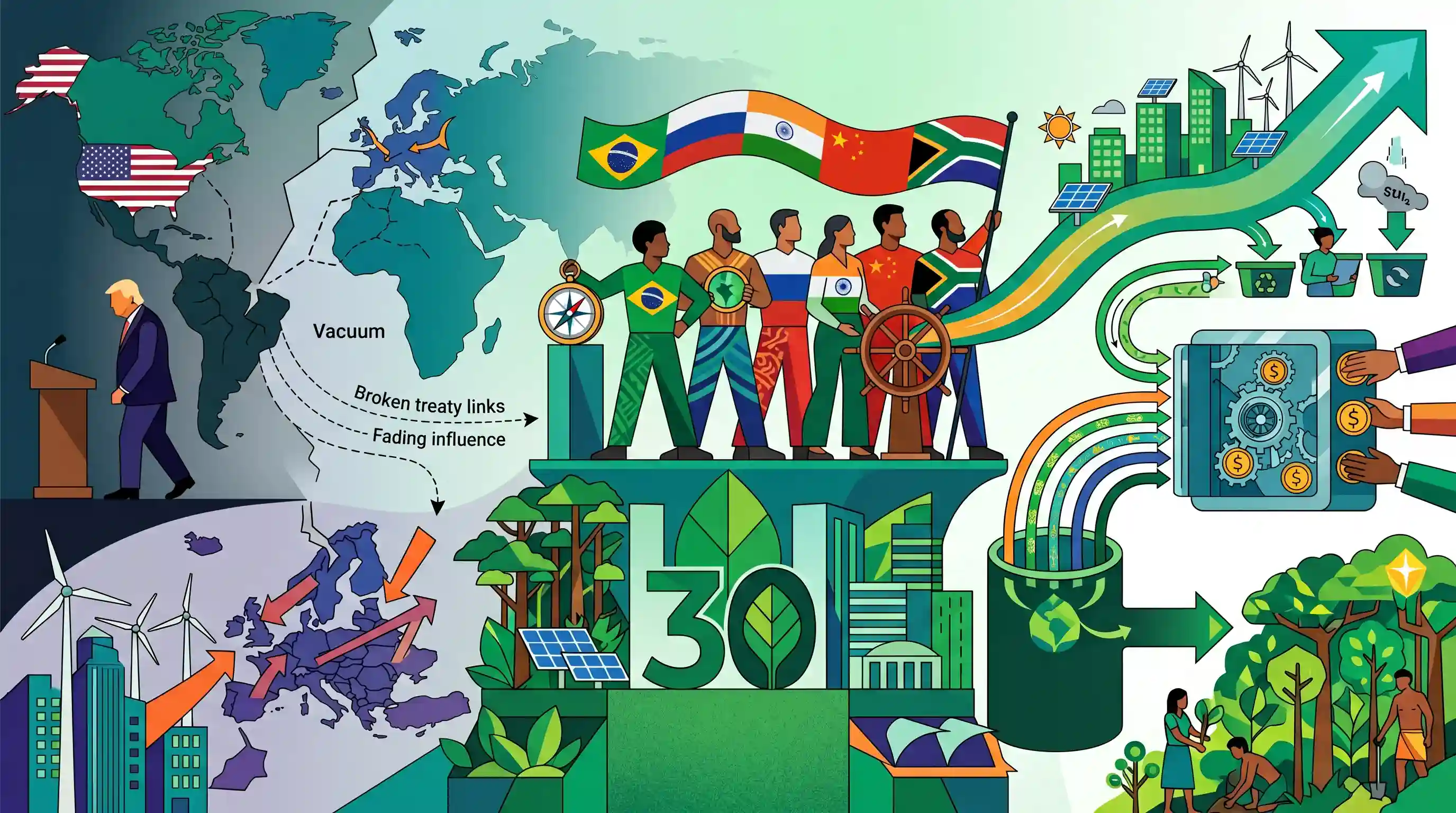
The upcoming COP30 climate summit in Belem, Brazil, is set against a backdrop of shifting geopolitical dynamics. With the United States officially withdrawing its participation under the Trump administration and Europe struggling to balance domestic economic concerns with its climate targets, a significant leadership vacuum has emerged. In response, the BRICS nations are stepping up to guide global climate diplomacy, aiming to ensure that the Global South's priorities—particularly economic growth aligned with emission cuts—are met without being overshadowed by the historical failures of developed nations. A central focus is securing robust climate finance through mechanisms like the New Collective Quantified Goal (NCQG) and introducing innovative financial structures like Brazil's proposed Tropical Forests Forever Fund (TFFF) to compensate developing countries for conservation efforts.
Key Points
- COP30 in Belem, Brazil, marks a pivotal moment for global climate action, coinciding with the 10th anniversary of the Paris Agreement.
- The withdrawal of the United States under Donald Trump and the weakening of European climate commitments have created a leadership vacuum in global climate governance.
- BRICS nations, led by Brazil and supported by India and China, are poised to champion the interests of the Global South and steer multilateral climate negotiations.
- The 'Baku-to-Belem Roadmap' aims to translate financial targets set at COP29 into actionable goals at COP30, emphasizing the need for developed countries to fulfill climate finance obligations.
- Brazil is aggressively pushing the Tropical Forests Forever Fund (TFFF) to secure continuous compensation for maintaining carbon sinks, fundamentally shifting the paradigm of conservation finance.
Important Terms
New Collective Quantified Goal (NCQG)

A post-2025 climate finance target replacing the $100 billion annual goal. It aims to mobilize trillions for developing nations' adaptation and mitigation efforts, discussed under the Paris Agreement framework.
UPSC context
GS-III (Environment/Economy). Tests understanding of climate finance architecture and the North-South divide in fulfilling international financial obligations.
Tropical Forests Forever Fund (TFFF)
A $125 billion Brazilian-led fund proposed for COP30 to provide performance-based payments to tropical countries for forest conservation, incentivizing keeping standing forests intact rather than clearing them.
UPSC context
GS-III (Conservation). Focuses on innovative financial mechanisms for biodiversity and forest protection, highlighting India's role in global environmental leadership.
BRICS
A multilateral grouping of major emerging economies—initially Brazil, Russia, India, China, and South Africa—recently expanded, advocating for the Global South's interests in global governance and climate diplomacy.
UPSC context
GS-II (International Groupings). Crucial for questions on multipolarity, South-South cooperation, and emerging blocs challenging Western-led global governance.
Global South
Nations typically in Africa, Asia, and Latin America characterized by shared histories of colonialism and common developmental challenges, often prioritizing Climate Justice and equitable finance in negotiations.
UPSC context
GS-II (IR). Essential for analyzing India's leadership role and the demand for equity and CBDR in international treaties.
Paris Agreement
A 2015 legally binding international treaty under the UNFCCC aiming to limit global warming to well below 2°C, preferably 1.5°C, through Nationally Determined Contributions (NDCs).
UPSC context
GS-III (Environment). Foundational for questions on NDCs, global stocktakes, and the 'ratchet mechanism' to increase climate ambition over time.
UNFCCC
The 1992 foundational treaty providing the framework for international climate negotiations and the annual Conference of Parties (COP) meetings to stabilize greenhouse gas concentrations.
UPSC context
GS-III (Environment). Essential for understanding the legal and institutional framework of global climate governance and the principle of CBDR.
Prelims Trap
The Tropical Forests Forever Fund (TFFF) functions as a traditional carbon offset market trading credits.
TFFF is an investment fund offering predictable, performance-based payments for maintaining standing forests, distinct from traditional 'avoided deforestation' carbon offset models.
Static Concepts Connected
What is the principle of CBDR-RC under the UNFCCC?
- Core Meaning: Acknowledges all states have a shared obligation to combat climate change but unequal historical responsibility.
- Developed Nations: Developed countries contributed most to historical GHG emissions and must lead mitigation and finance.
- Global South: Protects developing nations' right to economic growth, emphasizing financial support without imposing immediate binding emission cuts.
How does the New Collective Quantified Goal (NCQG) evolve global climate finance?
- Previous Target: Replaces the unmet $100 billion annual target set at COP15 (Copenhagen) for developed nations.
- New Scale: Aims to mobilize $1.3 trillion annually by 2035 to support developing countries' climate actions.
- Quality of Finance: Emphasizes the need for non-debt-creating financial flows, grant-based mechanisms, and technology transfers for the Global South.
Cross-Topic Patterns
BRICS+ as a Global South bloc
The expanded BRICS is pivoting from purely economic cooperation to multilateral climate leadership, filling the global governance vacuum left by Western political transitions and domestic priorities.
Conservation Finance vs Carbon Markets
Brazil's TFFF represents a shift from market-volatile REDD+ carbon credits to sovereign, performance-based investment funds, altering how developing nations monetize natural ecological sinks.

Expect a Prelims pairing of NCQG ($1.3T target) and TFFF, testing the distinction between sovereign conservation funds and REDD+ offsets.
Linked PYQs · 5
Linked PYQs · 5
- 2021MainsGS3
Describe the major outcomes of the 26th session of the Conference of the Parties (COP) to the United Nations Framework Convention on Climate Change (UNFCCC). What are the commitments made by India in this conference?
- 2025MainsGS3
Write a review on India's climate commitments under the Paris Agreement (2015) and mention how these have been further strengthened in COP26 (2021). In this direction, how has the first Nationally Determined Contribution intended by India been updated in 2022?
- 2012MainsGS2
Compare the significance of IBSA and BRICS in the context of India's multilateral diplomacy.
- 2019MainsGS2
‘The long-sustained image of India as a leader of the oppressed and marginalised nations has disappeared on account of its new found role in the emerging global order.’ Elaborate.
- 2015PrelimsGS1
Which of the following statements regarding 'Green Climate Fund' is/are correct? 1. It is intended to assist the developing countries in adaptation and mitigation practices to counter climate change. 2. It is founded under the aegis of UNEP, OECD, Asian Development Bank and World Bank. Select the correct answer using the code given below.
