US Climate Policy Rollback and Implications for India
Source:Indian Express ↗
Why It Matters
Climate change and global environmental governance are central themes in both GS2 (International Relations) and GS3 (Environment). Understanding how domestic political shifts in major powers like the US affect international treaties and India's diplomatic and environmental strategies is crucial for analytical Mains answers.
Summary
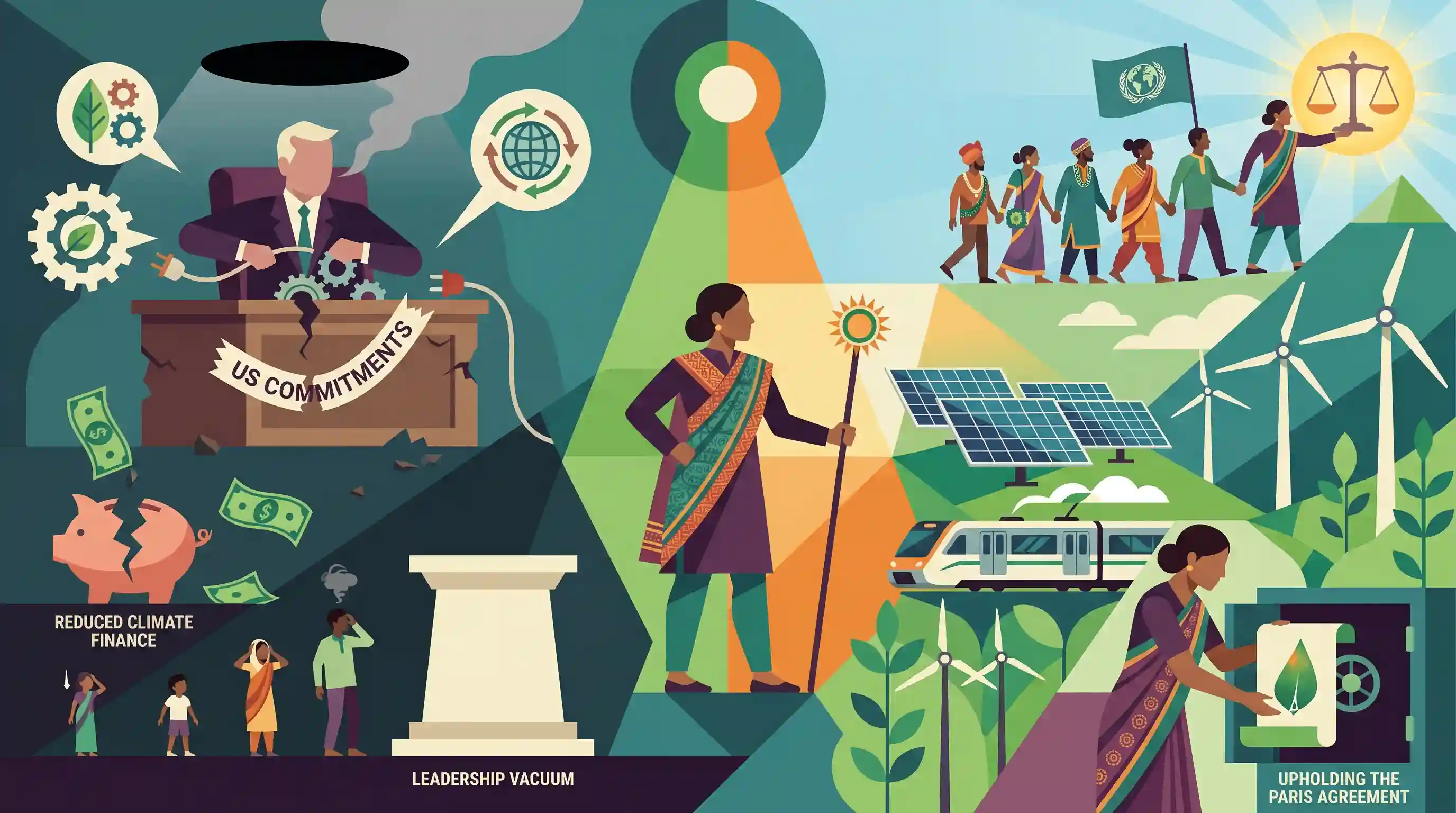
The article analyzes the potential implications of a Donald Trump presidency on global climate governance, focusing on the rollback of Environmental Protection Agency (EPA) regulations and the US retreat from international climate commitments. It highlights how this shift creates a global leadership vacuum and negatively impacts climate finance and emissions targets. Consequently, the piece outlines what India must do to navigate this geopolitical shift, emphasizing the need for India to independently strengthen its renewable energy transition, uphold its climate commitments under the Paris Agreement, and assert leadership among developing nations to demand equitable climate action and climate justice.
Key Points
- A potential US retreat from global climate commitments under Donald Trump threatens international efforts to meet emissions targets and mitigations.
- The potential rollback of Environmental Protection Agency (EPA) regulations in the US signals a shift away from environmental protection toward prioritizing fossil fuels and economic deregulation.
- The US stepping back creates a massive vacuum in global climate finance and leadership, disproportionately affecting vulnerable developing nations.
- India must continue to champion its domestic renewable energy goals and 'Panchamrit' commitments despite the shifting geopolitical landscape.
- India has an opportunity to assert climate leadership by advocating for the Global South, emphasizing the principle of Common But Differentiated Responsibilities (CBDR), and building strategic green partnerships globally.
Important Terms
Paris Agreement

A legally binding 2015 international treaty aiming to limit global warming to well below 2°C, preferably 1.5°C, compared to pre-industrial levels.
UPSC context
GS-II/III: Tests understanding of global governance frameworks and India’s specific international climate commitments.
Nationally Determined Contributions (NDCs)
Climate action plans submitted every five years under the Paris Agreement, outlining a country's self-defined targets for reducing emissions and adapting to climate impacts.
UPSC context
GS-III Environment: Crucial for evaluating India’s progress toward its 2030 targets and its 2070 Net-Zero goal.
UNFCCC
The primary 1992 international treaty established to stabilize greenhouse gas concentrations; it acts as the parent framework for the Paris Agreement.
UPSC context
GS-III Environment: Foundational knowledge for questions on the history of international environmental law and annual COP negotiations.
Climate Finance
Local, national, or transnational funding—drawn from public and private sources—that supports mitigation and adaptation actions to address climate change.
UPSC context
GS-III Economy/Environment: Tests understanding of the global $100 billion funding commitment and its necessity for developing nations.
Climate Justice
A framing of climate change as an ethical and political issue, emphasizing historical responsibility and the disproportionate impact on vulnerable populations.
UPSC context
GS-IV Ethics/GS-III Environment: Tests India’s leadership in advocating for equitable climate action for the Global South.
Environmental Protection Agency (EPA)
The independent US federal agency tasked with environmental protection; its domestic regulatory shifts (e.g., on emissions) significantly impact global climate governance.
UPSC context
GS-II International Relations: Evaluates how US domestic policy changes affect global environmental standards and India’s geopolitical interests.
Prelims Trap
"Nationally Determined Contributions (NDCs) under the Paris Agreement are legally binding emission reduction targets."
Under the Paris Agreement, the act of submitting and reporting NDCs is legally binding, but the actual domestic emission targets themselves are voluntary, not legally enforceable.
Static Concepts Connected
What are the core targets of India's 'Panchamrit' climate commitment?
- Capacity Building: Reach 500 GW of non-fossil energy capacity by 2030.
- 50% Renewables: Meet 50 percent of its total energy requirements from renewable energy by 2030.
- Emissions Reduction: Reduce total projected carbon emissions by one billion tonnes from now onwards till 2030.
- Net Zero 2070: Achieve the ultimate target of Net Zero emissions by the year 2070.
How does the UNFCCC define CBDR-RC?
- Shared Obligation: Acknowledges that all states share an obligation to address environmental destruction, but denies equal responsibility.
- Historical Burden: Places greater mitigation burden on developed countries due to their historical industrial greenhouse gas emissions.
- Respective Capabilities: Action is dictated by a nation's distinct financial and technological capacity to enact climate mitigation.
Cross-Topic Patterns
US climate retreat vs. EU's CBAM
As the US steps back from climate finance, the EU weaponizes climate via the Carbon Border Adjustment Mechanism (CBAM), forcing India to navigate trade protectionism disguised as environmentalism.
G20 legacy & Voice of Global South
India's defense of CBDR-RC aligns with its recent G20 presidency legacy, cementing its geopolitical role as the chief negotiator for developing nations facing Western climate hypocrisy.

Expect a 2026 GS-3 Mains question linking US climate policy shifts to the global climate finance deficit and India's Panchamrit goals.
Linked PYQs · 4
Linked PYQs · 4
- 2022MainsGS2
‘Clean energy is the order of the day.’ Describe briefly India's changing policy towards climate change in various international fora in the context of geopolitics.
- 2021MainsGS3
Describe the major outcomes of the 26th session of the Conference of the Parties (COP) to the United Nations Framework Convention on Climate Change (UNFCCC). What are the commitments made by India in this conference?
- 2022MainsGS3
Do you think India will meet 50 percent of its energy needs from renewable energy by 2030 ? Justify your answer. How will the shift of subsidies from fossil fuels to renewables help achieve the above objective ? Explain.
- 2025MainsGS3
Write a review on India's climate commitments under the Paris Agreement (2015) and mention how these have been further strengthened in COP26 (2021). In this direction, how has the first Nationally Determined Contribution intended by India been updated in 2022?
