US AI action plan prioritises deregulation to secure global dominance
Source:The Hindu ↗
Why It Matters
The article highlights critical intersections between emerging technologies, international relations, regulatory frameworks, and environmental governance. It is highly relevant for GS-3 (Science & Tech, Environment, IPR) and GS-2 (International Relations, Policies of Developed Nations) as it illustrates how global powers use technology for strategic dominance while compromising on environmental and copyright protections.
Summary
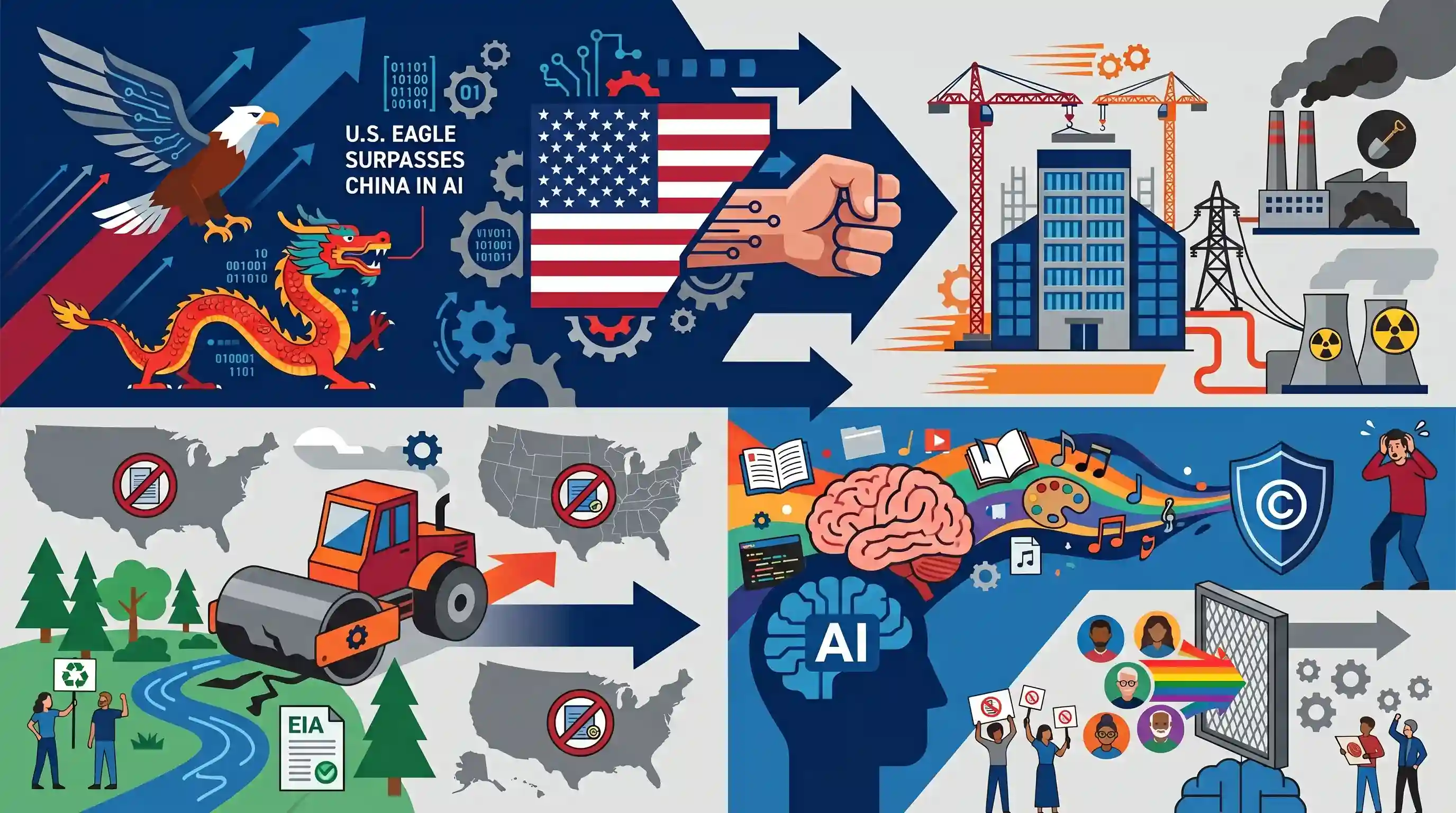
The Trump administration unveiled 'America’s AI Action Plan,' a comprehensive strategy aimed at cementing U.S. dominance in Artificial Intelligence (AI) by prioritizing aggressive deregulation and undermining environmental checks. The 25-page plan targets economic and military supremacy over China by establishing a single federal standard, overriding individual state regulations, and bypassing environmental assessments for the rapid construction of data centres powered by coal and nuclear plants. Additionally, the administration proposes blanket immunity from copyright claims for AI training and mandates that AI companies partnering with the government design systems devoid of 'ideological bias' or diversity-focused agendas, sparking concern from civil rights and environmental groups.
Key Points
- U.S. President Donald Trump introduced "America's AI Action Plan," a 25-page strategy focusing on accelerating AI innovation, building infrastructure, and leading internationally to secure dominance over China.
- The plan calls for sweeping deregulation, proposing a single federal standard while preventing U.S. states from implementing their own AI regulations.
- It seeks to bypass environmental concerns by streamlining permitting processes and creating environmental review exemptions for AI data centres, as well as promoting coal and nuclear power.
- The administration proposed broad immunity from copyright claims for AI development and mandated that AI systems used by the government be free from "ideological bias" or "social engineering agendas."
- The strategy also seeks to counter Chinese influence in global governance bodies and strengthen export controls on advanced AI computing technology.
Important Terms
America’s AI Action Plan

A 2025 strategic roadmap (28-page blueprint) aiming for U.S. AI supremacy through deregulation, infrastructure (data centers), and global tech diplomacy, framing AI as a national security race against China.
UPSC context
GS Paper 2 (International Relations) and GS Paper 3 (Science & Technology); tests awareness of global tech governance.
Environmental Impact Assessment (EIA)
A systematic process to identify and evaluate the potential environmental consequences of proposed projects before implementation, ensuring sustainable development and identifying mitigation strategies for ecological damage.
UPSC context
GS Paper 3 (Environment & Ecology); critical for understanding the balance between infrastructure growth and conservation.
Intellectual Property Rights (IPR)
Legal protections for creations of the mind, such as patents and copyrights. In AI, it specifically concerns the legality of using copyrighted data to train large-scale models.
UPSC context
GS Paper 3 (Economy/IPR); assesses legal challenges in the digital economy and global trade standards.
Techno-Nationalism
A geopolitical strategy linking a nation's technological prowess directly to its national security and economic power, often leading to competitive trade policies and export controls.
UPSC context
GS Paper 2 (Geopolitics); focuses on tech-led diplomacy and the US-China rivalry (strategic competition).
Data Centers
Large-scale physical facilities housing servers and storage for processing AI data. They are central to the Action Plan but criticized for their massive energy and water consumption.
UPSC context
GS Paper 3 (Infrastructure); tests understanding of the physical requirements and environmental footprint of the digital revolution.
Silicon Valley
The premier global hub for high-tech innovation and venture capital in California, representing the private-sector industry interests that heavily lobby for AI deregulation and federal support.
UPSC context
GS Paper 1 (Geography/Economic) and GS Paper 3; symbolizes the influence of tech clusters on global policy.
Prelims Trap
"The US AI Action Plan aligns globally by establishing strict environmental and copyright regulations for AI."
Aspirants often assume Western nations are harmonizing AI rules. The US strategy explicitly pursues aggressive deregulation, fundamentally contrasting with the EU's strict regulatory AI Act.
Static Concepts Connected
What is the statutory basis for Environmental Impact Assessment (EIA) in India?
- Statutory Backing: EIA is notified under the Environment (Protection) Act, 1986, to assess the potential environmental impact of proposed projects before clearance.
- Exemptions & Limitations: Certain strategic, defense, or Category B2 projects are exempted from public consultation. Data centers currently fall into a gray area regarding strict EIA scrutiny despite high resource usage.
Does Indian Copyright Law permit unauthorized data scraping for AI training?
- Current Framework: Governed by the Copyright Act, 1957. Currently, it lacks explicit provisions for Text and Data Mining (TDM) or generative AI training.
- Fair Dealing Exception: Section 52 allows 'fair dealing' for private research or criticism. However, mass data scraping for commercial AI models likely infringes copyright without explicit licensing.
Cross-Topic Patterns
AI's Carbon Footprint vs Climate Goals
The massive energy and water demands of AI data centers, and the US pivot to coal/nuclear to power them, creates a direct conflict with global Net Zero timelines and UNFCCC climate pledges.
Regulatory Divergence: US vs EU vs India
The US deregulatory, innovation-first strategy sharply contrasts with the EU's strict, risk-based AI Act, highlighting global fragmentation in technology governance and complicating India's regulatory calculus.

Expect a 2026 Mains question on the AI trilemma: balancing rapid innovation, environmental sustainability (data centers), and IPR protection.
Linked PYQs · 4
Linked PYQs · 4
- 2023MainsGS3
Introduce the concept of Artificial Intelligence (AI). How does Al help clinical diagnosis? Do you perceive any threat to privacy of the individual in the use of Al in healthcare?
- 2014MainsGS3
In a globalized world, Intellectual Property Rights assume significance and are a source of litigation. Broadly distinguish between the terms-Copyrights, Patents and Trade Secrets.
- 2021MainsGS2
“The USA is facing an existential threat in the form of a China, that is much more challenging than the erstwhile Soviet Union.” Explain.
- 2014MainsGS3
Environmental Impact Assessment studies are increasingly undertaken before a project is cleared by the Government. Discuss the environmental impacts of coal-fired thermal plants located at coal pitheads.
