India Rejects US Mediation Claims on Kashmir
Source:The Hindu ↗
Why It Matters
It highlights India's strict red lines regarding external intervention and third-party mediation in bilateral disputes. The event also underscores the diplomatic challenges of 'hyphenation' in US foreign policy and tests the depth of the US-India strategic partnership concerning cross-border terrorism.
Summary
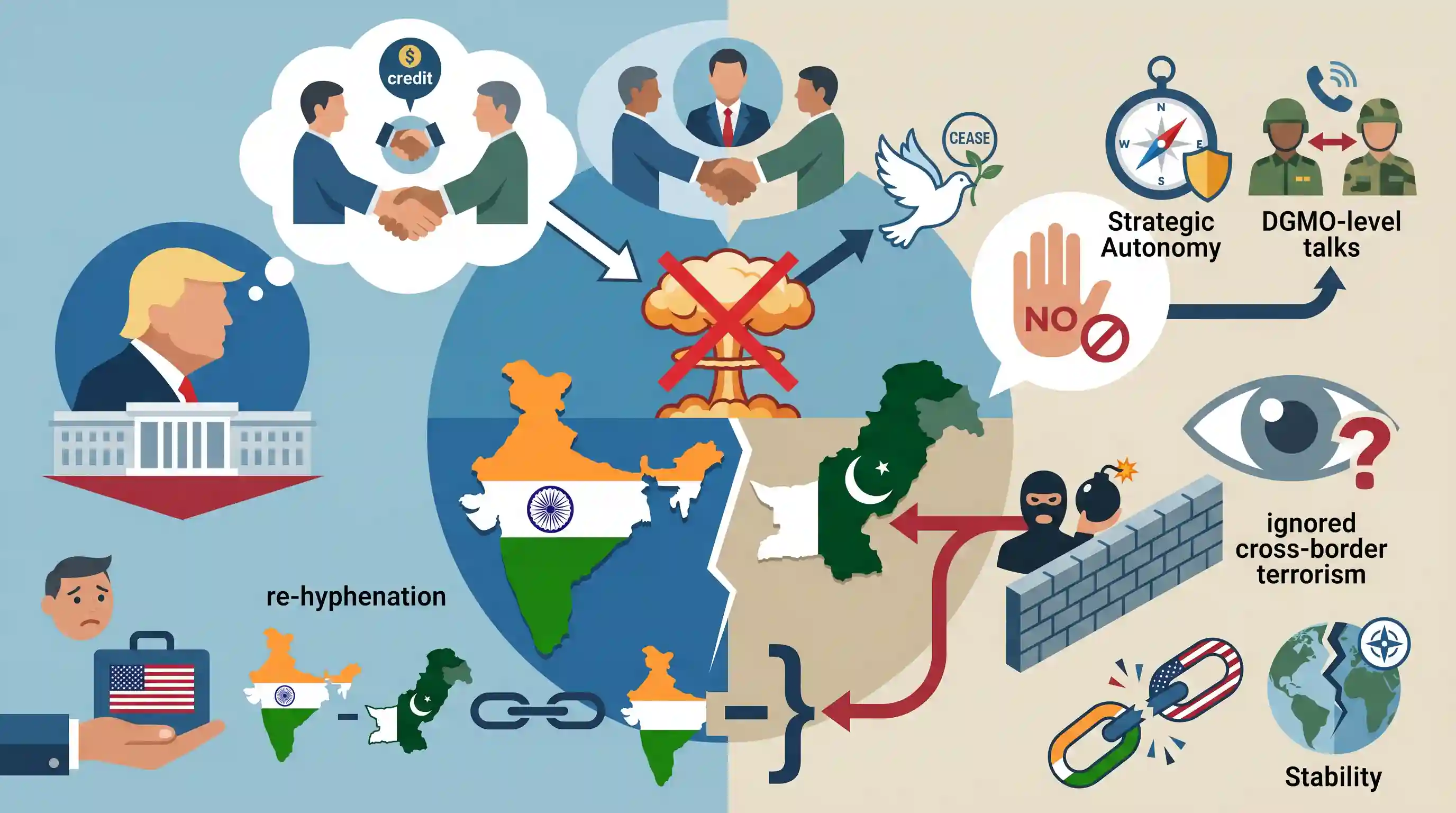
US President Donald Trump recently claimed credit for averting a 'nuclear conflict' between India and Pakistan by allegedly mediating a ceasefire. India has categorically rejected these claims, reiterating its strict policy of non-mediation in bilateral disputes like Kashmir and emphasizing that the ceasefire was achieved via direct DGMO-level talks. Trump's assertions risk re-hyphenating India and Pakistan in US diplomatic equations and ignoring the core issue of cross-border terrorism originating from Pakistan. This raises concerns for New Delhi regarding the consistency of the US-India strategic partnership and Washington's stance on regional stability.
Key Points
- US President Donald Trump claimed to have averted a nuclear conflict between India and Pakistan by mediating a ceasefire following 'Operation Sindoor'.
- India’s Ministry of External Affairs rejected these claims, clarifying that the ceasefire resulted from direct, bilateral talks between the DGMOs of the two countries over a hot-line.
- Trump's assertion directly contradicts India's long-standing foreign policy of refusing third-party mediation in bilateral disputes (such as Kashmir) and threatens to 're-hyphenate' India and Pakistan in US diplomacy.
- India also denied Trump's claim that he used the threat of halting bilateral trade to force both nations to abandon their nuclear postures.
- Trump's failure to address Pakistan's cross-border terrorism raises concerns in New Delhi regarding Washington's reliability as a partner in combating terror, despite cooperation through forums like the Quad.
Important Terms
Operation Sindoor

A 2025 Indian military campaign involving precision strikes against terrorist infrastructure in Pakistan-administered Kashmir and Punjab, following a terror attack in Pahalgam; it reflects India's proactive cost-imposition strategy.
UPSC context
GS Paper II & III; tests India's deterrence doctrine, response to cross-border terrorism, and escalation management.
De-hyphenation
A diplomatic policy of engaging with rival nations (e.g., India and Pakistan) independently on their own merits, rather than viewing them through the lens of their mutual conflict.
UPSC context
GS Paper II (International Relations); central to analyzing India-US strategic shifts and regional power dynamics.
Director General of Military Operations (DGMO)
A senior three-star Indian Army officer responsible for planning and monitoring military operations; they manage the dedicated hotline with Pakistan to de-escalate border tensions and implement ceasefires.
UPSC context
GS Paper III; tests knowledge of India's military command structure and crisis communication protocols.
Ministry of External Affairs (MEA)
The primary Indian government agency responsible for formulating and implementing foreign policy, conducting diplomatic relations, and representing the country's strategic interests in international forums.
UPSC context
GS Paper II; fundamental to understanding the institutional framework and official stance of Indian diplomacy.
Third-party Mediation
Intervention by an external state or organization to resolve a dispute between two parties; India maintains a strict policy of bilateralism, rejecting such involvement in the Kashmir issue.
UPSC context
GS Paper II; relates to the Shimla Agreement (1972) and India's long-standing diplomatic "Red Lines."
Quad
The Quadrilateral Security Dialogue—a strategic forum comprising India, the US, Japan, and Australia focused on ensuring a "Free and Open Indo-Pacific" through security and economic cooperation.
UPSC context
GS Paper II; critical for discussing multilateralism, maritime security, and India's growing role in the global order.
Prelims Trap
"The UN or friendly nations can mediate India-Pakistan disputes if both nations agree."
Since the 1972 Simla Agreement, India completely rejects any third-party mediation, maintaining that all disputes with Pakistan must be resolved strictly bilaterally.
Static Concepts Connected
What is the significance of the 1972 Simla Agreement?
- Strict Bilateralism: It cemented the principle that India-Pakistan disputes must be resolved peacefully through direct bilateral negotiations, barring any third-party mediation.
- Line of Control: It converted the 1971 ceasefire line into the Line of Control (LoC), with both nations agreeing to respect it and not alter it unilaterally.
What does 'De-hyphenation' mean in US-South Asia policy?
- Independent Tracks: A diplomatic strategy where the US engages with India and Pakistan independently based on their own merits, rather than as a single, zero-sum conflict bloc.
- Strategic Partnership: This foundational shift allowed the US to deepen strategic, economic, and defense ties with India without being constrained by its historical relationship with Pakistan.
Cross-Topic Patterns
Strategic Autonomy vs Quad Alignment
India's rejection of US mediation, despite close Quad cooperation, illustrates its doctrine of strategic autonomy and refusal to compromise on sovereign bilateral disputes.
Military CBMs in Diplomatic Vacuums
The successful use of the DGMO hotline demonstrates how military-to-military Confidence Building Measures (CBMs) manage crises even when formal political dialogue is frozen due to terrorism.

Expect a 2026 Mains question analyzing the risk of US 're-hyphenating' India-Pakistan and its impact on Indo-US strategic partnerships.
Linked PYQs · 2
Linked PYQs · 2
- 2015MainsGS2
Terrorist activities and mutual distrust have clouded India-Pakistan relations. To what extent the use of soft power like sports and cultural exchanges could help generate goodwill between the two countries? Discuss with suitable examples.
- 2016MainsGS2
Increasing cross-border terrorist attacks in India and growing interference in the internal affairs of several member-states by Pakistan are not conducive for the future of SAARC (South Asian Association for Regional Cooperation)." Explain with suitable examples.
