US-China Summit Geopolitical and Trade Outcomes
Source:Indian Express ↗
Why It Matters
Understanding US-China bilateral summits is crucial for analyzing global economic shifts, protectionism trends, supply chain realignments, and their direct strategic and economic spillovers onto India's foreign policy and trade posture.
Summary
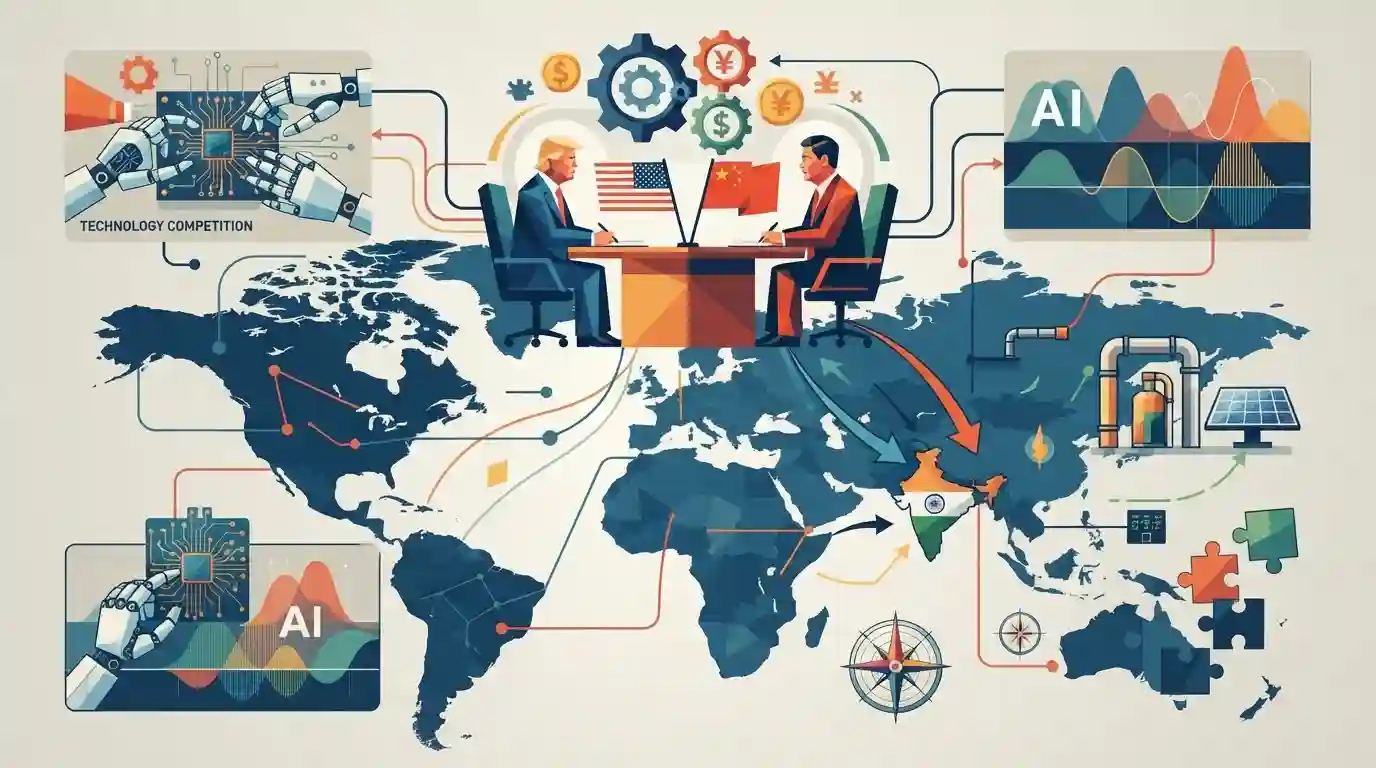
The Trump-Xi summit highlights major developments in US-China relations, focusing on global trade, tariff policies, artificial intelligence competition, and broader strategic impacts on emerging economies like India, including energy and geopolitical maneuvering.
Key Points
- The summit between Donald Trump and Xi Jinping addressed major geopolitical friction points including trade tariffs, technology restrictions, and artificial intelligence governance.
- US-China bilateral negotiations carry deep implications for global supply chains, economic protectionism, and multilateral trade structures.
- The diplomatic and economic outcomes of major power summits affect emerging economies like India, particularly regarding energy trade, sanctions, and strategic autonomy.
- Technological competition, especially around AI and semiconductor supply chains, remains a core arena of rivalry and tactical alignment between major superpowers.
Important Terms
US Government

The executive branch and federal administration of the United States, responsible for shaping foreign policy, trade agreements, and strategic postures towards major powers like China and emerging economies like India.
UPSC context
Important for GS Paper II (International Relations - Bilateral, regional and global groupings involving India and/or affecting India's interests).
Chinese Government
The central government of the People's Republic of China, led by the Chinese Communist Party, steering national strategies on artificial intelligence, global trade, and geopolitical alignments.
UPSC context
Crucial for GS Paper II (International Relations - China's foreign policy and its impact on India and global stability).
BRICS
An association of major emerging economies comprising Brazil, Russia, India, China, South Africa, and expanding members, serving as a platform for alternative global economic and geopolitical governance.
UPSC context
Relevant for GS Paper II (International Relations - Bilateral, regional and global groupings and agreements involving India and/or affecting India's interests).
Prelims Trap
bilateral agreements between the US and China replace multilateral trade frameworks under the WTO entirely.
Aspirants often assume US-China bilateral agreements eliminate multilateral bodies like the WTO, whereas superpowers routinely bypass or utilize WTO dispute mechanisms selectively while relying primarily on plurilateral and bilateral frameworks.
Static Concepts Connected
What are the key pillars and strategic objectives of the US CHIPS and Science Act?
- Funding Scope: Provides approximately $52 billion for domestic semiconductor manufacturing, research, and workforce development in the United States.
- ITSI Fund: Establishes the International Technology Security and Innovation (ITSI) Fund to secure global semiconductor supply chains with partner nations like India.
- Strategic Aim: Aims to reduce critical technology dependencies on geopolitical rivals and secure domestic supply chains for advanced electronics and AI.
Cross-Topic Patterns
Tech Decoupling + Indo-Pacific Economic Framework
US-China tech decoupling and export controls on advanced semiconductors run parallel to plurilateral frameworks like the Indo-Pacific Economic Framework (IPEF), testing India's non-aligned stance.
Great Power Trade Truces + Energy Security
Great power tariff truces and bilateral energy deals directly influence India's import baskets, balancing discounted Russian crude against Western secondary sanctions.

Superpower tech rivalry + semiconductor supply chains + strategic autonomy will likely feature in GS-II International Relations.
Linked PYQs · 2
Linked PYQs · 2
- 2024MainsGS2
‘The West is fostering India as an alternative to reduce dependence on China's supply chain and as a strategic ally to counter China's political and economic dominance.’ Explain this statement with examples.
- 2025MainsGS3
What are the challenges before the Indian economy when the world is moving away from free trade and multilateralism to protectionism and bilateralism? How can these challenges be met?
