Global Geopolitical Implications of US China Summit Outcomes
Source:Indian Express ↗
কেন এটি গুরুত্বপূর্ণ
The US-China summit directly influences global trade architecture, technology governance, and geopolitical alignments, shaping India's strategic autonomy, supply chain strategies, and economic diplomacy.
সারসংক্ষেপ
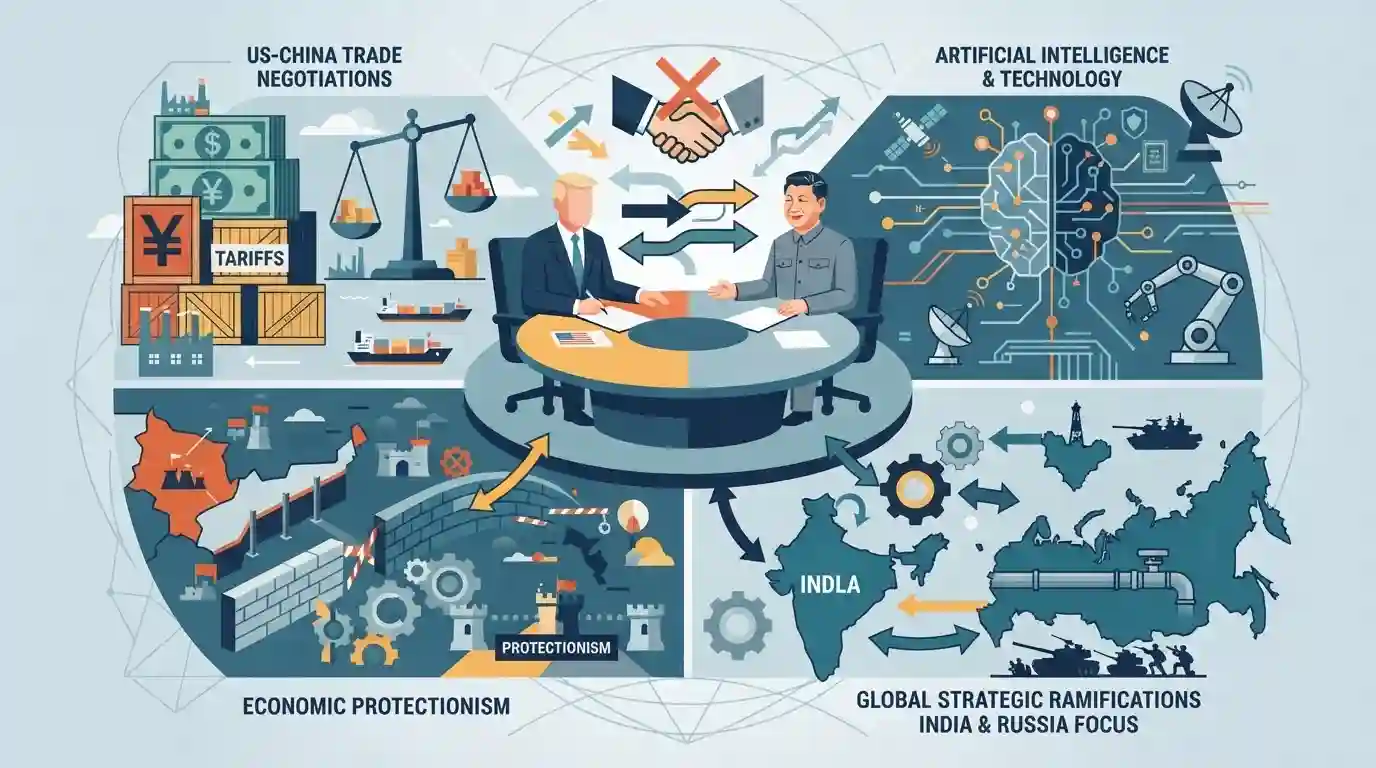
The article examines the key outcomes, takeaways, and global implications of the Trump-Xi summit, focusing on US-China trade negotiations, artificial intelligence, economic protectionism, and the broader strategic ramifications for nations like India and Russia.
মূল বিষয়
- The Trump-Xi summit addressed bilateral trade issues, tariffs, and economic decoupling between the US and China.
- Discussions included artificial intelligence (AI) cooperation, tech regulations, and supply chain dependencies.
- Implications for third countries like India, including trade shifts, energy dynamics, and strategic positioning amidst shifting US-China equations, were analyzed.
- Global economic impacts of protectionist measures, bilateral deals, and multilateral trade norms were a central focus.
গুরুত্বপূর্ণ শব্দ
US Government

The executive and legislative institutions of the United States, operating under a federal system with separation of powers that profoundly shape international economic and security policies.
UPSC context
UPSC GS Paper II (International Relations / Bilateral Relations) — crucial for understanding US policy shifts affecting India and global trade.
Chinese Government
The centralized authoritarian political apparatus of the People's Republic of China, led exclusively by the Chinese Communist Party, directing state policy, trade, and diplomacy.
UPSC context
UPSC GS Paper II (International Relations / China's Foreign Policy) — tests understanding of adversarial and cooperative bilateral dynamics.
World Trade Organization
The global international organization established to regulate, monitor, and establish rules for international trade between nations, providing a forum for resolving trade disputes.
UPSC context
UPSC GS Paper II & III (International Institutions / Global Trade) — relevant for multilateral trade rules, subsidies, and India's trade negotiations.
প্রিলিমস ফাঁদ
Bilateral trade deals between major economic superpowers reinforce and strengthen multilateral WTO trade norms.
Aspirants often assume bilateral US-China trade pacts automatically strengthen WTO multilateralism, whereas they frequently bypass and weaken WTO dispute settlement and tariff norms.
সংযুক্ত স্থির ধারণা
What are the key pillars of India-US strategic and technological cooperation?
- iCET Framework: Initiative on Critical and Emerging Technology (iCET) focuses on AI, quantum computing, and defense tech collaboration.
- Quad Partnership: Quad grouping promotes a free, open, and secure Indo-Pacific with resilient supply chain initiatives.
- Foundational Pacts: COMCASA, LEMOA, and BECA foundational agreements enable advanced military and intelligence interoperability.
আন্তঃবিষয় প্যাটার্ন
Bilateral Trade Deals vs WTO Multilateralism
US-China trade deals and bilateral tariff maneuvers increasingly bypass WTO mechanisms, challenging multilateral dispute resolution and reshaping global supply chains.
Energy Security vs Western Sanctions Regime
Western pressure on emerging economies to restrict discounted Russian energy imports directly intersects with India's strategic autonomy and energy security imperatives.

Expect UPSC to link US-China trade negotiations, friend-shoring, and India's manufacturing positioning in a multi-statement prelims question.
সংযুক্ত PYQ · 2
সংযুক্ত PYQ · 2
- 2024MainsGS2
‘The West is fostering India as an alternative to reduce dependence on China's supply chain and as a strategic ally to counter China's political and economic dominance.’ Explain this statement with examples.
- 2025MainsGS3
What are the challenges before the Indian economy when the world is moving away from free trade and multilateralism to protectionism and bilateralism? How can these challenges be met?
