US China trade truce and its strategic implications for India
Source:Indian Express ↗
Why It Matters
The evolving US-China trade dynamics directly impact India's economic diplomacy and its strategic aspirations to become a global manufacturing hub. The geopolitics of critical minerals and supply chain resilience are central to contemporary international relations and frequently tested in UPSC GS2.
Summary
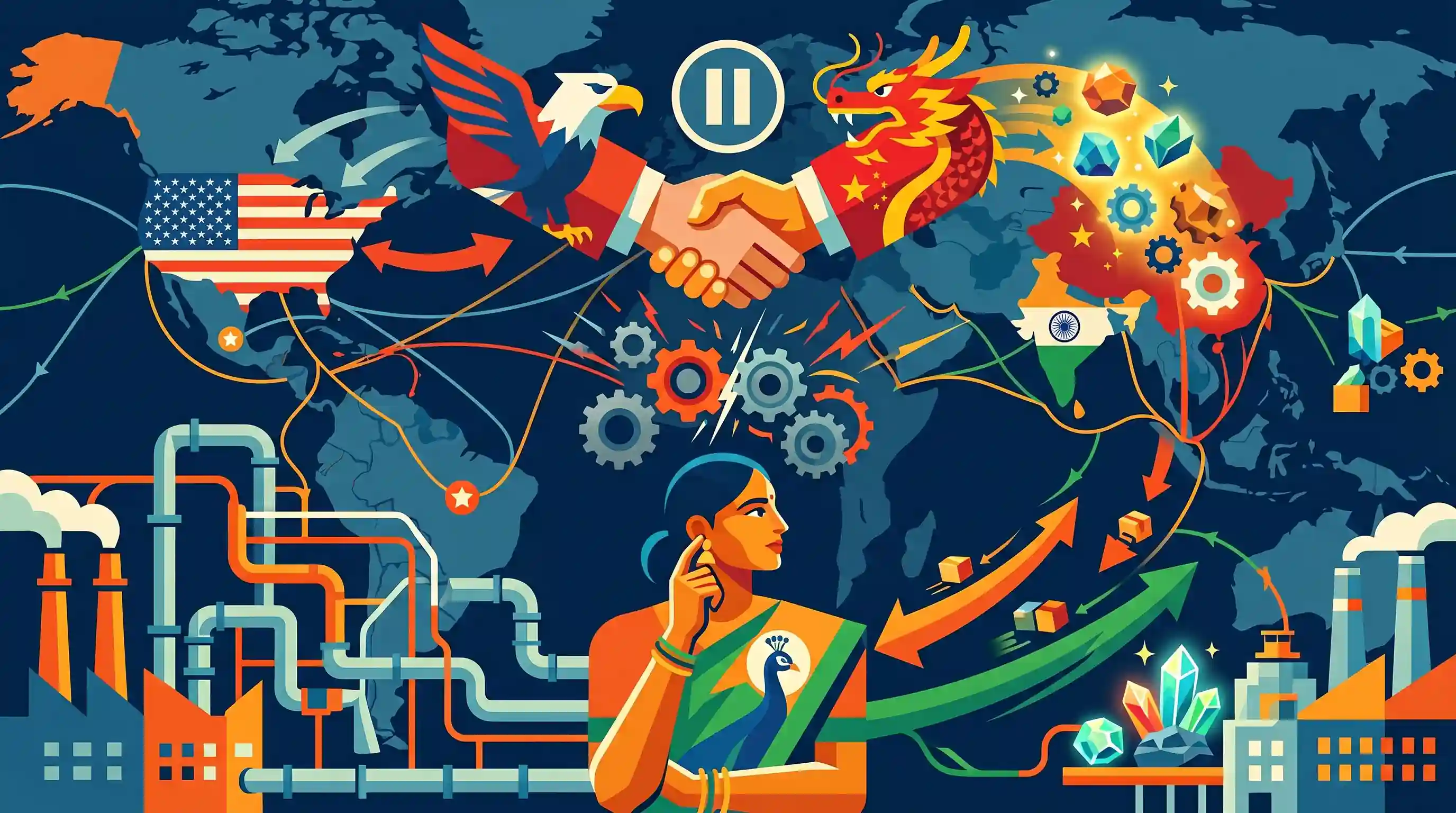
The article discusses the recent ceasefire in the US-China trade war agreed upon by Donald Trump and Xi Jinping, which involves China easing export curbs on rare earth minerals in exchange for a pause in new US tariffs. While this tactical truce temporarily halts immediate economic hostilities, the underlying geopolitical rivalry between the two superpowers persists. This shifting dynamic presents a complex scenario for India, which has been positioning itself as a reliable manufacturing alternative under the 'China-Plus-One' strategy. A temporary US-China detente might ease the immediate urgency for Western supply chains to decouple from China. However, the enduring strategic competition ensures India remains a vital partner for the West in building resilient supply chains, provided New Delhi continues to enhance its domestic manufacturing competitiveness and secures strategic critical mineral resources.
Key Points
- The US and China have agreed to a tactical ceasefire in their ongoing trade war, temporarily pausing new tariff escalations while maintaining their broader geopolitical rivalry.
- As part of the truce, China has eased export restrictions on critical rare earth minerals, which are essential for high-tech manufacturing, defense equipment, and green energy.
- The temporary easing of US-China trade tensions impacts the 'China-Plus-One' strategy, potentially slowing the immediate pace of Western manufacturing supply chains relocating to alternative hubs.
- India must navigate this new trade calculus by enhancing its manufacturing competitiveness and securing its own critical mineral supply chains to remain a viable alternative to China.
- Despite the truce, the long-term strategic rivalry between Washington and Beijing ensures India remains a crucial partner for the West in diversifying global supply chains and countering China's economic dominance.
Important Terms
China-Plus-One Strategy

A global business strategy where companies diversify their supply chains by establishing manufacturing hubs in other countries while maintaining operations in China to mitigate overdependence risks.
UPSC context
GS Paper II (International Relations) and GS Paper III (Economy). Tests understanding of global manufacturing shifts and India's competitive positioning.
Critical Minerals
Minerals essential for national security and modern technologies (e.g., lithium, cobalt) that face high supply risks due to geographical concentration or processing monopolies.
UPSC context
GS Paper I (Resources) and GS Paper III (Energy/Security). Relevant for energy transition and strategic autonomy discussions.
Rare Earth Elements
A group of 17 metallic elements indispensable for high-tech industries, including defense, electronics, and green energy, where China currently holds a dominant position in refining.
UPSC context
GS Paper III (Science & Technology/Economy). Significant for understanding global resource geopolitics and India's industrial vulnerabilities.
Supply Chain Resilience
The ability of a supply chain to manage disruptions and ensure continuity, often achieved through diversification of suppliers to avoid over-reliance on a single nation.
UPSC context
GS Paper II (Global groupings) and GS Paper III (Economy). Central to the 'Supply Chain Resilience Initiative' involving India, Japan, and Australia.
Strategic Decoupling
The process of unwinding deep economic and commercial interdependencies between two nations, primarily used in the context of the US seeking to reduce its economic integration with China.
UPSC context
GS Paper II (International Relations). Crucial for analyzing US-China rivalry and its cascading effects on Indian foreign and trade policy.
Prelims Trap
"Rare Earth Elements are geologically scarce, and China holds nearly 90% of the world's natural REE reserves."
REEs are relatively abundant in the Earth's crust. China's 90% monopoly lies in the complex, highly polluting processing and refining stages, not just natural reserves.
Static Concepts Connected
What constitutes Rare Earth Elements (REEs) and where are they found in India?
- Composition: A group of 17 chemical elements (15 lanthanides plus scandium and yttrium) exhibiting unique magnetic, luminescent, and electrochemical properties crucial for high-tech manufacturing.
- Indian Reserves: India has the 5th largest REE reserves globally, primarily found in monazite and ilmenite beach sands along the coasts of Kerala, Tamil Nadu, and Odisha.
- Regulation: Monazite is a prescribed substance under the Atomic Energy Act, mined exclusively by the PSU Indian Rare Earths Limited (IREL) under the Department of Atomic Energy.
How does the WTO regulate export restrictions like China's curbs on critical minerals?
- General Prohibition: GATT Article XI generally forbids quantitative restrictions, including export bans, quotas, and licensing requirements, to prevent artificial trade distortions.
- GATT Exceptions: Countries often justify export curbs citing the conservation of exhaustible natural resources or essential security interests (Article XX and Article XXI exceptions).
Cross-Topic Patterns
Minerals Security Partnership (MSP)
India’s induction into the US-led 14-nation MSP aims exactly to secure critical mineral supply chains, acting as a geopolitical hedge against China's export weaponization.
EVs vs. Mineral Monopolies
The transition to green energy replaces oil dependency (OPEC) with supply chain reliance on China for processing rare earths used in permanent magnets for EVs and wind turbines.

Expect a 2026 Prelims question interlinking REE geological properties, India’s monazite reserves, and the Minerals Security Partnership.
Linked PYQs · 2
Linked PYQs · 2
- 2024MainsGS2
‘The West is fostering India as an alternative to reduce dependence on China's supply chain and as a strategic ally to counter China's political and economic dominance.’ Explain this statement with examples.
- 2012PrelimsGS1
Recently, there has been a concern over the short supply of a group of elements called 'rare earth metals'. Why? 1. China, which is the largest producer of these elements, has imposed some restrictions on their export. 2. Other than China, Australia, Canada and Chile, these elements are not found in any country. 3. Rare earth metals are essential for the manufacture of various kinds of electronic items and there is a growing demand for these elements. Which of the statements given above is/are correct?
