US China Diplomacy and Iran Sanctions Pressure Strategy
Source:The Hindu ↗
Why It Matters
This article captures major shifts in the global order, involving the world's major powers (US, China, Russia) and a crucial region for global energy (Iran). The weaponization of trade (tariffs), the reshaping of critical mineral supply chains, and the expiration of nuclear arms treaties are direct themes in UPSC GS2 (International Relations) and GS3 (Economy/Resources). India must navigate these crosscurrents, balancing its energy needs, critical mineral security, and strategic partnerships.
Summary
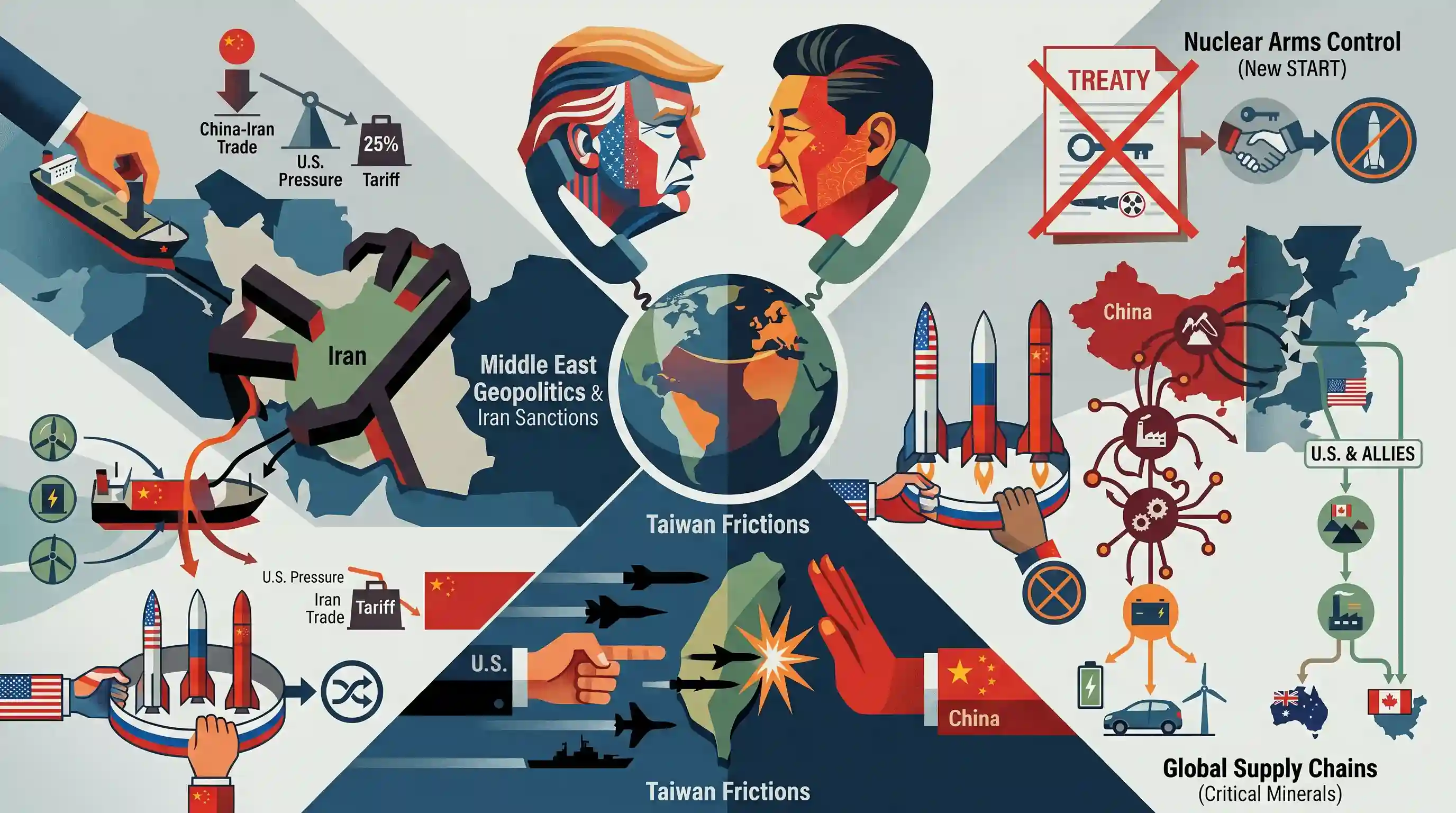
In a wide-ranging phone call, U.S. President Donald Trump and Chinese President Xi Jinping discussed geopolitical strategies, primarily focusing on isolating Iran. The U.S. is pressuring China—Iran's largest trading partner—to sever ties with Tehran by threatening 25% tariffs on nations doing business with Iran. The leaders also touched upon nuclear arms control following the expiration of the U.S.-Russia New START treaty, with Washington wanting Beijing included in a new framework. The dialogue highlighted ongoing frictions over U.S. arms sales to Taiwan and U.S. efforts to establish critical mineral supply chains independent of China's dominance.
Key Points
- U.S. President Donald Trump pushed Chinese President Xi Jinping to cut economic ties with Iran, threatening a 25% tariff on countries doing business with Tehran.
- The diplomatic call comes amid heightened Middle East tensions following Israeli strikes on Iranian nuclear sites during a 12-day conflict.
- The U.S. is seeking a new nuclear arms control framework to replace the expired New START treaty, explicitly aiming to bring China into agreements alongside Russia.
- Tensions persist over U.S. arms sales to Taiwan (a recent $10 billion package) and China's insistence on the "One China" principle.
- The U.S. is also moving to build global supply chains for critical minerals independent of China, which currently dominates the market, affecting global tech and energy transitions.
Important Terms
New START treaty

The last remaining strategic nuclear arms control treaty between the U.S. and Russia, limiting deployed warheads and launchers with verification mechanisms like on-site inspections.
UPSC context
GS Paper 2: International Relations; crucial for global security architecture and disarmament topics.
One China principle
Beijing’s official position that there is only one sovereign state called China, with Taiwan as an inalienable part, and the PRC as its sole legal government.
UPSC context
GS Paper 2: International Relations; tests knowledge of East Asian geopolitics and diplomatic norms.
Critical Minerals
Metallic or non-metallic elements (like lithium and cobalt) essential for modern technologies and green energy, characterized by high supply risk due to scarcity or geopolitical concentration.
UPSC context
GS Paper 3: Economy and Energy Security; vital for India's clean energy transition.
JCPOA (Joint Comprehensive Plan of Action)
The 2015 landmark agreement between Iran, the P5+1, and the EU to limit Iran’s nuclear program in exchange for the lifting of international economic sanctions.
UPSC context
GS Paper 2: International Relations; essential for West Asia dynamics and India’s energy interests.
Strategic Ambiguity
A long-standing U.S. policy of being non-committal about whether it would intervene militarily if China attacked Taiwan, intended to deter both aggression and secession.
UPSC context
GS Paper 2: International Relations; relevant to Indo-Pacific security and US-China frictions.
Reciprocal Tariffs
A trade policy where a nation imposes import duties that mirror those charged by its trading partners to ensure 'fairness' and reduce trade deficits.
UPSC context
GS Paper 3: Indian Economy and Trade; impacts India’s exports and global supply chains.
European Union (EU)
A political and economic union of 27 member states that operates a single market and common foreign policy, serving as a major global trade bloc.
UPSC context
GS Paper 2: International Institutions; significant for global governance and India-EU trade relations.
Prelims Trap
"The New START treaty is a trilateral nuclear arms control agreement involving the US, Russia, and China."
New START was strictly bilateral between the US and Russia. The US is only now pushing for a new trilateral framework following its expiration.
Static Concepts Connected
How do secondary sanctions differ from primary sanctions?
- Primary Sanctions: Prohibit a country's own citizens and domestic companies from engaging in trade or financial dealings with a sanctioned nation.
- Secondary Sanctions: Target non-domestic entities, penalizing third-party countries (like China or India) or foreign companies for doing business with the sanctioned nation.
- Impact on India: India has historically had to drastically cut oil imports from Iran and Venezuela due to the threat of US secondary sanctions (e.g., CAATSA).
What are Rare Earth Elements (REEs) and why are they critical?
- Composition: A group of 17 chemically similar metallic elements (15 lanthanides plus scandium and yttrium) crucial for manufacturing modern technologies.
- Strategic Importance: Essential for green energy transition (EV batteries, wind turbines), defense equipment, and consumer electronics.
- Supply Chain Dominance: While reserves are globally distributed, China dominates the supply chain, controlling over 60% of global extraction and nearly 90% of processing capacity.
Cross-Topic Patterns
Post-New START Nuclear Vacuum
The expiration of bilateral treaties like New START forces a shift to a tripolar (US-Russia-China) nuclear dynamic, directly impacting global non-proliferation regimes and India's strategic deterrence calculus.
Critical Minerals & The MSP
US efforts to bypass China's monopoly on critical minerals closely align with India's membership in the US-led Minerals Security Partnership (MSP) to secure green-tech supply chains.

Expect a multi-statement Prelims question linking China's critical mineral monopoly with US secondary sanctions and arms control treaties.
Linked PYQs · 5
Linked PYQs · 5
- 2018MainsGS2
In what ways would the ongoing US-Iran Nuclear Pact Controversy affect the national interest of India? How should India respond to this situation?
- 2012MainsGS2
How have the US sanctions against Iran affected India's bilateral relations with Iran?
- 2021MainsGS2
“The USA is facing an existential threat in the form of a China, that is much more challenging than the erstwhile Soviet Union.” Explain.
- 2012PrelimsGS1
Recently, there has been a concern over the short supply of a group of elements called 'rare earth metals'. Why? 1. China, which is the largest producer of these elements, has imposed some restrictions on their export. 2. Other than China, Australia, Canada and Chile, these elements are not found in any country. 3. Rare earth metals are essential for the manufacture of various kinds of electronic items and there is a growing demand for these elements. Which of the statements given above is/are correct?
- 2025PrelimsGS1
Consider the following statements : Statement I: Some rare earth elements are used in the manufacture of flat television screens and computer monitors. Statement II : Some rare earth elements have phosphorescent properties. Which one of the following is correct in respect of the above statements?
