US-China Summit and India Strategic Autonomy Imperative
Source:Indian Express ↗
Why It Matters
Understanding the evolving US-China dynamic is crucial for the IR segment of GS Paper 2, as it dictates the broader global balance of power, regional security in the Indo-Pacific, and directly impacts India's foreign policy choices and push for strategic autonomy.
Summary
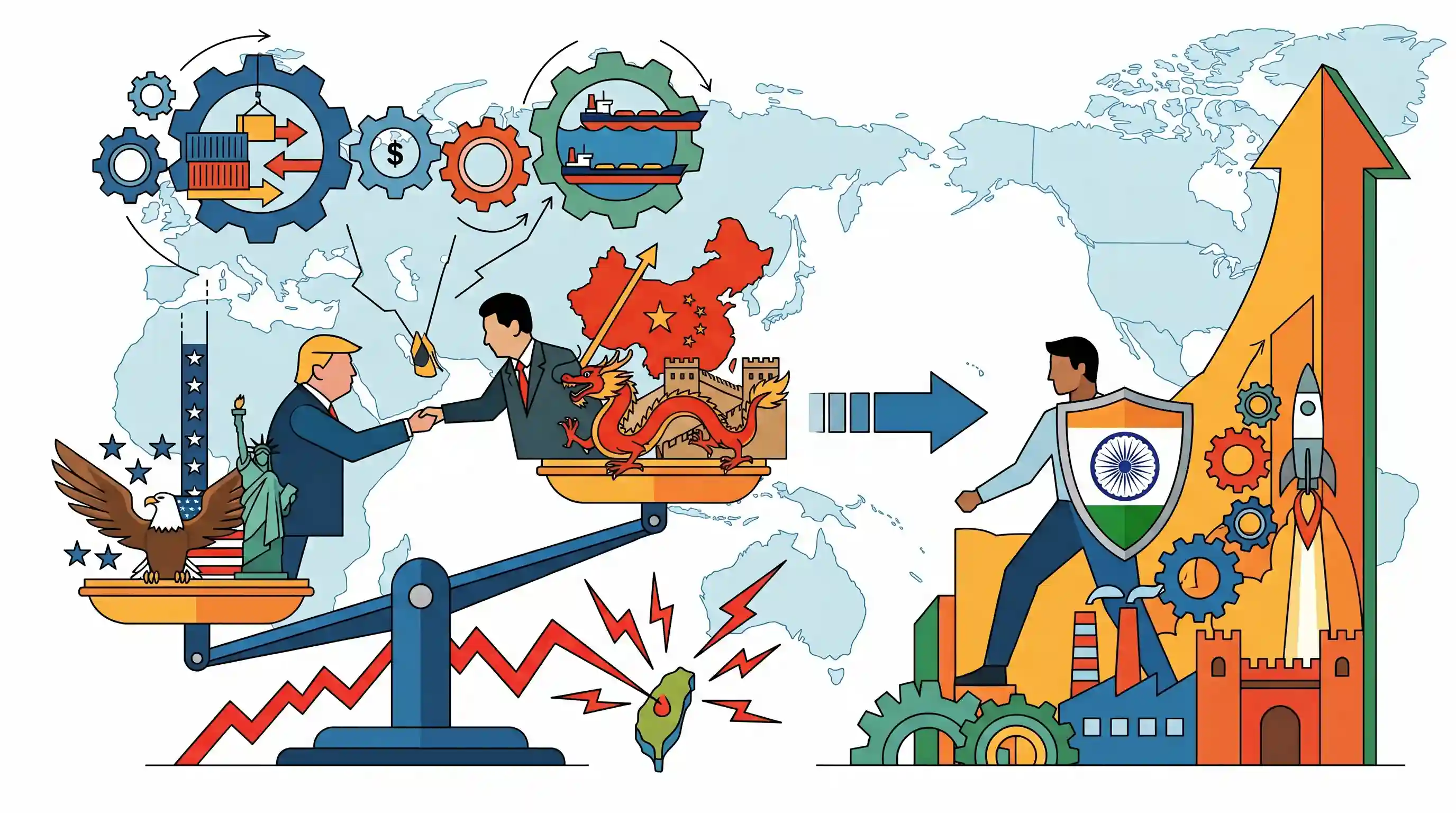
The recent summit between Donald Trump and Xi Jinping in Beijing underscores a shifting global balance of power, with China now commanding greater economic and military strength. Both leaders are navigating an 'unsteady balance,' seeking constructive strategic stability through selective cooperation on issues like trade and the Strait of Hormuz, while managing core contentions such as Taiwan. For India, this evolving US-China equilibrium reinforces the need to rapidly enhance its domestic capabilities as the most reliable hedge to secure its strategic autonomy.
Key Points
- The recent meeting between Donald Trump and Xi Jinping in Beijing highlights an evolving "constructive strategic stability" amid a shifting global balance of power.
- China's economic, technological, and military capabilities have grown significantly since 2017, leading to a more assertive stance and a modified US-China dynamic.
- The summit focused on selective cooperation, including commercial agreements and securing China's support for reopening the Strait of Hormuz, despite Trump's earlier tariff threats.
- Taiwan remains a critical "red line" for Beijing; Xi emphasized non-interference, while Trump tactically avoided mentioning it publicly during the meeting.
- For India, the fluid US-China dynamic necessitates accelerating its own economic, technological, and military capabilities to maintain strategic autonomy.
Important Terms
Strategic Autonomy

A nation's ability to pursue its national interests and make sovereign foreign policy decisions without being constrained by external powers or alliances.
UPSC context
GS Paper II: Essential for analyzing India's foreign policy and its navigation between US-China-Russia power dynamics.
Indo-Pacific
A geopolitical region spanning the Indian and Pacific Oceans, serving as the primary theater for global power competition and maritime trade.
UPSC context
GS Paper II: Critical for questions on maritime security, Quad, and India’s strategic interests in its extended neighborhood.
Strategic Stability
An international relations concept where major powers maintain an equilibrium to prevent conflict, ensuring neither side has an incentive to initiate escalation.
UPSC context
GS Paper II: Relevant for discussing US-China bilateral relations and global security architecture.
Strait of Hormuz
A strategic maritime chokepoint between the Persian Gulf and the Gulf of Oman, critical for global energy security and oil transit.
UPSC context
GS Paper I (Geography) & II (IR): Important for global trade routes and West Asian geopolitical conflicts.
Thucydides Trap
The historical tendency for conflict when a rising power threatens to displace an established hegemon, popularized to describe US-China rivalry.
UPSC context
GS Paper II: Advanced theoretical framework for analyzing structural tensions in the US-China relationship.
Balance of Power
A situation where nations have roughly equal power, preventing any single state from dominating the international system.
UPSC context
GS Paper II: Fundamental theory for understanding global shifts and strategic alliances.
Prelims Trap
India officially endorses the 'One China Principle' recognizing Beijing's absolute sovereignty over Taiwan.
India follows a nuanced 'One China Policy', which acknowledges Beijing's claim but does not legally recognize sovereignty over Taiwan, unlike Beijing's absolute 'Principle'.
Static Concepts Connected
What are the key geographical features of the Strait of Hormuz?
- Water bodies: Connects the Persian Gulf to the Gulf of Oman and the wider Arabian Sea.
- Bordering nations: Sandwiched between Iran to the north and Oman (specifically the Musandam Peninsula) to the south.
- Strategic role: Acts as a global maritime chokepoint, facilitating nearly 20% of the world's petroleum trade.
How does India's 'Strategic Autonomy' differ from traditional 'Non-Alignment'?
- Shift to Multi-alignment: Moves past Cold-War equidistance to active, issue-based multi-alignment with competing global powers simultaneously.
- Capability focus: Relies heavily on internal capability building (Atmanirbharta in tech and defence) rather than mere diplomatic posturing.
Cross-Topic Patterns
Defence Indigenization & Hedging
India's diplomatic hedging against US-China volatility is practically executed through internal economic policies, specifically defence negative import lists and Atmanirbhar Bharat initiatives.
Energy Security & Maritime Chokepoints
US-China selective cooperation over the Strait of Hormuz underscores how major power rivalries are temporarily paused by mutual energy supply chain vulnerabilities and petroleum trade dependencies.

Expect a 2026 Prelims question mapping Middle Eastern maritime chokepoints (Hormuz) paired with nuances of the 'One China Policy'.
Linked PYQs · 3
Linked PYQs · 3
- 2024MainsGS2
‘The West is fostering India as an alternative to reduce dependence on China's supply chain and as a strategic ally to counter China's political and economic dominance.’ Explain this statement with examples.
- 2014MainsGS2
With respect to the South China sea, maritime territorial disputes and rising tension affirm the need for safeguarding maritime security to ensure freedom of navigation and over flight throughout the region. In this context, discuss the bilateral issues between India and China.
- 2020MainsGS2
What is the significance of Indo-US defence deals over Indo-Russian defence deals? Discuss with reference to stability in the Indo-Pacific region.
