US Administration Prepared to Reimpose Tariffs if Court Blocks Them
Source:Indian Express ↗
Why It Matters
The article highlights a major shift in global trade dynamics towards protectionism led by the US, which directly affects macroeconomic stability and export sectors of emerging economies like India. It also touches upon the core constitutional theme of separation of powers and judicial review over executive actions.
Summary
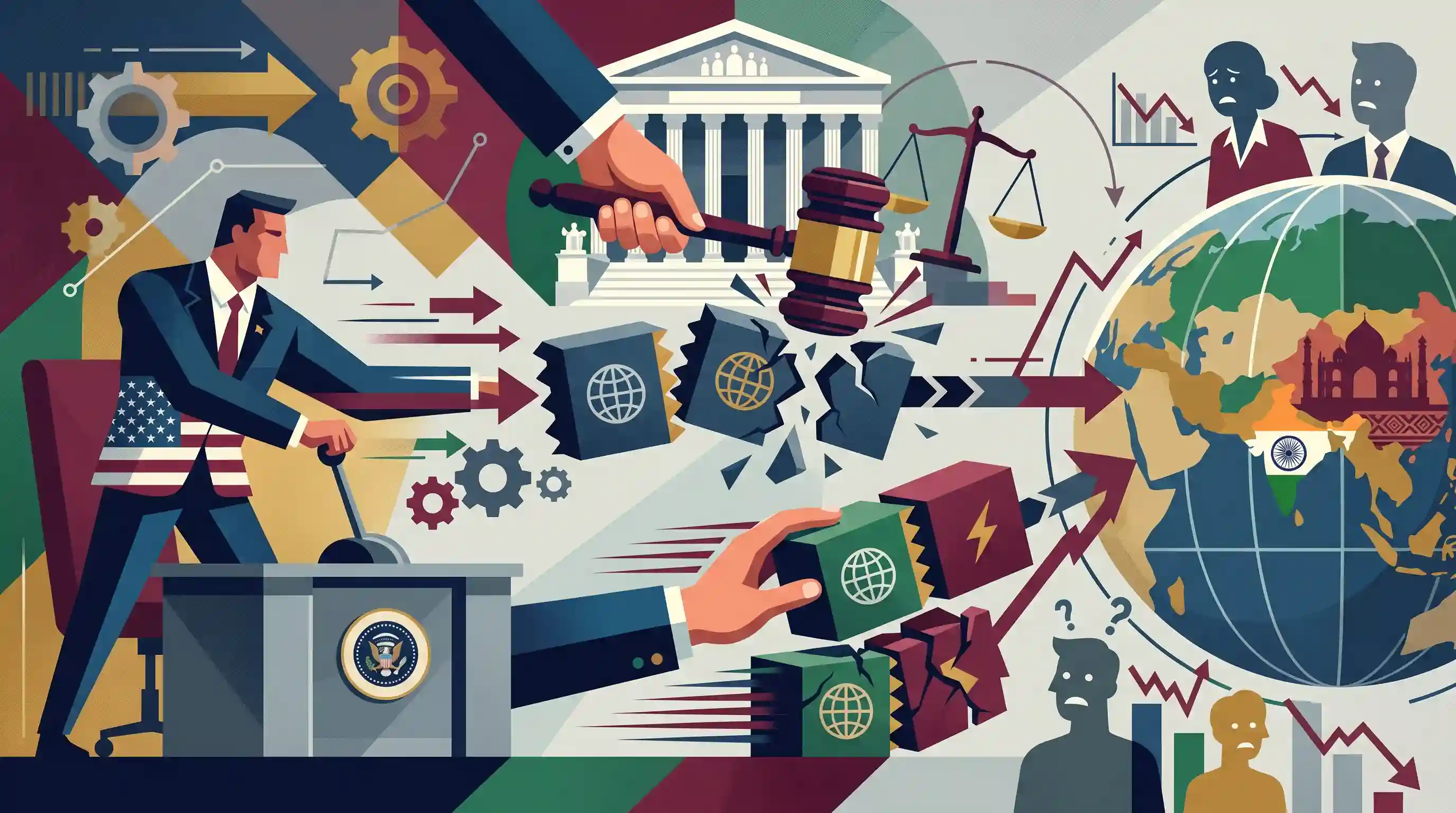
A top US trade aide has indicated that the Trump administration will swiftly re-impose global tariffs if the US Supreme Court decides to strike down the president's current executive actions imposing them. The standoff highlights potential constitutional clashes over the executive branch's authority to levy sweeping tariffs without explicit legislative backing, while reinforcing the administration's aggressive protectionist trade policy that continues to concern global markets.
Key Points
- The US Supreme Court is considering a challenge to the global tariffs recently imposed by US President Donald Trump.
- Jamieson Greer, the US Trade Representative, stated that the Trump administration is prepared to quickly enact new tariffs if the Supreme Court strikes down the president's current orders.
- The issue underscores a significant constitutional friction point concerning the extent of executive power in trade matters versus judicial review.
- The ongoing protectionist stance of the US administration continues to cause uncertainty in global trade dynamics.
Important Terms
International Emergency Economic Powers Act (IEEPA)

A 1977 US law granting the President authority to regulate international commerce during a declared national emergency. It was recently used—and legally challenged—as a tool for imposing global tariffs.
UPSC context
GS Paper II (International Relations). Tests knowledge of executive authority and its impact on global trade stability and Indian exports.
US Supreme Court (Trade Jurisdiction)
The highest judicial body in the US, which recently ruled that the President cannot use emergency powers (like IEEPA) to unilaterally impose tariffs without explicit Congressional authorization.
UPSC context
GS Paper II (Comparison of Constitutions). Tests understanding of separation of powers and judicial checks on executive trade policy.
Section 122 (Trade Act of 1974)
A US law allowing the President to impose temporary surcharges (up to 15%) for 150 days to address large and serious balance-of-payments deficits.
UPSC context
GS Paper III (Economy). Relevant for understanding 'fallback' mechanisms US administrations use to bypass judicial blocks on trade measures.
US Trade Representative (USTR)
The principal trade advisor and negotiator for the US President. The office investigates foreign trade barriers and 'unfair' practices (Section 301) that affect US commerce.
UPSC context
GS Paper II (Bilateral Groupings). Key agency in India-US trade dialogues, including GSP and Intellectual Property Rights (IPR) disputes.
Section 301 (Trade Act of 1974)
A US trade provision that authorizes the USTR to investigate and respond to foreign acts that are 'unjustifiable' or 'unreasonable' and burden US commerce.
UPSC context
GS Paper III (Global Trade). Crucial for analyzing US protectionism and its direct pressure on India's digital taxes and labor laws.
Major Questions Doctrine
A US legal principle stating that if an agency or President decides an issue of 'major' economic/political significance, they must have clear permission from Congress.
UPSC context
GS Paper II (Governance). Relevant for comparing how courts in different democracies limit executive discretion in economic matters.
Prelims Trap
"The US President holds direct constitutional authority to unilaterally impose global tariffs and taxes on imports."
The US Constitution (Article I) vests tariff power exclusively in Congress. The President relies on delegated statutory acts (like Section 232 or IEEPA), not inherent executive constitutional power.
Static Concepts Connected
How does tariff-levying authority work constitutionally in the US versus India?
- US Constitution: Article I vests tariff and taxation powers exclusively in Congress, making unilateral presidential tariffs a delegated statutory exercise, not a constitutional right.
- Indian Constitution: Article 265 mandates no tax or duty can be levied except by authority of law, requiring parliamentary statutes like the Customs Tariff Act.
- Executive Bypass: Both executives use delegated frameworks (US Section 232/IEEPA; India's Customs Act Section 11) to adjust rates, causing friction over legislative overreach.
What key WTO principles are undermined by unilateral global tariffs?
- Bound Rates: WTO members commit to a ceiling on customs duties (bound rates). Sweeping unilateral tariffs frequently breach these legal commitments.
- MFN Principle: Applying tariffs selectively or demanding reciprocal concessions violates the Most-Favored-Nation rule, which requires equal trade treatment among all WTO members.
- Dispute Settlement: Unilateral retaliation bypasses the WTO's dispute mechanism, further weakening a system already paralyzed by the US blocking Appellate Body appointments.
Cross-Topic Patterns
Tariffs + India's Macroeconomic Stability
US protectionism suppresses India’s labor-intensive exports like textiles and steel. This reduces export revenue, risking a widened Current Account Deficit (CAD) and localized job losses.
Domestic Law vs International Law
The reliance on domestic US acts (IEEPA, Section 301) to enact tariffs highlights the growing weaponization of domestic law over multilateral WTO obligations, accelerating deglobalization.

Expect a 2026 Prelims question linking US unilateral tariffs to WTO's Most-Favored-Nation exceptions and India's CAD vulnerabilities.
Linked PYQs · 4
Linked PYQs · 4
- 2025MainsGS3
What are the challenges before the Indian economy when the world is moving away from free trade and multilateralism to protectionism and bilateralism? How can these challenges be met?
- 2018MainsGS3
How would the recent phenomena of protectionism and currency manipulations in world trade affect macroeconomic stability of India?
- 2012MainsGS2
Discuss the likely negative impact of the protectionist measures proposed by the US on India's software industry.
- 2020MainsGS2
Judicial Legislation is antithetical to the doctrine of separation of powers as envisaged in the Indian Constitution. In this context justify the filing of large number of public interest petitions praying for issuing guidelines to executive authorities.
