US Sanctions Threat and Eurasian Axis Dynamics
Source:Indian Express ↗
Why It Matters
The article showcases the real-time evolution of a multipolar world order and the strategic use of economic sanctions. The deepening Russo-Chinese alliance and the US response are highly relevant for GS Paper 2 questions focusing on the shifting balance of power, new Cold War dynamics, and the impact of great power rivalry on global peace and stability.
Summary
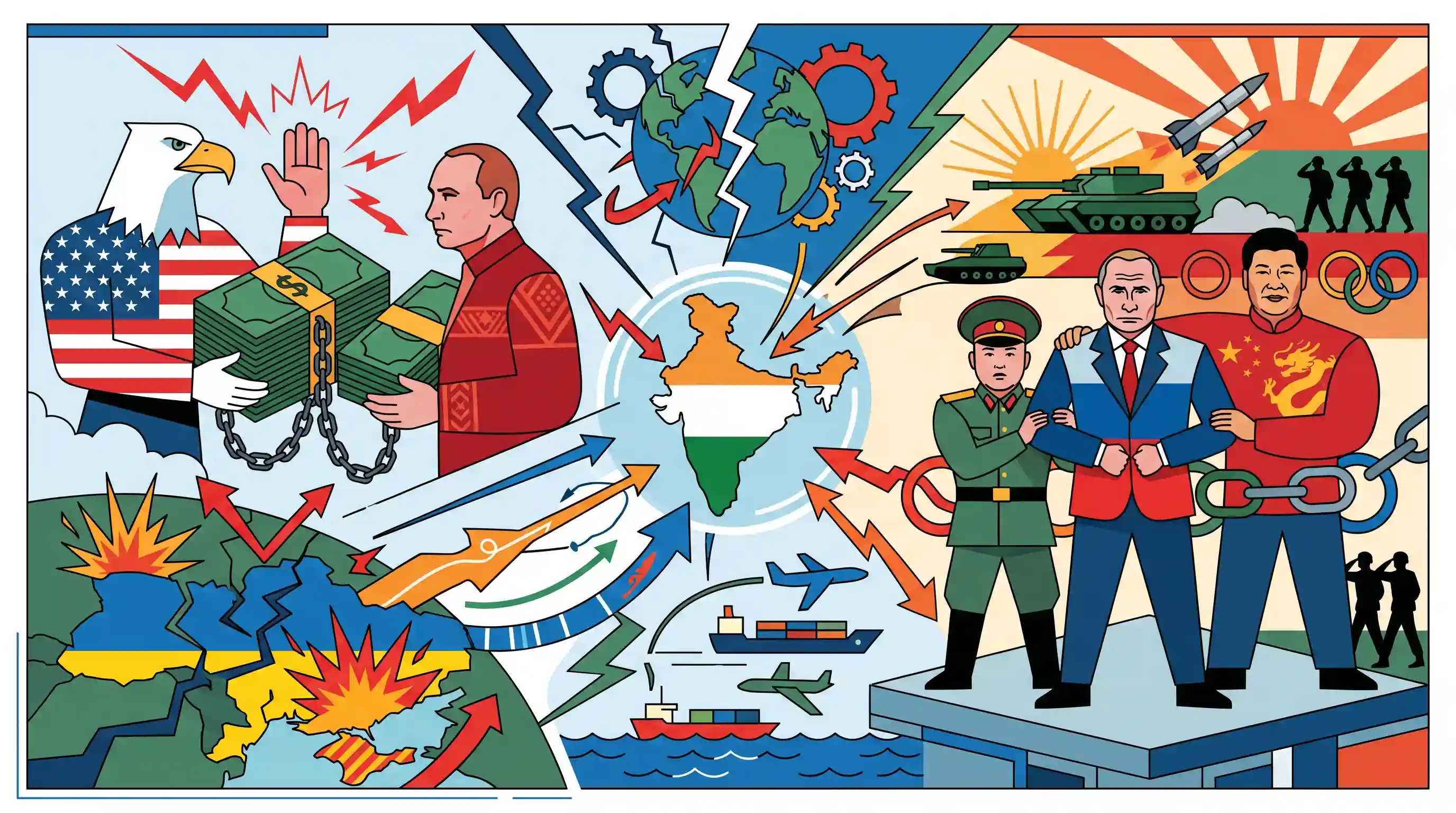
US President Donald Trump has warned Russian President Vladimir Putin of new sanctions if a peace deal to end the Ukraine conflict is not reached. The geopolitical tension is further amplified by Putin's recent attendance at a military parade in China alongside Chinese President Xi Jinping and North Korean leader Kim Jong Un, signaling a deepening strategic alignment among non-Western powers. These developments underscore the ongoing diplomatic confrontation between the US and the consolidating Russia-China axis over the future of global security and the post-Cold War order.
Key Points
- Donald Trump threatened Russia with new economic sanctions if progress on resolving the Ukraine war stalls, emphasizing the continued use of economic statecraft in US diplomacy.
- Russian President Vladimir Putin reaffirmed his stance that military operations in Ukraine will continue unless an acceptable peace agreement is brokered.
- A strategic alignment among non-Western powers was visibly demonstrated as Putin attended a military parade in China alongside Xi Jinping and North Korean leader Kim Jong Un.
- The situation highlights the complex geopolitical friction between US-led conflict resolution efforts and the consolidation of a Russo-Chinese-North Korean axis.
Important Terms
Ukraine Peace Deal

A proposed 28-point framework to end the conflict, reportedly requiring Ukraine to cede territory (Donbas), cap its military size, and adopt neutrality, often viewed by Kyiv as a form of capitulation.
UPSC context
GS Paper II: International Relations. Relevant for understanding conflict resolution, sovereignty, and the diplomatic role of major powers in regional wars.
Secondary Sanctions
Penalties imposed by one country (e.g., USA) on third-party nations or entities that continue trading with a sanctioned state (e.g., Russia), effectively forcing global compliance with unilateral sanctions.
UPSC context
GS Paper II & III: Effect of policies of developed countries. Tests impact on India's energy security and defense procurement (e.g., S-400).
Russia-China-North Korea Axis
An emerging strategic partnership between Moscow, Beijing, and Pyongyang aimed at countering Western hegemony, characterized by shared military displays, technology transfers, and "no-limits" diplomatic cooperation.
UPSC context
GS Paper II: Global Geopolitics. Crucial for analyzing the shifting balance of power and threats to India’s continental security interests.
Strategic Autonomy
India's foreign policy doctrine of making independent decisions based on national interest without being formally aligned with any specific power bloc, despite external geopolitical pressures.
UPSC context
GS Paper II: Indian Foreign Policy. A core theme in Mains regarding India’s balancing act between the US and the Russia-China axis.
De-dollarization
A move by a group of nations (like the SCO members) to reduce reliance on the US dollar for international trade and reserves, often to bypass Western financial sanctions.
UPSC context
GS Paper III: Indian Economy/International Trade. Relevant for discussions on the internationalization of the Rupee and alternative payment systems.
Shanghai Cooperation Organisation (SCO)
A permanent intergovernmental organization for security and economic cooperation in Eurasia, increasingly used by non-Western powers as a counterweight to NATO and G7 influence.
UPSC context
GS Paper II: Important International Institutions. Significant for India's engagement with Central Asia and its management of ties with China/Pakistan.
Prelims Trap
"Sanctions on Russia over the Ukraine conflict are mandated by the United Nations Security Council."
The UNSC cannot impose sanctions on Russia due to its permanent member veto power. The sanctions imposed are strictly unilateral (US/EU).
Static Concepts Connected
What is CAATSA and how does it affect India?
- US Legislation: Countering America's Adversaries Through Sanctions Act (2017) targets Iran, North Korea, and Russia through economic penalties.
- Secondary Sanctions: It penalizes third-party nations engaging in significant defense or intelligence transactions with Russia.
- India's Dilemma: It threatens India's acquisition of legacy Russian hardware (like the S-400 systems), requiring complex US presidential waivers to avoid penalties.
What alternative mechanisms are used to bypass SWIFT and US sanctions?
- Alternative Networks: Countries deploy domestic systems like Russia's SPFS and China's CIPS to replace the Western-dominated SWIFT financial messaging network.
- Local Currency Trade: Establishing special Rupee-Ruble or Yuan-Ruble Vostro accounts to settle bilateral trade completely independent of dollar intermediation.
Cross-Topic Patterns
Russia-China Axis vs India's Multialignment
The Moscow-Beijing-Pyongyang nexus complicates India's SCO and BRICS engagements, forcing a delicate balancing act between its primary rival (China) and traditional defense supplier (Russia).
Weaponized Dollar & De-dollarization
Frequent unilateral US sanctions accelerate the push by the Global South to develop local currency settlement mechanisms, tying defense geopolitics directly to macroeconomic foreign exchange management.

Expect a 2026 Prelims question mapping global payment alternatives (SWIFT, SPFS, CIPS) against unilateral vs multilateral sanctions.
Linked PYQs · 4
Linked PYQs · 4
- 2025MainsGS2
"The reform process in the United Nations remains unresolved, because of the delicate imbalance of East and West and entanglement of the USA vs. Russo-Chinese alliance.” Examine and critically evaluate the East-West policy confrontations in this regard.
- 2021MainsGS2
“The USA is facing an existential threat in the form of a China, that is much more challenging than the erstwhile Soviet Union.” Explain.
- 2025MainsGS2
"With the waning of globalization, post-Cold War world is becoming a site of sovereign nationalism.” Elucidate.
- 2012MainsGS2
Does Putin's return as President of Russia mark a shift to a confrontationist stance in international diplomacy towards the West?
